
A newly restored ‘Riverbend’ finds fresh resonance in the modern era
A series of unlikely events collided to give new life to the 1989 film, which will screen at the Wexner Center for the Arts on Friday, Oct. 2.
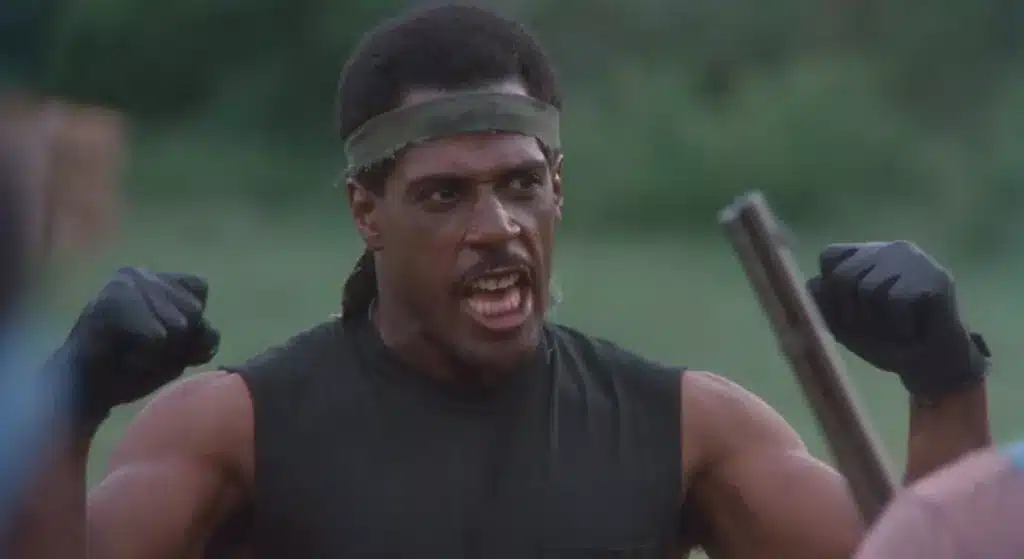
For decades, actor Julius Tennon had accepted that the 1989 film “Riverbend” would remain a cult curiosity, having screened a handful of times and then releasing via VHS before largely disappearing from public view.
“I remember [actor] Steve James … calling me, like, ‘Man, I don’t know what’s going on,’” Tennon said of the uncertainty that took hold among the cast members as the film sat in this early theatrical limbo. “And then I didn’t hear anything for a while, and it never ended up getting a proper release. And most people don’t even know about this film, and when they hear about it, they’re shocked it exists.”
In recent years, however, an unlikely series of events have collided to deliver an audience for a newly restored version of the movie, which stars the late James (“I’m Gonna Git You Sucka,” “To Live and Die in L.A.”) and Margaret Avery, fresh off her supporting actress Oscar nomination for “The Color Purple.”
A donation powers the future of local, independent news in Columbus.
Support Matter News
Reached by phone in late September, filmmaker and archivist Michael J. Dennis said he first posted a VHS transfer of the film on his YouTube channel in 2020, which led “Riverbend” director Sam Firstenberg to send him an email about a year later. “And I thought he was going to say, ‘Take it down,’ but he actually said, ‘Leave it up. You’re doing the film a great service,’” said Dennis, who around the same time came across a 35mm South African print of the film on Ebay, which he purchased, cleaned up, and then screened in a limited U.S. theatrical run.
Though far from perfect – the print was missing nearly 13 minutes of footage, completely excising a romantic side story from the film – these screenings eventually caught the eye of co-producer Valerie Vance, who helped Dennis to track down a negative print of the complete movie, along with all of the original sound mixes. These source materials were then used to create a fully restored 6k version of “Riverbend,” which received a Blu-ray release in August and is currently in the midst of a cross-country screening run that includes a stop at Wexner Center for the Arts on Friday, Oct. 2, with Dennis and Tennon in tow for a Q&A.
Set in the segregated South of the 1960s, the film centers a trio of Black soldiers who escape court-martial for refusing to destroy a village in Vietnam. The servicemen, played by Tennon, James, and Alex Morris, then hide out in a small Georgia town overseen by a corrupt judge and a racist sheriff, where they eventually organize the townspeople to fight back against the injustices.
“We were helping these African American people get the boot off their neck, as it were,” said Tennon, who now believes that the film’s lack of a “white savior” in part helped to doom its early release. “This was Black people saving themselves, which was totally against the status quo. … And then we’re in U.S. Army fatigues, and we’re capturing white people, not to hurt them, but to make a statement and say we want people to see what’s going on with this town. And I don’t think the studio ever had in mind to release a film with that kind of controversy.”
According to Dennis, the film never even aired on cable television, having only survived for its eventual rediscovery owing to the existence of video stores, which is where even the cast members scored copies for their own private collections.
“Everybody [in the cast] had one from Blockbuster,” Tennon said, and laughed.
Though more than three decades have passed since the film premiered, both Tennon and Dennis said that recent viewings had affirmed its continued relevance, with each expressing how they were struck by the way “Riverbend” speaks to this current era.
“We premiered it in Denton, Texas in January 2024, so it was very close to George Floyd,” Dennis said. “And now people see police brutality happen all the time on their phones. And here’s a move from 1989, set in 1966, that shows the same racism and abuse of power, and that presents possible solutions that don’t involve retribution.”
Tennon, for his part, sees in the film lessons for a social and political moment that has seen the Trump administration marshalling anti-DEI sentiment as a means to erase the historical contributions of minority populations and to advance segregationist policies.
“This is one of those films that should make people think about the plight we’re in now, where … we’re fighting against racism on another level, and where there’s this kind of erasure of Black culture,” Tennon said. “But we’ve come too far to be erased. And I don’t think it’s going to happen. What you’re starting to see, though, is that ugly snake rear its head up. … So, in the same way the soldiers were coming in to help these people bring attention to their plight, we all have to get out and stop the scourge, as it were, that is trying to take us over. And it’s all of us. It’s not just these Black folks in a small town that want to be saved. I think most of us are going, ‘Wait a minute, what happened to Democracy? What the hell’s going on?’ We got to stand up the way the people in that town stood up.”
Author

Related Articles

‘Ice Cream Land’ balances fantasy, reality in making its way to the big screen
More than two decades in the works, the new documentary from artist David Denniston lovingly traces the life and experiences of Ricky ‘Ice Cream’ Jackson, who will be on hand when the film premieres at the Lincoln Theatre on Thursday, Sept. 17.

‘Wood Street’ was filmed in Oakland but it could have been made in Columbus
The new documentary from California journalist and filmmaker Caron Creighton screens at the Drexel Theatre this weekend as part of Cinema Columbus.
Filmmaker Logan St. Hilaire explores the in betweens with ‘Maroon’
The Columbus native turned the camera on his Haitian family for his new short film, which screens this weekend at the Wexner Center for the Arts as part of Cinema Columbus Film Festival.