
Antoinette Savage creates with her ancestors at her back
‘Memory Keepers,’ the new solo exhibition from the Columbus artist, kicks off with an opening reception at Lindsay Gallery on Friday, Aug. 7.
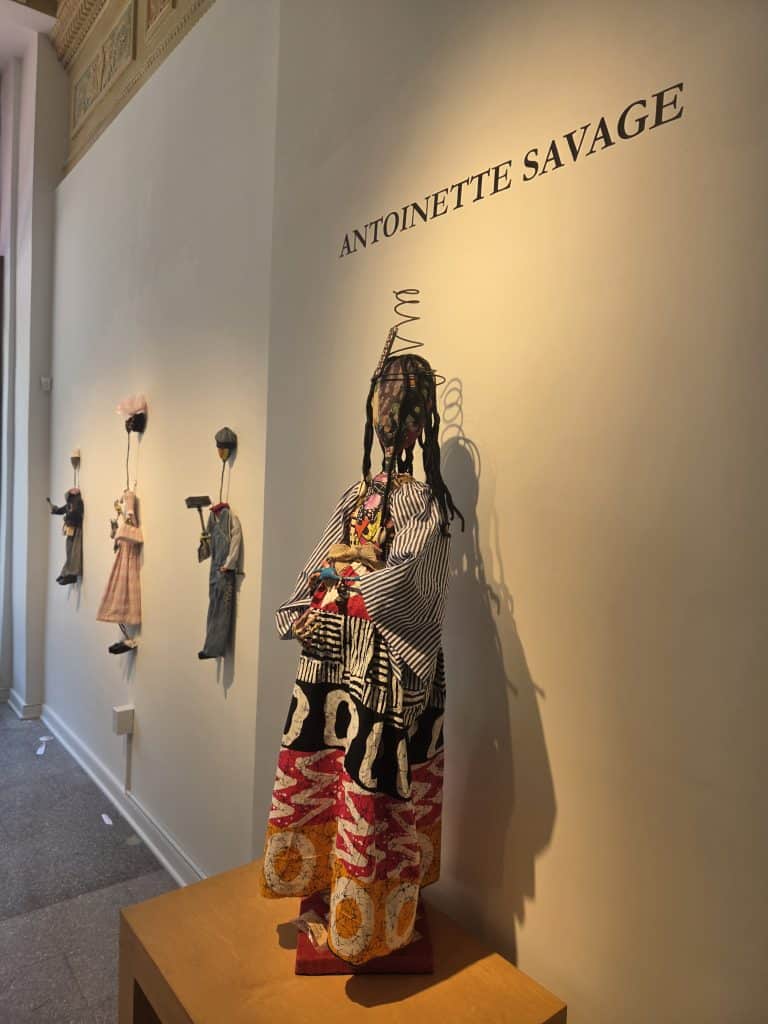
The characters populating “Memory Keepers,” the new solo exhibition from Columbus artist Antoinette Savage, take shape in stages.
The first involves Savage crafting a “skeleton” from wire, chicken wire, and scraps of tightly wound fabric – a comparatively utilitarian process centered on craft. The second and most important step arrives more mysteriously, with the artist uncovering the character’s soul, for lack of a better term, outfitting the skeleton in hand-stitched clothing and creating for it an elaborate backstory that adds even greater dimension.
As one example, witness “Psalms 23,” a young woman positioned on the cusp of adulthood who carries herself “with a sense of pride and dignity.”
A donation powers the future of local, independent news in Columbus.
Support Matter News
“Her ways may seem old-fashioned to some, but she knows the beauty of carrying herself with grace,” said Savage, reading the character’s story aloud to me at Lindsay Gallery, where “Memory Keepers” kicks off with an opening reception from 5:30-8:30 on Friday, Aug. 7. “There ain’t nothing wrong with a young lady who knows her worth, honors herself, and holds tight to the values planted in her. … She is blessed. She is covered. She is walking in the footsteps of those who came before her.”
This last line is also exceedingly true of Savage, whose artwork is deeply informed by ancestry and lineage – connections exemplified by her inclusion of a pregnant figure in each of the five solo shows she has staged to this point in her arts career.
“I’m the family historian,” said Savage, who in this role visits her ancestral gravesites three times a year to clean all of the headstones. “I talk to them when I’m doing my artwork, whatever it is. I’m always asking them, ‘What story should I be telling?’”
Savage’s stories, deeply rooted in the years between the post-Reconstruction era and the early 1940s, are backed by voluminous research, the artist compiling folders of documentation that can help to give greater shape and context to a piece. A recent sculpture of a fisherman, for instance, takes inspiration from the true history of Arthur Wright, the last commodore of the Charleston Mosquito Fleet, a group of African American and Gullah Geechee mariners who for centuries provided fresh-caught seafood to the people of Charleston, South Carolina. Even the distinctive color Savage selected for the vessel has historic precedent, the artist painting it haint blue, a shade adopted by the Gullah Geechee and meant to ward off restless spirits.
The small sculpture contains other hallmarks of Savage’s style, including the use of discarded elements such as a tackle box crafted from an Altoids Smalls tin and filled with hand-bent hooks. At multiple points in our conversation, Savage professed a fondness for rusted and salvaged materials, which carry their own sort of history that can enhance a sculpture in tough-to-define ways. The artist crafted a headpiece worn by the pregnant figure central to “Memory Keepers,” for instance, from a steel coil she cut from a turn-of-the century boxspring. Other sculptures are outfitted with inherited pieces – her grandfather’s razor and bits cut from his work belt – their clothes sewn from materials that are largely thrifted or donated.
Savage said this approach can impact how moves through the city, her head on a swivel as she scans the ground for discarded treasures she can incorporate into her work. At times, these searches have taken on a more spiritual dimension, the artist recalling a 2024 trip she took to Ghana as a means to celebrate her college graduation, during which she visited and collected samples from a wealth of ancestrally rich sites, including the Pra River, which she immersed herself in before filling a small bottle with water to bring home.
“The Pra River is the last place my ancestors were able to take a bath before they were marched to the castles at Elmina and Cape Coast” and into slavery, Savage said. “And we got to go into the water. And we did a prayer in the water, and I drenched myself from my shoulders to my feet, and it was liberating. … And I was thinking about how my ancestors were here at one time, and I’m splashing the water on myself, saying, ‘I’m honoring you. Thank you for surviving,’ because they could have been one of those who jumped off the ship. But they survived, and I’m here.”
Savage traced this resilience down through her bloodlines, seeing it firsthand in the person of her mother, who was widowed at age 26 and left to raise six children with little outside assistance aside from the meager social security payments she received in the wake of her husband’s death.
“I think she saw what Black people had to do to survive in this world, and it made her resilient,” said the artist, who noted how her mother grew up watching her father return from the job physically bowed from his work as a hod carrier hauling bricks and mortar on construction sites. “And in that she saw what it took just to be here. And then being 26 with six kids. We would see her get up every morning, go to work, come home, cook, clean, take care of us. … And on top of that, I’m telling you, my mom was as clean as the Board of Health. And when she would get off of work, men would be sitting on the porch just waiting for her to walk down the street. She was classy. She was elegant.”
Though Savage’s mother more recently passed away, she remains a pronounced presence in the artist’s life, perched alongside the other ancestors whose spirits can be felt more intensely in those moments when she crafts. Savage said she felt the particular weight of this assemblage alongside her as she worked on the pregnant figure of “The Unborn Child,” which she created while keeping close in mind “all of the women in my family,” as she explained it.
“‘The Unborn Child’ represents a promise that, from the soil, the water, the iron, and the stones that witness history, new life will always emerge,” Savage said, reading from the story she wrote to accompany the sculpture. “The ancestors are not gone. They live in the child. They live in us. They continue.”
Author

Related Articles
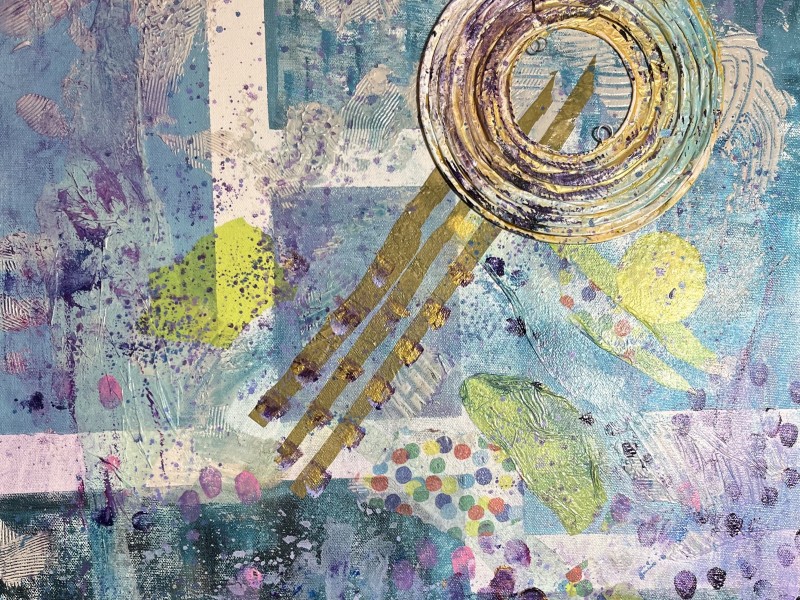
Deep conversations pave the way to ‘Chasing the Light’
A couple of years ago, Loren Bucek invited a group of artist friends to her Clintonville home. The gathering soon evolved into regular meetups that shaped the creation of a new exhibition opening this week at McConnell Arts Center.
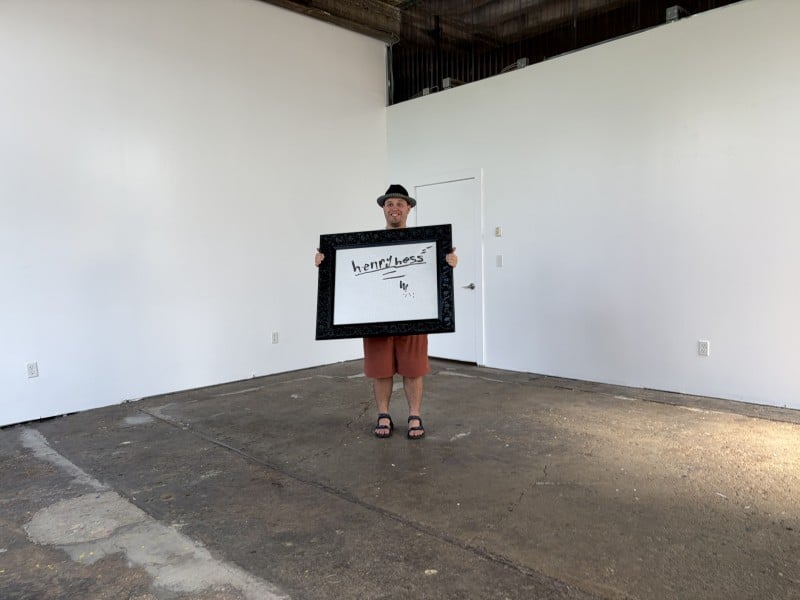
Henry Hess says goodbye to his longtime Chromedge studio
Faced with a rent increase of more than 30 percent, the Hess family opted to move on from the artist’s creative home of the last eight years. And while the next steps remain uncertain, they stressed that Henry would maintain a presence in Franklinton. ‘We’re not going anywhere,’ Sophia Hess said.

Nick Stull adopts a quieter approach
With his latest collection, on view at Sarah Gormley Gallery beginning today (Friday, Sept. 11), the Columbus artist hopes to entice viewers to linger a little longer in his world.