
On Development: Rapid-transit is moving slowly. Maybe we need a new model
Our policies suggest a willingness to spend any amount to add lanes and bigger (towering!) interchanges for major highways, while transit spending is too often regarded as frivolous.
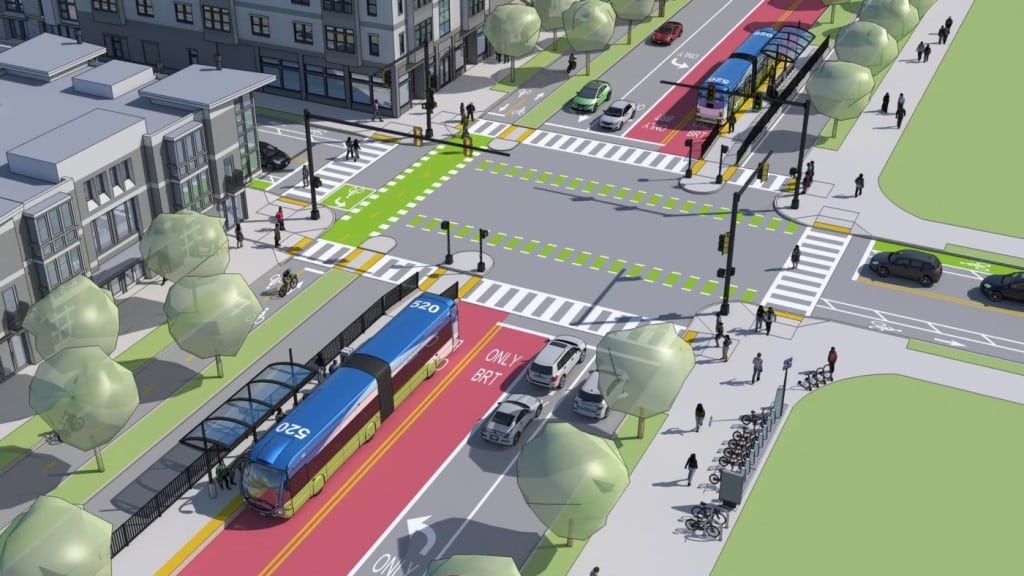
I’m supportive of LinkUs and a planned bus/rapid-transit (BRT) network, but I’m not optimistic.
Already, construction of the West Broad Street leg – COTA’s first-ever real BRT line – has been delayed. The Central Ohio Transit Authority plans two other BRT lines, and envisions still others eventually. Is it too little, too late?
The current hurdles are understandable as COTA seeks federal funding support from an administration that has not made transit – or any other funding in urban areas – a priority. The $150 million (and currently delayed) grant from the Federal Transit Administration would contribute a bit more than one-third of the West Broad total cost.
A donation powers the future of local, independent news in Columbus.
Support Matter News
Another challenge is that Columbus is not, and has never been, designed for, nor conducive to, mass transit. And it’s too late to redesign the city and suburbs. Very few thoroughfares span the entire city from north to south or east to west, and streets in one jurisdiction do not always mesh neatly with those in other cities and townships (rivers and creeks are a factor in some cases).
As for new development, we’re not only making the same decentralized mistakes, but we’re also compounding them with new construction throughout Central Ohio that offers little semblance of a coherent city. Instead, we expand with disconnected subdivisions that are designed for automobiles and that make it difficult, or at least circuitous, to walk to shops, schools, and parks.
Even our “new urbanist” developments can seem more Disneyesque than natural. If your neighborhood has a website and a marketing slogan, it might not be organic. Dublin has been lauded for the nice, walkable, urban density in Bridge Park, but it is accessible only by car (like Easton, and the Continent before that). Unless you live in the development, or right across the pedestrian bridge in “old “Dublin,” it’s a destination to which you must drive.
It’s not a neighborhood that grew there organically; it’s a corporate master-plan. It’s an unusually well-done example of such developments, sure, but that doesn’t make it authentic.
And yet, our policies suggest a willingness to spend any amount to add lanes and bigger (towering!) interchanges for major highways, while transit spending is too often regarded as frivolous.
In the long run, what we probably need is not the common rail-transit model of “spokes” around the region all feeding commuters to a downtown “hub.” Our hub is still important, but it shares economic and cultural activity with busy nodes around the Outerbelt. We need rail to connect the nodes – a modern, suburb-friendly, new-generation transit system.
This would include Bridge Park, but also Westerville, Worthington, Gahanna, Hilliard, Upper Arlington, Grove City, and the logistics hotbed around Groveport – not to mention key nodes in the urban core: Ohio State University, Short North, Clintonville, Bexley, Fifth-by-Northwest, Franklinton and Hilltop. With several interconnecting lines, trains could serve each of these nodes.
With a rail transit network, the highest density – and the highest land value – tends to be in these nodes. But our highest residential land values are in far flung places that are the least accessible to transit.
On one hand, this idea is just a transit geek’s dream.
On the other hand, it might be a wakeup call to challenge an expensive and unsustainable, auto-dependent chaos.
We’ve made it harder for ourselves. What other country has abandoned so much of its transportation infrastructure? A century ago, Columbus had eight regional interurban rail lines. Ohio is full of unused and underused rail lines – and others that have been removed, bulldozing our past to spite our future.
What will it take for us to realize that adding highway lanes does not ease traffic in the long run?
Resume.io, a New York based online company that helps people build their resumes, conducted an online poll in July that, in effect, let respondents rate their stress related to commuting by how much of their income they would sacrifice if they could be free of highway traffic. Ohio, the seventh largest state by population, has less rail transportation than the six larger states. In the poll, Ohio commuters, on average, said they would give up almost $3,000 of their annual earnings in order to avoid the urban Interstate highways they must commute on each workday.
It was not, of course, a scientific poll, given that 3,017 respondents across the 50 states and dozens of cities are not a reliable sample. But it raises questions. Is there an accurate way to determine whether commuter frustration is growing and whether people in different regions are silently hungry for transit options?
Would people be willing to use reliable rail transit if it was an option that could free them from traffic?
What we’re working on now is yesterday’s transit for today’s city. It’s time to dream of tomorrow’s transit for tomorrow’s city.
Brian Williams is a semi-retired retropolitan.
Related Articles
Opinion: You can’t talk about Issues 8 and 9 without race
A problem with the discourse around these issues is that it isn’t being completely honest when it comes to race. Not publicly, anyway.
Opinion: Trifectas are only good for racing and the lottery
The legacy of Ohio’s Republican Party is corruption, scandal, and culture wars. Our votes could put an end to their occupation of state government.

If you start from a place of love, you can’t go wrong
A vigil for an unhoused community member who recently died in Newark served as a call to not look away.