
Amber Groome finds resilience in ‘Internal Garden’
The Columbus artist’s new exhibition will remain on display at Sarah Gormley Gallery through Sept. 5.
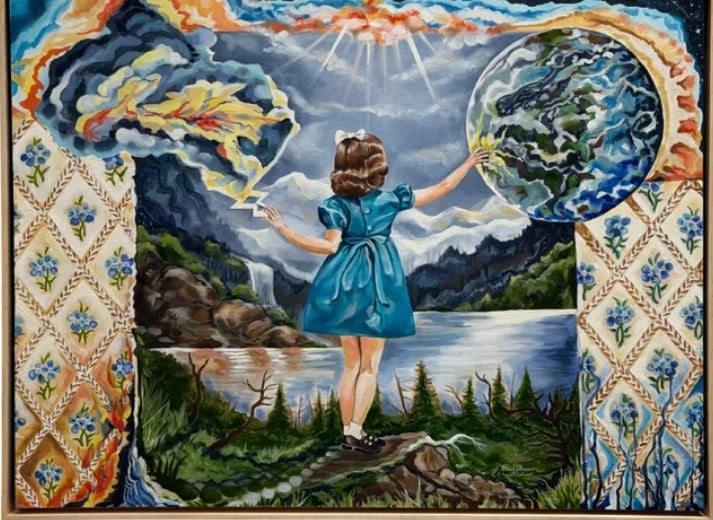
The work in Amber Groome’s new exhibition at Sarah Gormley Gallery emerged over the last three years as the artist expanded from dollmaking and collage into painting – a practice she had engaged in throughout her life but hadn’t yet revealed to the larger world.
“I wanted to be even bolder in my expression,” Groome said in mid-August from the downtown gallery, where “Internal Garden” will remain on display through Sept. 5. “I feel like I was always illustrating in this style, drawing in sketchbooks. … So, this just brought those drawings to fruition.”
Consisting of both collage and painting, the exhibition is almost universally directed inward, with Groome exploring and expanding on themes of resilience and transformation. A self-portrait titled “Picture Day,” for instance, is based on a kindergarten school photo of the artist but is surrounded by a series of doll-like figures that tell the larger, loosely autobiographical story of Groome uncovering a whimsical, subconscious world that over time has helped her to better express her emotions.
A donation powers the future of local, independent news in Columbus.
Support Matter News
“I think I was a really depressed child,” said Groome, who for years refused to share the picture owing to the sense of melancholy she saw reflected in it. “You know how you get those full-page printouts of photos that you’re supposed to clip and share with people? I always hated the picture because I knew that I looked so sad, so I never did, and I still have the sheet.”
Other paintings capture a sense of transformation in a more impressionistic form, including “Neuroplasticity,” which is representative of brain waves and the rewiring that can take place at a more cellular level. “For me, what I’m imagining in that one … is these neuropathways or different things firing off in our brain,” Groome said. “But it’s also the ability to reroute those things and to have the ability to heal, or to essentially transform things and see them in a more positive light. And I know you can do that, and that you can use your cognitive power to reroute thoughts, which does alter the map of your brain.”
Compared with dollmaking and the more exacting process the artist employed in covering a skull form in mosaiced seashells, these looser works convey a sense of freedom, with the lively “Burst of Life” depicting the initial spark of creative inspiration before it has been harnessed or refined. “It feels like you could almost dance when you’re doing it,” said Groome, who within these works incorporated everything from water-soluble oils and graphite to oil pastels and even markers. “It’s just movement, harmony, shapes, colors, repetition.”
Owing to this approach, there were times when Groome didn’t know in the moment precisely what a given work might be interrogating, with time and distance combining to introduce greater clarity. A brightly colored painting dubbed “Carnivalesque,” for one, captures a sense of overwhelm that the artist began to associate with a child’s experience at the carnival, which in turn led her to dive deeper into her own family history.
“I had two great aunts who around the time of the Depression … were bareback [horse] riders and acrobats in the circus,” said Groome, who included a smaller reproduction of “Carnivalesque” in a collage titled “The Fire Eater’s Daughter” that is also on display in the gallery. “And then one of their husbands, who was my great uncle Skinny, he started working at the circus as a sideshow barter when he was 14, bringing in people and doing the tickets. And he worked all his life with the circus, eventually becoming an elephant tamer. And on his gravestone, there are elephants.”
The artist then connected her fondness for this era with the 1940s and ’50s fashion magazines she utilized in crafting a series of collages for in the exhibition, and which she created, in part, as a means to place these women in a new context and to reestablish the power stripped from them by the way the publications presented them at the time. “They were more ornamental, like accessories, where they could be a facade, an empty image,” Groome said.
In recasting these images, Groome began to explore the concept of resilience, which echoes throughout the space but resonates most cleanly in a painting of phantom-esque growths titled “Ghost Pipes” that depicts flowering plants that thrive in the deepest, darkest regions of the forest.
“They don’t have any chlorophyll, so they don’t get their energy from the sun, but from the network of underground fungus,” the artist said. “And there’s a lot of lore with ghost pipes, which can … allude to sitting with grief or pain. But I see them as resilient, as a form that can flourish without direct light.”
Groome attributed the themes recurrent in “Internal Garden” to having grown older and experienced adversity, as well as to the “trauma everybody experiences in life,” as she explained it.
“It’s a challenge just to persevere through what we’re bombarded by daily,” she continued. “But you have to transform that adversity into something that can work for you, and that can bring that darkness into light. And creative expression, I think that’s a direct way to transform and express energy in a positive manner. And the practice of creating, for me, is that. It’s the healing, the working through things. And it will always guide me through.”
Author
Related Articles
‘Immigration: A Journey of Belonging’ seeks deeper understanding
The new group exhibition, open now at the Losinski Gallery at the Main Library, will host a reception from 2-4 p.m. on Saturday, Oct. 3.
Deep conversations pave the way to ‘Chasing the Light’
A couple of years ago, Loren Bucek invited a group of artist friends to her Clintonville home. The gathering soon evolved into regular meetups that shaped the creation of a new exhibition opening this week at McConnell Arts Center.
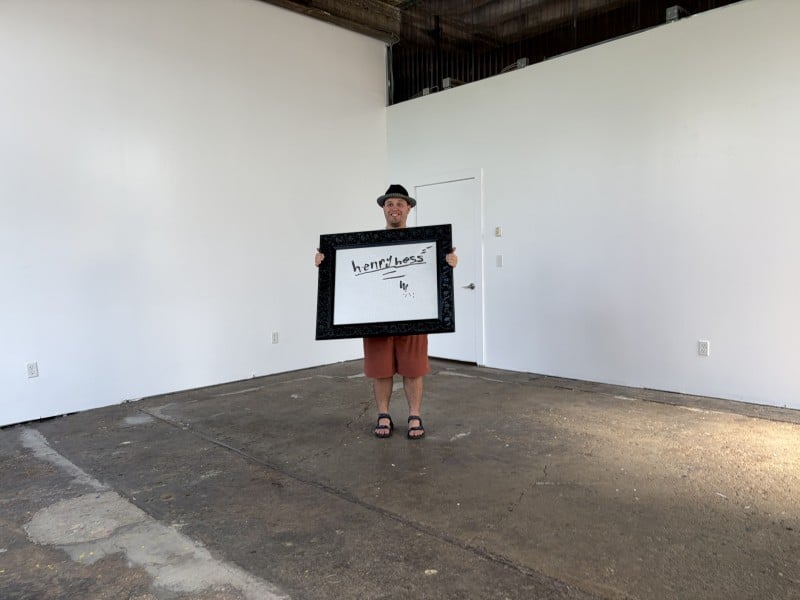
Henry Hess says goodbye to his longtime Chromedge studio
Faced with a rent increase of more than 30 percent, the Hess family opted to move on from the artist’s creative home of the last eight years. And while the next steps remain uncertain, they stressed that Henry would maintain a presence in Franklinton. ‘We’re not going anywhere,’ Sophia Hess said.