
‘We don’t really have anywhere else to go’: Residents of a South Side encampment brace for eviction
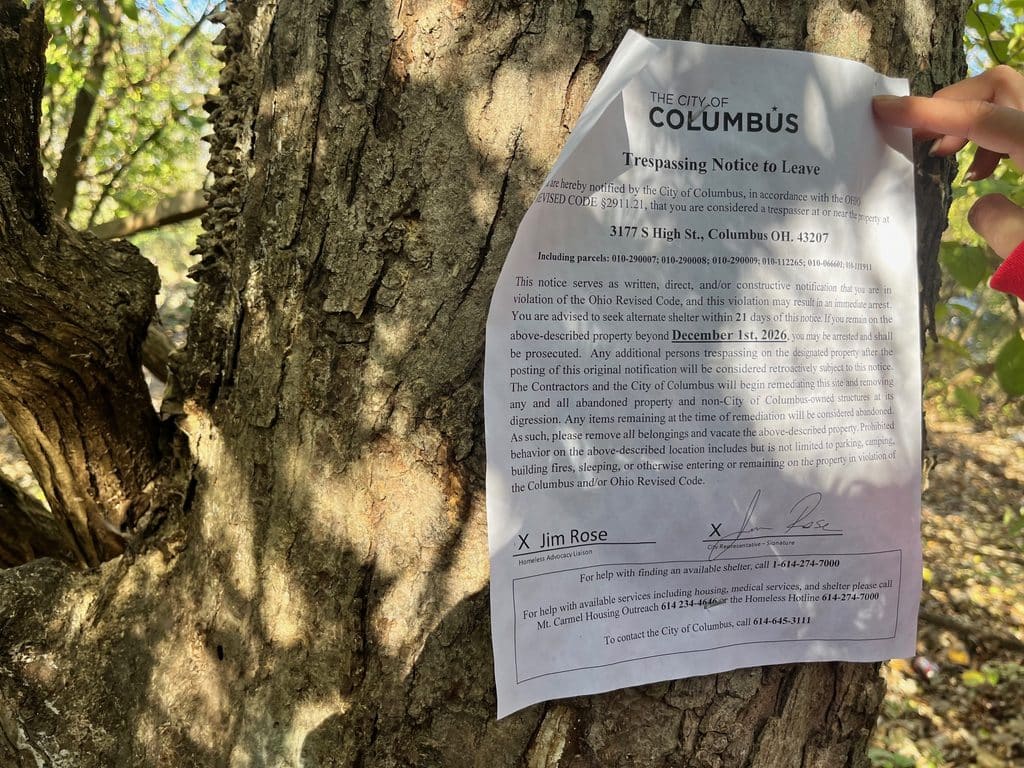
Earlier this month, the city posted trespassing notices at the encampment, which is located just off of South High Street, informing its residents that the site would be cleared on Dec. 1.
Most mornings, Corey wakes up in his makeshift shelter at a South Side unhoused encampment and walks to one of the nearby restaurants on High Street where he’ll attempt to clean himself up as best he can by taking what he described as “a bird bath” in the restroom sink.
The rest of the day is then largely dedicated to survival, with Corey either panhandling or trying to earn a few bucks by clearing the trash from the parking lots at neighboring stores. Some days, he makes enough to grab a bite to eat. More often, he’ll scrounge area dumpsters, cobbling together his meals from discarded food items.
Fellow encampment resident Justin described a similar existence, sharing how he spends most days combing the nearby streets and alleys for cast-off metal he can scrap for money. “If you’re not constantly moving, you’re dead in the water,” he said. “I equate it to being a shark.”
A donation powers the future of local, independent news in Columbus.
Support Matter News
In recent weeks, Justin has invested more of this precious time to try and prepare for the winter months, collecting materials to better insulate his tent and making sure he’s stored the items essential to surviving on the land amid inhospitable conditions – hand tools, cooking utensils, and a small axe for cutting wood included.
“And now it feels like all that work was for nothing,” Justin said in late November at the encampment, which has been targeted by the city for remediation, leaving its residents fearful of their future prospects right as winter begins to take root.
Earlier this month, the city posted trespassing notices at the encampment informing its residents that the site would be cleared on Dec. 1. The land, which Emily Myers of the mutual aid organization Heer to Serve said is home to roughly 60 unhoused people, is currently owned by the Columbus and Franklin County Metro Parks and the city, which plans to sell one of the parcels to Rambling House Soda founders John and Jen Lynch for development into an entertainment complex.
The city’s decision to destroy the encampment has sparked pushback from citizens, activists, and even some members of City Council, who during last week’s council meeting questioned Director of Development Hannah Jones on the timing of the sweep.
At the meeting, council member Melissa Green said that Jones “adamantly stated” in a September conversation with her that there were no plans to evict residents from the site and questioned why the decision to evict had not been made months earlier when temperatures were more hospitable.
Jones pushed back, saying that the sweep was timed to coordinate with the opening of winter warming centers, and adding that if the remediation had taken place in the spring, it would have sparked the same conversation “but without the ability to offer any alternate shelter options.”
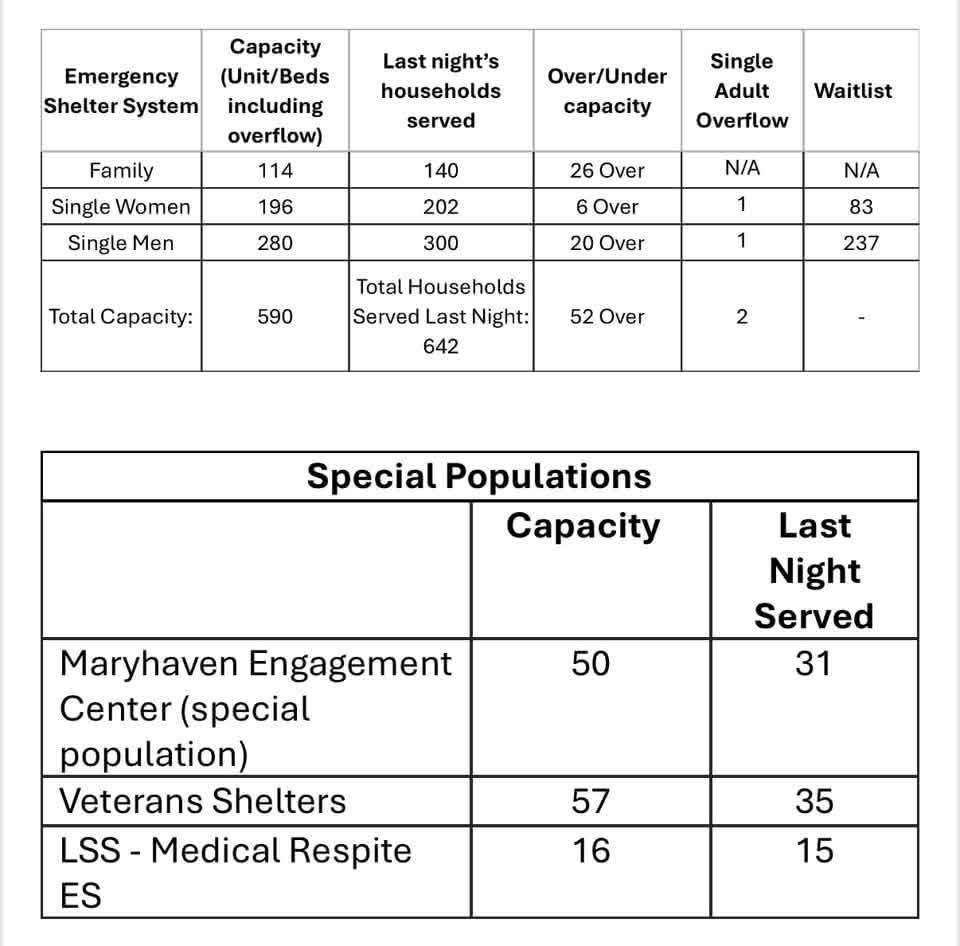
Myers, meanwhile, argued that warming centers are a grossly inadequate solution to Columbus’ growing homeless crisis, noting that they already face the same overcrowding issues currently overwhelming the city’s shelter system. A recent capacity report of the city’s emergency shelter system showed 642 households served in a single night – 52 people above the system’s capacity – with an additional 320 people left on the waitlist.
Even if shelters had the capacity, there are numerous reasons some unhoused people choose to eschew the system. These can include their relationship status (there is no shared housing for unmarried couples), pet ownership, being a person who uses drugs, concerns related to personal safety, restrictions on the number of possessions that can be carried by a person staying in a shelter, and not wanting to live under restrictions such as a curfew.
“I mean, we’re adults. Who wants a curfew?” Corey said. “And then a lot of people out here have PTSD, and being enclosed with people you don’t know does not mix well with us.”
Plus, encampments offer a sense of connection that the residents interviewed said can be lacking within the system. Stacia described her fellow campers as “family,” while Justin called out the misconception that he believes some members of the public hold that the people who live within an encampment “are always out to get each other.”
“And that’s really not it,” he continued. “It’s our own little community and we try to help each other where we can, with food, with toiletries, clothing, blankets.”
Since the posting of the eviction notice, advocates have pushed the city to delay the camp sweep until the spring – a request the Ginther administration has so far ignored. And during last week’s council meeting, President Shannon Hardin asked council member Tiara Ross, who chairs the housing committee, to present a plan on the potential options that might exist for displaced camp residents, along with the financial resources available to the administration, when the council convenes for its meeting tonight (Monday, Nov. 22).
Columbus’ use of camp sweeps has come under greater scrutiny in recent years owing to the advocacy of groups such as Heer to Serve and others, which have routinely stated that the practice is expensive, leads to worse health outcomes for those displaced, and does nothing to address the root causes of homelessness.
In a mid-August interview, council member Rob Dorans acknowledged the city’s need “to evolve” on the issue of camp remediations, pointing as a primary reason to the lack of capacity within the shelter system, which has been further taxed by rising evictions and steep federal funding cuts to homeless programs initiated by the Trump administration.
“You cannot look someone in the eye and say, ‘You need to leave here and go to the shelter’ when there is no bed. That is disingenuous,” said Dorans, who added that council member Green had advanced legislation earlier this year that, if passed, would provide basic services for camps including trash, portable toilets, and showers. “And I think that’s a key first step, and a fundamental shift at the city on this issue.”
Asked about this potential legislation, Myers expressed skepticism. “We can’t even get a safe-sleeping parking lot going,” she said, calling attention to the designated parking lots in use elsewhere in the state where people experiencing homelessness can legally stay in their vehicles without the risk of being forced out. “And these are things we could do right now that don’t even require a policy change.”
Stacia has been living in encampments on the South Side for more than a decade and has already been through multiple displacements, including the 2022 sweep of Heer Park. And she said the city’s widespread use of sweeps has left those living at the targeted camp with few if any relocation options within the neighborhood. “We don’t really have anywhere else to go,” she said. “If we did, we wouldn’t be here.”
Justin expressed similar resignation, believing it unlikely the city would grant the camp an extension and sharing how he intended to focus his efforts this next week on packing up his belongings as best he can, not wanting to lose everything as he did the last time authorities bulldozed his encampment.
“I lost my great grandfather’s watch, family photos,” he said, and paused. “I mean, it’s hard enough to keep things out here to begin with, because things get ruined by the weather and whatnot. … I just want to get all of my stuff together, and if I’m able to find somewhere to go, make sure I can get it there.”
Author

Related Articles

Local Politics: City Council questions Ginther on planned encampment sweep
The city intends to destroy a 60-person homeless encampment in Heer Park come December.

Donovan Lewis should still be here
Lewis’ story persists through those who loved him. Through his son, through his friends, through his mother’s resilience and bravery.

Supporters rally to try and win clemency for Keith LaMar
Speakers at Friday’s demonstration, which is scheduled to take place outside of Trinity Episcopal Church at 3 p.m., will include death row exonerees Elwood Jones, Lamont Hunter, and Derrick Jamison.