Artist Mehri Davis stakes out a place of calm amid the chaos
In the aftermath of a stroke, Davis discovered focus and clarity in the act of creation, paving the way for a new exhibit opening this weekend at Awesome Gallery.
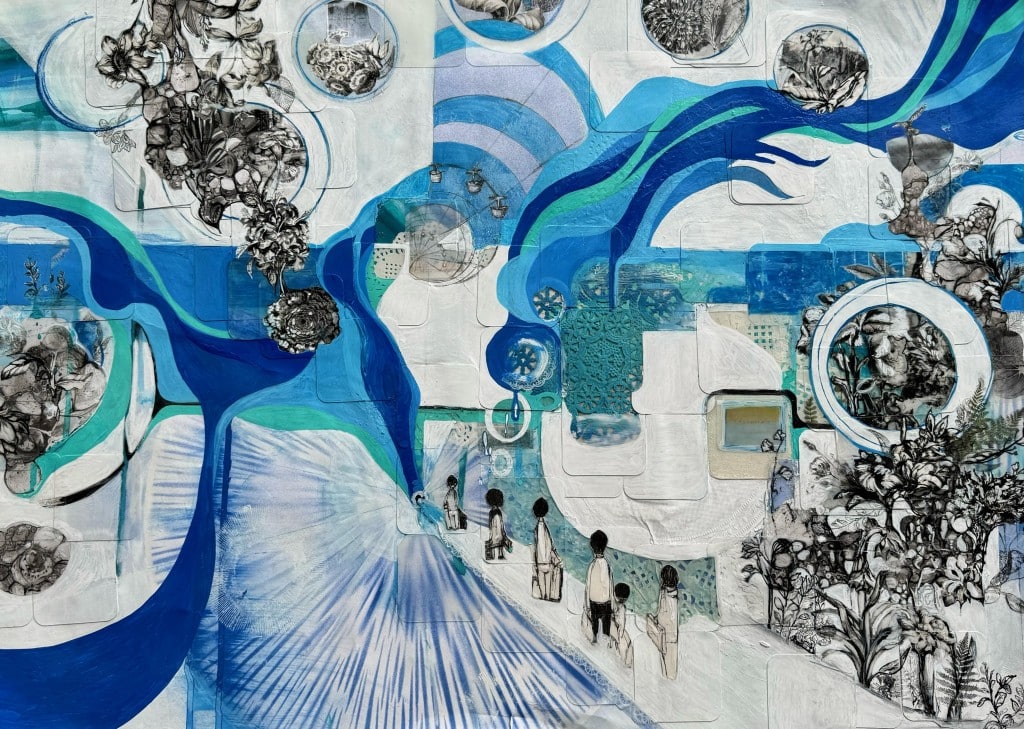
One of the dozens of paintings by Mehri Davis on display in a new exhibit opening this weekend at Awesome Gallery centers on a series of figures shown standing on a conveyor belt, their backs turned to the viewer. Around them, Davis has painted a wondrous world of oceanic blue swirls and vivid floral overgrowth, which these travelers are missing entirely, their gazes fixed resolutely forward and ignorant to the magic that surrounds.
For the artist, the painting now signifies her experiences navigating the world as a neurodivergent person, which she said have led her to absorb her surrounding environment in ways many of us do not.
“If you look at these people, they’re all on this conveyor belt, and they’re looking ahead at what’s normal and boring. And if they were really looking, they would see this wow, and I feel like that’s what my brain does,” Davis said in late October at Awesome Gallery, where her new exhibit, “Takiwatanga” (taken from the Māori word meaning in my own time and space), kicks off with an opening reception at 1 p.m. on Saturday, Nov. 9. “There are people who will be like, ‘How did you see that?’ And I’ll be like, ‘Well, I turned upside down.’ And people don’t do that much.”
A donation powers the future of local, independent news in Columbus.
Support Matter News
Six years ago, prior to having a stroke, Davis said she lived life at a much different pace, describing herself as the type of person who was constantly on the go, her work calendar overflowing as she juggled hundreds of business contacts at the expense of relationships with family and close friends. “And, yes, it’s lovely that you’re doing all of this and trying to help all these people, but it didn’t change the fact I wasn’t there,” said Davis, who recalled organizing a massive hip-hop show the summer prior to her stroke. “There were like 400 people there, live graffiti, beatboxing battles. It was incredible. Then I had my stroke, and I was talking to a therapist and she said, ‘What kind of art do you make that’s small?’ And I said postcards. And she said, ‘Okay, with your life now you need to figure out the postcard-sized version of that hip-hop show.”
In many ways, “Takiwatanga” came about from Davis’ experiences relearning her brain post-stroke, with art serving as the one place that both calmed her and focused her thoughts, enabling her to better mitigate the “neurodivergent burnout” that tended to accompany her overstimulated mind.
“I’ve heard people describe neurodivergence as we see everything,” said Davis, founder and director of the nonprofit Columbus on the Spectrum. “If you’re driving a car and you’re neurodivergent, you know the color of the car driving next to you, and you probably know how many people are in it, and you probably know if it has a bumper sticker. Everybody else just sees a car. And I started to realize, because of this, we get burnout. … So, for me, drawing becomes my active meditation, and it’s the only time my brain is completely calm.”
While Davis makes art explicitly for herself, repeatedly describing the process in therapeutic terms, a majority of her pieces are rooted in personal relationships, including a handful meant to memorialize people close to her who died. The artist said until recently she hadn’t lost many people in her life, but in the last two years nearly 20 had passed, a number of whom were artists with special needs. “And I wasn’t able to say goodbye to those people until I started making art,” Davis said, directing my attention to one work done in memory of a late friend named Judy. “And I started to figure out that because there are so many layers to a relationship, my brain being so busy and bouncing all over the place can actually visualize that idea better than a lot of other people.”
A number of the works on display in the exhibit incorporate collaged found materials – handwritten letters, newspaper clippings and photographs – which add purposeful layers of depth. For one piece, Davis combed through letters salvaged by a friend and written by a man previously unknown to the artist, whose correspondences trace a slow decline into alcoholism, marital collapse and familial estrangement. Davis’ work, in contrast, serves as a snapshot of the promise that existed prior to these later stumbles, which the artist traced in large part to her innate desire to find the good in people.
“I very much believe that everyone has a gift, and mine is that I can find the best thing about a person within 15 minutes of meeting them 100 percent of the time. And it’s the coolest gift in the world, because I can see what they could become, even if they have no idea,” Davis said. “And so, with this piece, I sat and thought about a man who had lost everything, and where you [read his later letters] and it’s just divorce and alcoholism. But that wasn’t all of his life. At one point you were doing this, and you were proud.”
In her artist’s statement, Davis wrote about restarting her life in the wake of her stroke, which she said was brought about due in part to the pace at which she lived and the relentless hours she logged working as a mental health counselor and running a community arts studio for people with disabilities. Part of this recovery meant learning to embrace those things lost to her. So, rather than lamenting the damage done to her short-term memory, which she said led fewer people to rely on her, she embraced the solitude and space afforded by her now more-open schedule. And no longer able to readily recall the source of particular grievances, she necessarily began to let go of anger, enabling peace and optimism to take greater hold.
“I stopped using the words get better at some point in the last year and a half of making this work, because I feel like I am better,” Davis said. “I’m better than I was before the stroke.”
Author
Related Articles
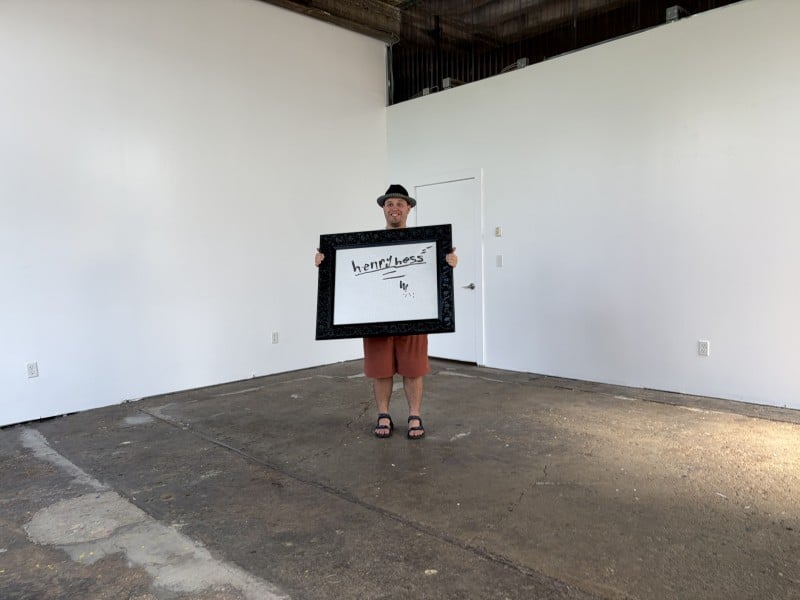
Henry Hess says goodbye to his longtime Chromedge studio
Faced with a rent increase of more than 30 percent, the Hess family opted to move on from the artist’s creative home of the last eight years. And while the next steps remain uncertain, they stressed that Henry would maintain a presence in Franklinton. ‘We’re not going anywhere,’ Sophia Hess said.

Nick Stull adopts a quieter approach
With his latest collection, on view at Sarah Gormley Gallery beginning today (Friday, Sept. 11), the Columbus artist hopes to entice viewers to linger a little longer in his world.
Melissa Vogley Woods slows things down for ‘When the Earth Bends we Bend’
The artist’s new exhibition opens at Brandt Gallery on Friday, Sept. 11.