
Artists find ways forward through grief, addiction in ‘Surviving’
Emily Strange, Allison McGovney, Lauren Ashleigh and Josephine Birdsell find healing in a new exhibit opening at Blockfort today (Friday, Sept. 6).
It’s often said that grief isn’t a straight line, and that recovering from loss can involve all manner of fits and starts, with stretches of good days followed by lulls during which it can be a challenge to so much as roll out of bed.
Artist Emily Strange has experienced this firsthand in constructing and then reassembling an evolving art piece she initially created when her best friend, Rel, died of suicide in the midst of a drug addiction. At the time, Strange also used drugs, and she said her friend’s death served as a catalyst for her to get sober. In the early stages of this recovery, while still deep in grief, Strange created an installation roughly the shape and size of a closet, the walls of which were lined with parallel rows of syringes and tally marks – a practice Strange picked up nine years ago as a means of ticking off each day of sobriety.
The first time Strange built the installation, she felt the weight of her loss at every stage. But while reassembling the piece years later for a 2023 show at All People Arts, she said she was so locked in on the details – reworking the design to fit the space, measuring and cutting lumber, ordering syringes – that the process almost felt mechanical. So, in again returning to the piece for “Surviving,” a new group show Strange curated at Blockfort, and which kicks off with an opening reception today (Friday, Sept. 6), the artist might have anticipated a similar level of detachment. But that’s not at all what happened.
A donation powers the future of local, independent news in Columbus.
Support Matter News
“This time around, when I ordered the needles and they came, my hands were shaking when I pulled them out [of the packaging],” said Strange, who is joined for the group show by artists Allison McGovney, Lauren Ashleigh and Josephine Birdsell. (The artist Zeph was also set to display but had to withdraw to deal with a medical issue.) “I was really struggling, and it was bringing me back to the past for some reason. But that pressure makes me work harder, so I just told myself that I could get through it, and not to worry about what was in my head.”
McGovney can trace a similar arc in her own art, describing it as “work that embodies the process of grieving.” This is particularly true of the pieces she has created in the four years since her childhood friend, Skylar, died of an overdose.
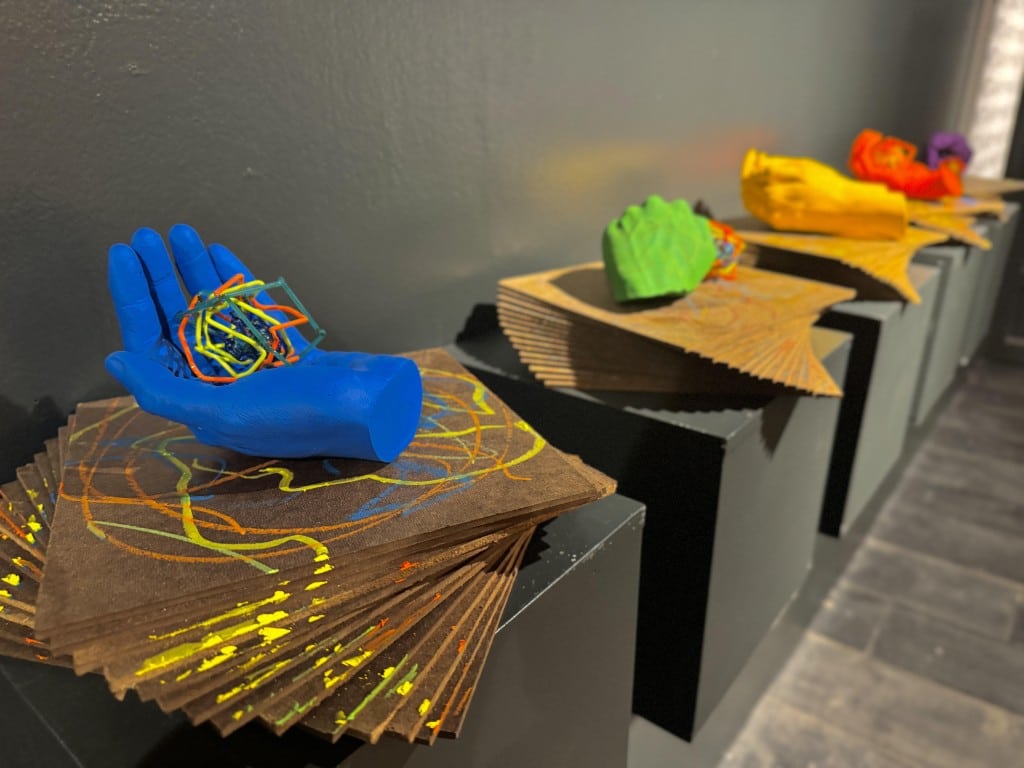
In the time since, McGovney’s work has continued to shift, moving from attempts to produce a realistic portrait of Skylar to the more impressionistic pieces she displayed last year at All People Arts, which echoed the confusion and loneliness that accompanied her sense of loss. It’s an evolution that continues in the three-dimensional works McGovney has on display in “Surviving,” which consists, in part, of a series of colorful, plaster cast hands, each clutching a fragile glass sphere.
In creating the series, McGovney, who also has a background in construction, focused primarily on process, describing the challenges inherent in working with plaster, which led her to discard nearly four out of every five casts she created.
“When I’m working, I’m thinking so much more about the crafting process. How am I going to get this to look like this? What material can I use? What hardware am I going to need to hang this?” she said. “And there are all kinds of different things that can go wrong when you’re casting, especially life casting with alginate. If you don’t let the alginate set enough before you pour the plaster, it’ll droop and create these warps in the shape. And if you let the alginate dry out, then it will shrink, and the scale will be off. And then sometimes the cast would have been perfect, and something will break when you’re taking it out. So, there are lots of things that can go wrong.”
Even in creating without a specific intent in mind, the series gradually began to take on deeper meanings, the collective works serving as a commentary on the fragile nature of recovery, where even a twinge of memory can again send a person spiraling into sadness. “There’s something really tense about the work, because even the way it’s set up, it looks like it could tip or fall or break,” McGovney said.
Collectively, the works on display by the four artists reflect on the challenges of surviving mental illness and addiction, and the reality that these are ongoing, lifelong struggles. Nine years into her sobriety, Strange said she only now appreciates the concept of taking things one day at a time, which she dismissed as “bullshit” following the first group sobriety meeting she attended. “But it’s true,” she said. “One day can be really good and the next you’re really struggling – even after you have many years sober. There’s always that chance for relapse, so it’s about getting through the day and finding different ways to deal with that stress and anxiety.”
For Strange, art has become an essential outlet for these stresses, recalling how she accidentally turned to creating in the wake of her friend’s death. At the time, Strange was a senior in college and the loss left her so consumed by grief that she contemplated dropping out. Instead, she spent hours in solitude in her studio, first painting the entire room in black chalkboard paint and then writing the word “suicide” in German over and over again, eventually going back and erasing the text so only faint ghosts of the letters remained.
“And it became an installation about suicide, and how even after people are gone, their spirits are still there,” Strange said. “But making that [initial piece] gave me the sense of purpose that I needed. I think the experience of making a thing is so important, whether you’re working with wood or ceramic or yarn or whatever. It gives me a reason to be, honestly, because I didn’t know if I was going to fucking make it through that. And I’ve carried that with me into everything I’ve made since.”
Author
Related Articles
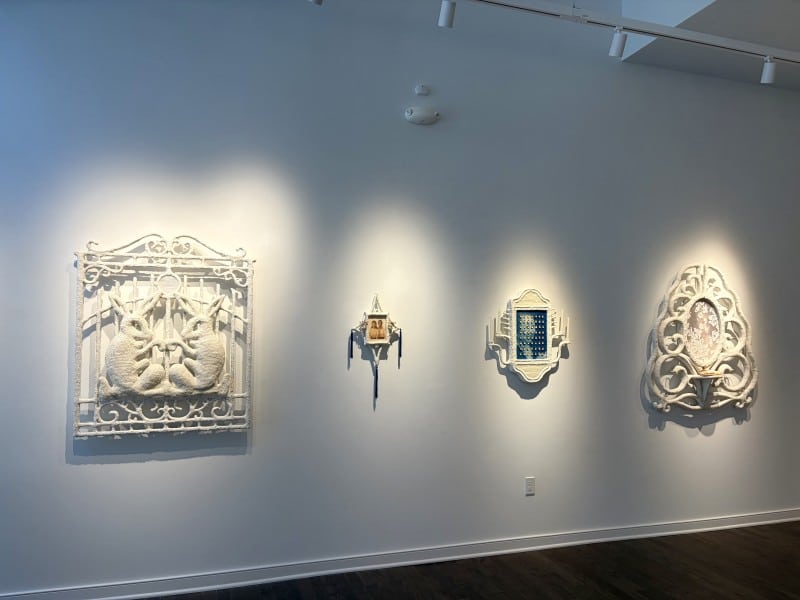
Dana Lynn Harper finds clarity through obfuscation with ‘Imagined Paradise’
The Columbus artist’s deeply personal new exhibition kicks off with an opening reception at Brandt Gallery on Friday, Aug. 7.
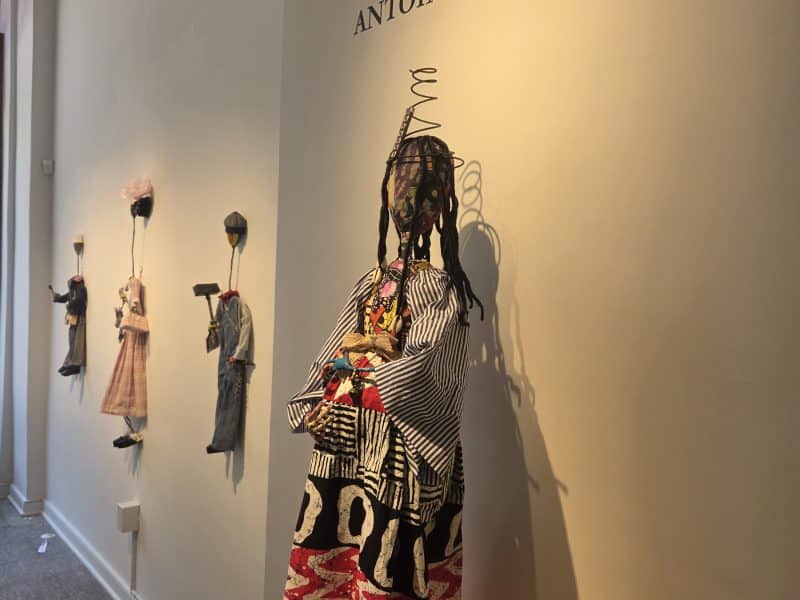
Antoinette Savage creates with her ancestors at her back
‘Memory Keepers,’ the new solo exhibition from the Columbus artist, kicks off with an opening reception at Lindsay Gallery on Friday, Aug. 7.
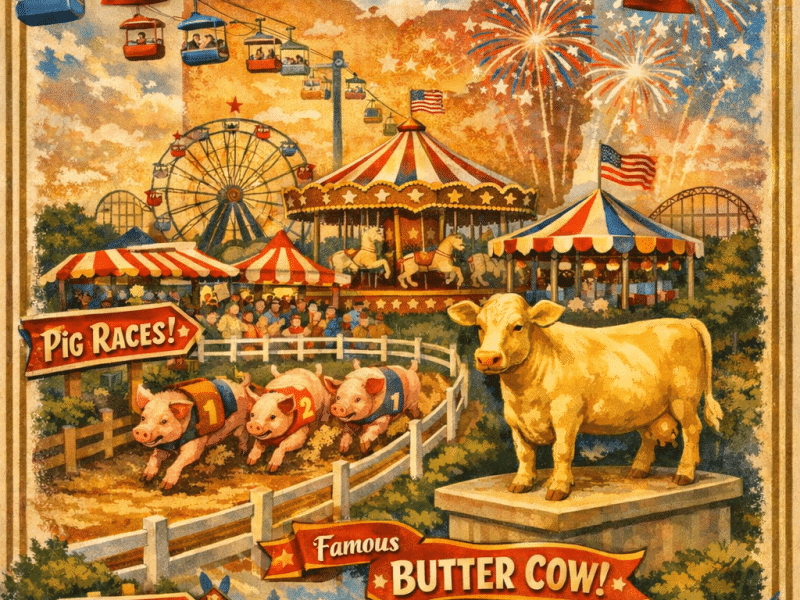
‘What message are we sending when we reward work with no humanity whatsoever?’
After an AI-created image won the grand prize in the Ohio State Fair poster competition, organizers announced their intent to reconsider the use of the technology in future contests amid vocal backlash from the state’s arts community.