
Micah Schnabel and Vanessa Jean Speckman keep eyes and ears on the road
The duo’s new record is populated by the types of people the two have encountered in an ongoing series of cross-country tours, the latest of which brings them to Rumba Cafe for a concert on Thursday, May 28.
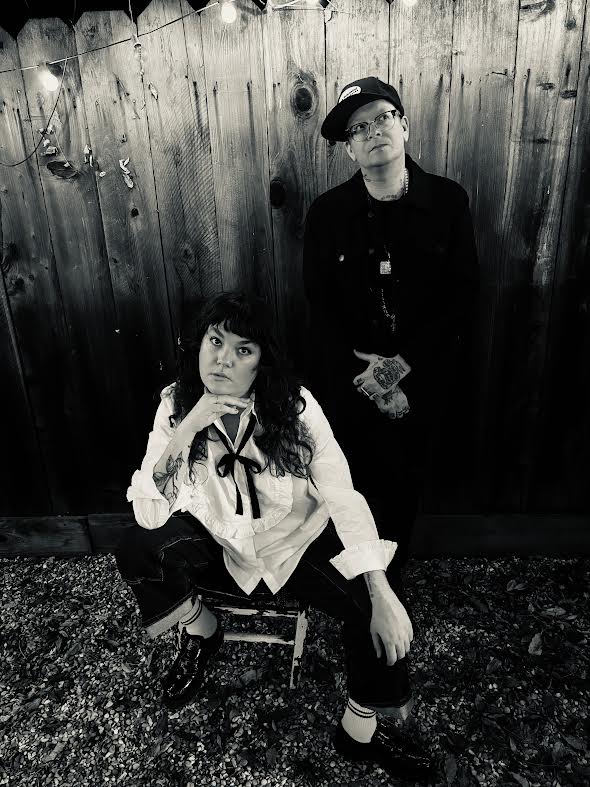
The characters populating The Great Degradation, the latest record from Micah Schnabel and Vanessa Jean Speckman, tend to exist on the fringes, the two musicians drawing vivid, three-dimensional portraits of the types who frequent suburban chain restaurants and haunt emergency rooms after hours. The types of people, in other words, that Schnabel and Speckman are likely to encounter criss-crossing the country by car as artists and musicians determined to eke out a living.
“Because of the ground-level touring we do, and because we’re in a vehicle driving ourselves around, booking our own shows, we see so much of this country, and we experience so much,” said Schnabel, who joined Speckman for an interview ahead of the pair’s full-band homecoming show at Rumba Cafe on Thursday, May 28, supported by Brian Damage and BeachKitty. “And we’re kind of tossed around where we might be at a suburban Chili’s for dinner, and then you go to the neighborhood where the club is, which is usually in the working-class, harder part of town. And then after the show we might go to a two- or four-star hotel, depending on the Hotwire deal of the day. … So, there’s a lot of material we get from being in gas stations at two in the morning.”
The two have a knack for bringing these folks to rich life in just a few sharply written lines. Witness the two characters who open “C.I. Hey!” by arguing over the appropriateness of smiling in one’s DUI mugshot – a conversation that in a few words manages to say volumes about the types of lives each has lived. Then there’s the protagonist at the center of “2P4P,” who bemoans working at a convenience store where the laundry detergent and razor blades are kept locked up behind plexiglass, but who also realizes their “shitty job” is the only thing preventing them from even worse outcomes. “I live in a death cult they call the USA,” Schabel sneers. “It gets a little more expensive every day.”
A donation powers the future of local, independent news in Columbus.
Support Matter News
“Enemy of the State,” written in the early stages of the Trump administration’s immigration crackdown, centers the kinds of blue-collar workers targeted by ICE, from the Motel 6 maid who scrubs away at cigarette-burned bathtubs in between silent prayers to the overnight cab driver pulled over by police for his complexion.
These collected frustrations boil over in “No X-mas Cards for Fascists,” where the down and out connect over triple dipper appetizers and a wariness of those politicians whose economic policies have driven an increased desperation in the many left behind. “It’s only a class war if both sides are allowed to fight,” Schnabel offers atop a prowling riff. “Otherwise it’s a massacre.”
While the songs might have been born in part from economic concerns and the frustrations that come with watching your country slide into fascism, they’re also buoyed by a sense of community, Schnabel and Speckman spiritually linking arms with the disadvantaged, the exiled, and the ignored.
“I think a lot of times we move through different socio-economic spaces, and we often feel overlooked or mistreated, and that comes back in our writing,” Speckman said. “But it’s also shining a light that everybody’s human, and everybody’s just trying to get through the day, and nobody’s status should be any different than anybody else’s.”
“Coming from where I come from, and having worked in the service industry myself, those are the people I know,” Schnabel said. “And I see that we are overlooked, that they are overlooked. And there’s a real joy in celebrating us, the people who serve the coffee, the people who deliver the pizzas. … It’s a moment to be seen.”
Though replete with characters living a fraught existence, the music itself is taught and muscular, Schnabel and Speckman buttressed by bandmates Jay Gaspar (guitar, organ), Jason Winner (drums), and Todd May (bass, synths), who curl together like five fingers into a fist. The urgency of the songs was further abetted by the nature of the recording, which took place over a trio of days last fall as Schnabel and Speckman prepared to relocate from Columbus to Santa Cruz, California – a move they discussed in detail in October. (At the time, Speckman described the move as a way “to triage the chaos,” buying the two additional time to regain their footing, assess the creative landscape, and figure out what might be next.)
And yet, rather than amplifying the chaos, Schnabel said the impending move lent the sessions a singular focus that months later he can recognize in the recording. “I can hear the laser-beam intention it took to get the thing over the finish line,” he said. “The studio is an intense place anyway, but when you know that if you don’t get it in the next couple of takes, then we’re going to have to sacrifice one of the songs we were intending to record, it just makes it more intense. And I can hear that intensity of focus.”
The sessions also helped the two to keep it together emotionally, giving them an anchoring point, or something over which they had a degree of control at a time when every other aspect of their lives felt up in the air. “It gave us something that wasn’t just going home and packing up our belongings,” Schnabel said. “And that was a huge mental and emotional safety net to keep us from collapsing.”
Though at times bleak – the protagonist in “2P4P” moves from professing they’re too pretty for prison to asking to be locked up as a means to escape modern realities – there in exists in spots a celebration of the moment, including the impromptu drum circle that inspires a brief moment of joy in “Bongos.”
“When I talk about the idea of abandoning hope, I mean the idea of sitting on the sidelines and hoping something will get better,” Schnabel said. “And once I abandon that, and it’s on the ground, what can I do right here, right now, that helps me and those around me a little bit? And even if that’s just laughing, or a little bit of joy in the moment, that’s enough. I don’t hope for a better day. I don’t hope for better things. I just try to appreciate what is right now.”
Author

Related Articles

‘You’re just trying to serve the song’: Get to know the backing band helping give life to the Ohio R&B Music Festival
LynMonty has spent the month listening to songs on repeat and charting out her bass parts in preparation for this weekend’s concert at Up Front Performance Space.
Kill Gosling rediscovers its joy on the way to ‘Super Plume’
The Columbus rock band will celebrate the release of its excellent new album in concert at Cafe Bourbon Street on Saturday, Sept. 26.

Keith Hanlon takes advantage of an unexpected layover to create ‘Music for Airport Workers’
The Columbus musician will celebrate the release of his new ambient album in concert at Old First Presbyterian Church on Friday, Sept. 25.