
Scott Short views old work with new eyes in No Place Gallery exhibition
The Columbus artist opens up about the evolving meanings he has uncovered in the career-spanning ‘Confundere,’ which will remain on view at the downtown gallery through Friday, March 28.
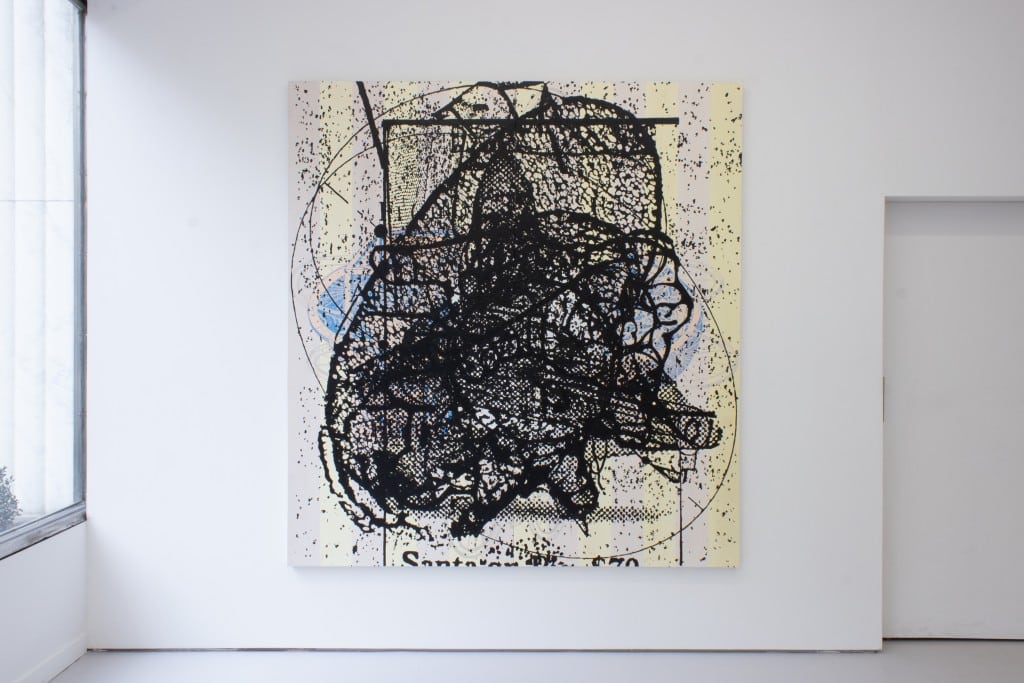
Much of the work by Scott Short present in “Confundere,” on display at No Place Gallery through Friday, March 28, has taken shape over the course of the artist’s lifetime – a reality that has allowed the large-scale paintings to continue to evolve and take on new meaning.
“The nice thing for me about this body of work, especially, is I’ve been thinking about this kind of thing for so long that I can tell you how I originally started doing it, I can tell you then what I started to think of it five years later, and I can tell you what I started to think of it five years after that,” said Short, who joined No Place owner/director James McDevitt-Stredney for a late March interview at the downtown gallery.
The seed for trio of more recent works on display in the main gallery, for instance, initiated from a series Short started as an undergrad at Ohio State University in the 1980s in which he explored the concept of appropriation, creating images by pulling photos from the library magazine archives and making photocopies of photocopies, allowing the machine to gradually degrade the print in the process.
A donation powers the future of local, independent news in Columbus.
Support Matter News
“The art department had this gorgeous Konica machine that just broke things down so beautifully,” Short said. “Eventually, though, I came to my wits end with that. … And I got to a point where I was like, ‘Okay, I have all of these images, now what do I do with them?’ Well, what if I just piled them up as trash? So, the first thought in painting these things one over the other is that you’re making a garbage mound or a landfill. And does their value somehow become reinvigorated in the act of throwing them away?”
As a result, the deeply layered paintings initially served for the artist as “a dustbin of history,” he said, incorporating crossed-out images of Ronald Reagan, dual portraits of Dr. Martin Luther King Jr., and a photo of John Cage lifted from the composer’s obituary, with Short layering this accumulated ephemera on the canvases until it became a visual blur. “At the core of the work is a sense of fragmentation – historical references collide with the contemporary condition, all distorted by the act of reproduction,” McDevitt-Stredney wrote in text accompanying the exhibition. “These elements mirror the fragmentation of modern life, where clarity and meaning slip through our fingers like sand.”
Owing to this splintering, Short continued to find new connections with the drawings as he returned to them at different points over the years.
“Something exists at a point that you make it, and then as time goes on, there are so many things where it’s like, ‘Oh, that’s there. I didn’t see that. That’s there, too. I didn’t see that.’ And that happens to me all of the time, where I think I’m working on this thing here but what I’m actually working on is this thing over there,” said Short, who now sees echoes in the work of the heartbreaking slide into dementia experienced by both of his parents, along with the genetic reality that he could one day experience the same fate. “When I started looking at the drawings again a couple of years ago, it was like, my god, this is my mom’s memory. The bits and pieces are there at the edge, but everything else is buried inside where she can’t access it. Then it becomes like, okay, dementia runs in my family. Am I actually looking at my future?”
The works have simultaneously continued to expand outward, McDevitt-Stredney said, growing to reflect the relentless and unavoidable nature of the modern social and political era. “Given the current geopolitical climate, where there’s this everyday bombardment of policy shifts, it’s becoming impossible to focus on everything at once,” said the gallerist. “So, Scott’s work being this compilation and just these piles of visual language atop of one another, we arrive at almost this Wall of Sound, I like to call it, where it’s this beautiful static. And even though it’s this cacophony of intense political rhetoric and things from throughout time, after a while some of the work becomes almost meditative.”
While Gallery A is given over to newer works, tucked deeper in Gallery B are a series of older studies, which comprise nearly two decades of Short’s practice and helped pave the way for the larger pieces that greet visitors to the space. While these newer paintings initially appear more gestural and expressive, the older images read as comparatively restrained, having emerged from an obsessively painstaking process in which the artist would take a piece of colored construction paper and photocopy it 200, 300, 400 times. Short described these efforts as “a game of telephone” in which the black and white reprints would gradually take on ghostly new life that he would then transfer with paint to large canvases in photorealistic detail.
“Because the machine can’t see color, it’s going to perform its function, which is to create a black and white image. And so, what happens is the machine ends up making a self-portrait of how it makes images,” said Short, who compared the resultant paintings with topographical maps capturing this process. “So, these are tough to see, but if you look at this [painting], you’re going to see these horizontals and verticals, and then you’re going to see diagonals. And what the machine is doing … is creating a series of Cartesian grids that are superimposed at angles. And the more you make these copies, the more that structure starts to come out. And then you’ll start to see diagonal lines, and you’ll start to see circles where the diagonals converge.”
Within the same space as these larger paintings exist a smaller series of prints that Short created while living in Chicago as a younger man. The artist recalled how he would visit a near north side Staples that had a printer capable of producing a beautiful black tone, and how he would hand cut watercolor paper to the appropriate size and run it through the machine over and over again until he had layered 20 different images one on top of another. Looking back, Short now views these pieces as reflective of the sense of overwhelm he felt at the time, as well as an attempt to sacrifice a degree of control and detach himself from the artistic process.
“Everything I’d been doing, I was trying so hard to control it, so it was like, you just have to let this go, make the copy, and let it be what it is,” said Short, who has since come to accept that his hand remains present even in his early attempts to obscure it. “I tried to be impersonal for so long, and I was trying to get myself out of the art. The problem is, anytime you erase yourself, you leave an erasure mark in the shape of your body, right? And so, it’s part of it. I’m part of it. And it’s just going to be.”
Author
Related Articles
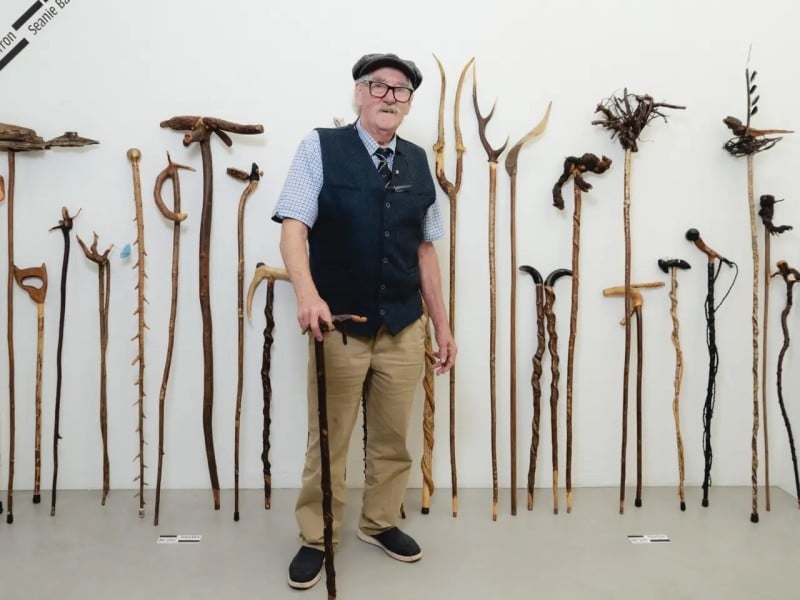
Take a leisurely stroll through the woods with Seanie Barron
The Irish artist’s new exhibition of hand-carved walking sticks kicks off at No Place Gallery with an opening reception today (Friday, Oct. 16).
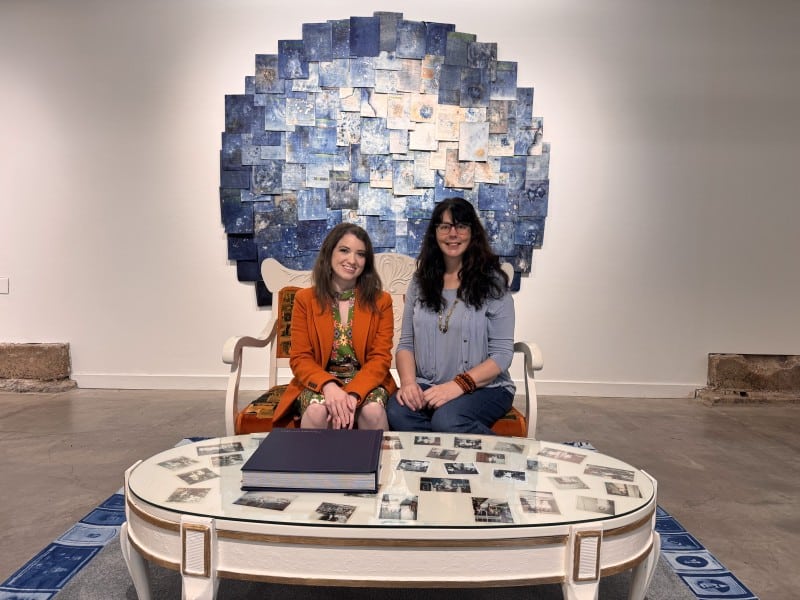
New Urban Arts Space exhibition opens up a conversation about death
‘Spirit & Dust,’ co-curated by Diane Callahan and Michelle Burdine, explores grief, loss, and the weight of mortality from a wealth of perspectives.
Scrawl meets Scrawl
Marcy Mays and Sue Harshe recently joined pioneering Urban Scrawl artist Dan Gerdeman for a conversation ahead of the band’s performance at the Franklinton art event that has been a longtime source of confusion for some of their fans.