
The past begins to crystallize for Tanya Kaiser
For her new exhibition, on display at 934 Gallery beginning on Friday, July 10, the Cleveland-based artist encased childhood objects in sugar crystals, intent on exploring the ways our culture consumes innocence.
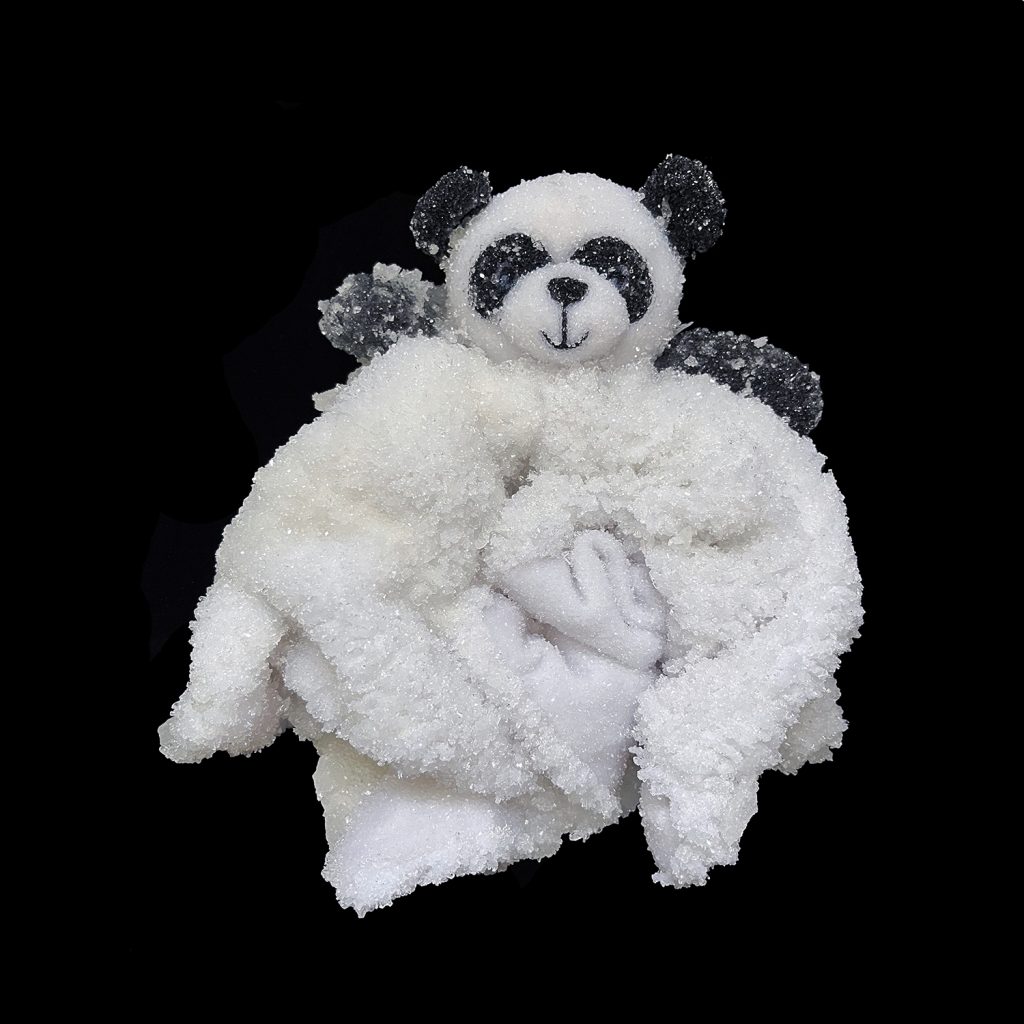
Tanya Kaiser first conceived of the idea for “Crystallized Innocence” a few years back, recalling how she began to wrestle with the idea that American society had increasingly moved to devour childhood innocence.
“Especially in this political climate, it’s something that’s not being protected. It’s something that’s being consumed,” said the Cleveland-based artist, whose new exhibition kicks off at 934 Gallery beginning with an opening reception from 6-9 p.m. on Friday, July 10, presented alongside works by Hannah Fitzgerald and Savannah Fout. “The big elephant in the room was the Epstein files. … Then the amount of child abductions in the U.S. is really concerning with how high it is. And the sexualization of children, of course. It just goes on and on, unfortunately.”
Building on the conceptual idea of something being consumed, Kaiser began to experiment with immersing childhood objects – onesies, stuffed animals, first communion gowns – in baths of sugar water for weeks at a time, allowing crystals to develop. The encased items were then placed in home-built dehumidifying chambers to dry, sprayed with a sealant, and set in wooden frames, the construction of which the artist compared with building coffins.
A donation powers the future of local, independent news in Columbus.
Support Matter News
“It really was kind of a mourning process,” she said. “And it’s very cathartic once I’m finished, because it’s almost this quiet ritual where I’m submerging it, I’m taking care of it and nurturing it, and then I’m building a box to mount it in its final resting place.”
Kaiser chose to work with sugar for a number of reasons, including the reality that it serves as a corrosive agent in contrast to its reputation as something sweet and indulgent. “There’s actually a darker side to it,” she said. “It’s toxic. It’s not a pleasant thing.”
It could also be incredibly finicky, forcing Kaiser to experiment with different temperatures and ratios of sugar to water in order to dial in the proper rate of crystallization. If the crystals formed too quickly, she said, the object would end up encased in a solid block. And if they formed too slowly, the crystals would reveal themselves as barely perceptible specks.
In the initial immersion process, Kaiser said she kept each object front of mind, lingering on questions that would shift based on the provenance of the item. In those cases when it was something either donated or picked up at a thrift store, these thoughts could be murkier, the artist asking herself where that child might be now, and if they were living a good life. In those cases when the item came from one of her children, including her son’s former onesie, these ideas could be more concrete.
“Because then you start reflecting on your own life, or your children’s lives, both the good times and the harms they encountered,” said Kaiser, who described similar thoughts surfacing when she saturated the first communion gown handsewn by her mother and worn by the artist as a child. “And that felt like a very full circle moment. This is something my mother made for me with love, and then it sat in my closet, and now it has been given new life.”
Having grown up in the Catholic Church, Kaiser said religious iconography has long played a role in her work, as have those political forces that like the church seek to restrict access to women’s health care. One earlier body of work, for instance, featured ceramic sculptures made from castings of the Virgin Mary that were then modified to resemble different vaginas and other parts of the reproductive system.
“Most of my work is a personal narrative, but it’s motivated by politics and our rights being stripped back,” said Kaiser, who traced her initial interest in exploring these concepts to the anger she felt in navigating the U.S. health care system when she gave birth to her first child. “I realized then how our health is not really prioritized. And that’s really what motivated me. I think with most creative people, we’re trying to express something. … There’s this idea of just getting it out of our bodies and into the world, which I think is a form of birth in itself.”
Author
Related Articles

Nick Stull adopts a quieter approach
With his latest collection, on view at Sarah Gormley Gallery beginning today (Friday, Sept. 11), the Columbus artist hopes to entice viewers to linger a little longer in his world.
Melissa Vogley Woods slows things down for ‘When the Earth Bends we Bend’
The artist’s new exhibition opens at Brandt Gallery on Friday, Sept. 11.
Jeff Hazelden presents different views of adulthood
For his new book, ‘these are adults,’ the Columbus photographer surveyed six locals on what it means to grow up, embracing the project as ‘a celebration of the different ways we navigate life.’