
‘We were once a school that allowed voices on campus. Now, no voices are allowed.’
Compared with protests at neighboring colleges, the administrative crackdown on the 2024 pro-Palestine encampment at Ohio State stands out for its severity, causing reverberations that continue to this day.
The crowd moved as a single body, chanting in unison. Flags waved in the soft April wind as the sun set behind the mass of people. Children raced through the crowd, giggling as they weaved between rows of demonstrators.
At the center, a woman stood with a microphone in hand, her voice carrying above the throng as she led the protest forward.
Heba Latif, then-president of Students for Justice in Palestine (SJP) at Ohio State University, quickly became one of the most recognizable figures in the local pro-Palestine movement that peaked in 2024, drawing both admiration and intense scrutiny.
A donation powers the future of local, independent news in Columbus.
Support Matter News
During her leadership term, Latif spent countless sleepless nights fielding messages, organizing teach-ins, and navigating mounting pressure as protests escalated across campus amid increased national attention.
Salma Hamamy occupied a similar position 183 miles away, serving as the president of Students Allied for Freedom and Equality, or SAFE, at the University of Michigan.
Similar leaders emerged at 525 American educational institutions as the pro-Palestine movement expanded nationally, according to the Crowd Counting Consortium.
And yet, despite surface-level similarities between the two large, state-funded public universities, the administrative reaction to encampment attempts varied drastically. At the University of Michigan, student encampments remained in place for 30 days. At Ohio State, the encampment was dismantled within six hours.
When fewer protests lead to more arrests
The Crowd Counting Consortium, a joint project of the Harvard Kennedy School and the University of Connecticut that compiles publicly available data on protests across universities in the United States, compared protest activity at three key institutions: Ohio State University, the University of Michigan, and Oberlin College.
An analysis using the collected data showed Ohio State among the top universities when it came to the number of arrests, with 40 reported arrests at pro-Palestinian demonstrations that took place between Oct. 7, 2023, and May 29, 2024. (Editor’s note: Hana El Nemr, one of the authors of this piece, was among the demonstrators arrested and charged with trespassing at Ohio State on April 24, 2024.)
“Ohio State has an ironclad commitment to free speech and supports the right of students, faculty and staff to speak out about issues that are important to them,” an OSU spokesperson said in a written statement. “The university’s space standards protect free speech rights while preventing disruption of the university’s daily work – education, research and patient care. The space standards prohibit encampments.”
The University of Michigan ranked fifth nationwide in total pro-Palestine encampment days and fourth in overall pro-Palestinian protest days between Oct. 7, 2023, and May 29, 2024. Oberlin College ranked 16th nationwide in total pro-Palestine protest days but did not rank for encampment days. Ohio State did not rank in the top 30 universities nationally for either of encampment days or total protest days.
Arrest data tells a different story, however.
The University of Michigan ranked 27th in the country for arrests at pro-Palestinian actions, with Ohio State close behind at 28th – this despite the Michigan encampment having extended almost 30 days longer than the one erected briefly at OSU. Oberlin College went unranked, with zero recorded arrests.
The buildup at University of Michigan
In the weeks and months before encampments appeared on the Michigan campus, organizers pointed to an increase in smaller actions and meetings, along with a growing frustration that set the stage for larger demonstrations.
“An encampment doesn’t typically just sprout out of nowhere,” said Hamamy, the former president of SAFE and a 2024 University of Michigan graduate in biology, health, and society and Middle Eastern and North African studies. “In order for us to even reach that point, we had to have been building a movement on our campus.”
At the University of Michigan, organizers made repeated attempts to raise concerns through official channels before the demonstrations escalated. SAFE, backed by Tahrir Coalition – a group of more than 80 student organizations supporting Palestinian liberation – emailed multiple university officials requesting a meeting but received no response.
“We initially reached out to them as 13 student orgs, then 23, and then 30, and then 46, and then 60, and then 70, and then 80. And we would sign our orgs in our emails every time and there was just no response,” Hamamy said.
When emails went unanswered, organizers turned to public meetings, but said those efforts were also unsuccessful.
“We attempted on numerous occasions through different means to meet with the Board of Regents, and with every attempt they shut us out,” Hamamy said. “Even when we were there for their public board meeting … where you’re supposed to allow your students, your alumni, your community, your faculty to come and speak, they would purposely try to change the timing of that last minute.”
Organizers said security measures at the board meetings also intensified, with several students arrested when they attempted to speak, further narrowing what they described as the remaining pathways for civil protest.
Pro-Palestinian organizers said that these restrictions felt specifically targeted at them due to the content of their speech.
“[The university’s] reactions were certainly hypocritical, heavily based and rooted in Islamophobia and anti-Palestinian hatred,” Hamamy said. “We were not given the same access as, for example, Zionist students. We were not given the same support. We were not given the same platform by any means. Their response was always to isolate us and put us in the category of the other or the minority.”
Tensions escalated again in November 2023 when a sit-in at the Ruthven Administration Building was met with what Hamamy described as an unprecedented police response. “I think there were maybe 13 different precincts of police officers, and they came from all over Michigan. There were at least 100 police officers that came,” Hamamy said. “The Ann Arbor city has never looked that packed with police officers.”
Restrictions were also placed on the protest, with officers stationed at the entrances to block water from being brought into the building, Hamamy said. The protest was eventually broken up by a surge of police officers in riot gear, according to The Michigan Daily, and 40 people were arrested at the demonstration.
Hamamy said the police response was the turning point that ultimately led to the decision to begin an encampment, citing the administration’s continued refusal to engage in dialogue as the most significant factor in the escalation of demonstrations.
“I believe if the university had taken the right steps very early on and they would have done what was morally required, what was morally just, then what they called the ‘uprising on campus’ would have never occurred,” Hamamy said. “The uprising occurs when it’s deemed necessary, and when there’s no action being taken. People put themselves on the line and they risk things because they find them to be necessary, and because they find the response of those in power to be morally abhorrent. Had the administration taken proper steps and heeded the students’ demands, then protests certainly would not have been in the magnitude we saw.”
University officials declined to comment directly on the events, instead providing a link to the University of Michigan’s guidelines on campus demonstrations.
The buildup at Oberlin College
At Oberlin College, a similar tension had developed.
Students for a Free Palestine (SFP) hosted multiple demonstrations and sought dialogue with administrators as tensions increased on campus. Nearly 100 students participated in a “die-in,” a form of protest similar to a sit-in, at Cox Administration Building, demanding divestment from Israel and a public acknowledgement of Israel’s genocidal assault on Palestine, according to The Oberlin Review.
Zane Badawi, a Spring 2025 graduate in anthropology, was involved in the pro-Palestine movement at Oberlin College. He was also a journalist for The Oberlin News, where he wrote about his experiences as a Palestinian at Oberlin.
In contrast with the University of Michigan, the sit-in at Oberlin did not result in arrests or the use of force by police. Instead, administrators agreed to meet with organizers to discuss their demands, though Badawi said those demands were never met.
“When it comes to activism, we prioritize dialogue between students, faculty, and staff. This was true during the encampment that occurred on campus, and we had productive dialogue throughout. As a private institution, we have differing responsibilities regarding speech than a public institution, but we still prioritize the free exchange of ideas as a tenet of our mission,” Thom Julian, senior associate dean of students at Oberlin College, said in an email.
Despite active opportunities for dialogue, student organizers at Oberlin decided to host an encampment to push demands for divestment and a public statement condemning Israel’s genocide in Gaza, which had not been provided after conversations with administration. At that point, several encampments had sprouted nationally, pushing Oberlin organizers to join the movement.
“I do think the main thing was just following the national trajectory. It happened sort of late Spring of 2024 and by that time, most of the major encampments across the country had been established already,” Badawi said. “Without those, I don’t know if it would have happened. There was a very noticeable lack of response from Oberlin about the genocide that I think contributed to that anger and eventually led to the encampment.”
The buildup at Ohio State
Two hours away, that national trajectory was reaching its boiling point at Ohio State. Prior to tents appearing on the South Oval, however, Latif, the former president of SJP and a spring 2025 OSU graduate, said tensions had been building quietly for months.
Latif described weekly meetings with administrators in which students reported threats and harassment, submitting repeated documentation that she said went unanswered.
“We’ve had probably one to 30 meetings with Student Life. Once a week we would discuss how we felt unsafe,” Latif said. “That we’re not able to practice our freedom of speech without getting death threats and getting death notes and getting death mail. I submitted over 50 reports, nothing. They told us that they were going to take care of it. They told us not to worry, but they never did anything about it.”
Despite growing tension between student organizers and administrators, Latif said SJP board members made a consistent effort to notify Student Life ahead of demonstrations, sending emails before each planned action.
“They always knew when we were doing something,” Latif said. “They were always told we were doing something, in the specific spot, at the specific time, so they can’t say we never gave them a heads up.”
On Nov. 6, 2023, then-acting President Peter Mohler issued a campus-wide email condemning hate following reports that two Jewish students had been spit on near campus. Latif said the university’s public response to that incident contrasted with her experience in reporting threats, which she said went unaddressed. “They made us feel alienated,” she said.
Seeking a formal channel to express student demands, organizers drafted Issue 29 – a student ballot initiative that called for divestment from Israeli weapons manufacturers and Israeli bonds. Latif said the group spent months working alongside legal advisors to ensure the proposal met university requirements.
“We were bringing in lawyers. We were bringing in like legal advisors,” Latif said. “Everyone was studying this document like it was their whole life, right? Because we wanted to make it perfect so they don’t have an excuse to deny us.”
Despite these efforts, Latif said organizers woke up to an email informing them that their issue had been removed from the Undergraduate Student Government (USG) ballot. “I remember waking up to it and just knowing that they knew it was going to pass,” Latif said. “Why else would they go to such great lengths?”
According to Lantern reporting, then university President Ted Carter Jr. reached out to Attorney General Dave Yost for advice on what to do with the ballot initiative. Attorney General Yost’s office responded and said that divestment would break Ohio law.
University officials said that under Ohio Revised Code Section 9.76 public universities and other state agencies are prohibited from boycotting or divesting from Israel. Latif said organizers were aware of the law but believed the ballot initiative still served an important purpose as a way to measure student opinion.
“The administration’s reason why they took it down was because it’s against Ohio’s law to boycott and divest from Israel anyway, but that’s not the point,” Latif said. “The point of having the issue on the ballot was to represent … what the students thought.”
Despite appealing the decision three times, Issue 29 did not make it back on the ballot that election cycle. Latif said the administrative overreach had already prompted the need for escalation, but when two students were arrested at a pro-Palestine demonstration on April 23, 2024, it signaled a clear turning point in tensions.
“That’s when I realized that we are kind of in a state of aggression, and I think they sensed that we were planning something bigger,” Latif said. “I think this was kind of like a warning to us, like, ‘Hey, guys, if you want to plan something bigger than this, then this is what’s going to happen, and that’s going to be you.’ Police were everywhere all the time, no matter what we did. But they never, ever touched any one of us. And they never once arrested us.”
The Oberlin encampment
Badawi participated in Oberlin’s encampment, which was significantly smaller than the encampment at the University of Michigan and the attempted encampment at Ohio State. Teach-ins, libraries, and group events helped create what Badawi said became a “community center” atmosphere within the encampment, which lasted roughly two weeks before dispersing voluntarily. Throughout its duration, there were no publicized arrests or formal disciplinary actions.
“There was sort of an open space, and in two patches of grass there were probably 10 to 20 tents,” Badawi said. “It was small – organized by SFP. There were a few people who stayed overnight, but because the administration wasn’t super hostile to the encampment, we didn’t necessarily have to guard it. I know a lot of students on other campuses did.”
Badawi attributed the relatively calm experience in part to the administration’s openness to student dialogue. Thom Julian, Senior Associate Dean of Students at Oberlin College, said in an email that the administration prioritized communication with students.
“When it comes to activism, we prioritize dialogue between students, faculty, and staff. This was true during the encampment that occurred on campus, and we had productive dialogue throughout,” Julian said.
The University of Michigan encampment
The Michigan encampment was large, diverse, and well-sustained, drawing on students from nearly 100 different organizations.
“We had the largest coalition to ever exist on our campus with nearly 100 student organizations from all walks of life,” Hamamy said, referring to the Tahrir Coalition at the University of Michigan.
Even during the encampment, the organizers continued to contact the administration in hopes of engaging in meaningful dialogue. Instead, they were met with similar silence as before the encampment. “They weren’t very communicative or open or very interactive whatsoever,” said Hamamy, who added that the primary demand of the encampment was for the university endowment to divest from direct and indirect investments in Israel.
Similar to Oberlin, Michigan’s encampment did not face police interference in its early stages. That changed on May 21, 2024, when authorities moved in to dismantle the encampment.
“They came in full riot gear; they came with batons; they came with a chemical spray called deep freeze which is a mix of tear gas and pepper spray. It’s the highest possible grade they can get their hands on as police officers,” Hamamy said. “And when they came to raid the encampment, there were rows and rows of them, ready to quite literally charge through us.”
Hamamy said the raid occurred at a time when fewer students were present, which she described as being done strategically “to try to minimize pushback that they would receive.”
The encampment was forcibly dismantled, and four students were arrested at the scene. In the weeks that followed, seven more students faced felony charges ranging from trespassing to obstructing police. These students, including Hamamy, later became known as the “Encampment 11.”
Hamamy said the felony charges were pursued after the encampment and were requested by the Board of Regents and carried out by the state’s attorney general. And though the charges were eventually dropped and the students’ records cleared – a process Hamamy said took about a year – long-term impacts remain.
“It really stays online. It’s public. If you search up our names, you will see. For example, I have the state of Michigan versus Salma Hamamy,” Hamamy said. “In the future, if somebody sees that, or if an employer sees that, they’re going to ask why.”
The Ohio State encampment
Unlike Badawi, Hamamy and Latif said they struggled to speak directly with administrators, instead being redirected to various campus offices when they weren’t ignored entirely. This consistent lack of response contributed to the rise in tensions and the eventual formation of encampments.
“It was just building up frustration, and I think it wasn’t just OSU. I think it was all universities nationwide. We were all dealing with the same type of frustration, and we didn’t know how we could present it,” Latif said. “I think that’s why the encampment really happened is because of the administration from all the universities just cracking down on students, silencing students.”
The Ohio State encampment was established on April 25, 2024, with organizers demanding financial divestment from Israel, financial disclosure of university investments, and acknowledgement of the genocide in Palestine, said Latif, who added that SJP made a space reservation for the South Oval prior to the encampment. “We made sure to make a space reservation for an art installation on the South Oval, so once again, even in the highest form of civil disobedience, we tried doing things the ‘right way.’”
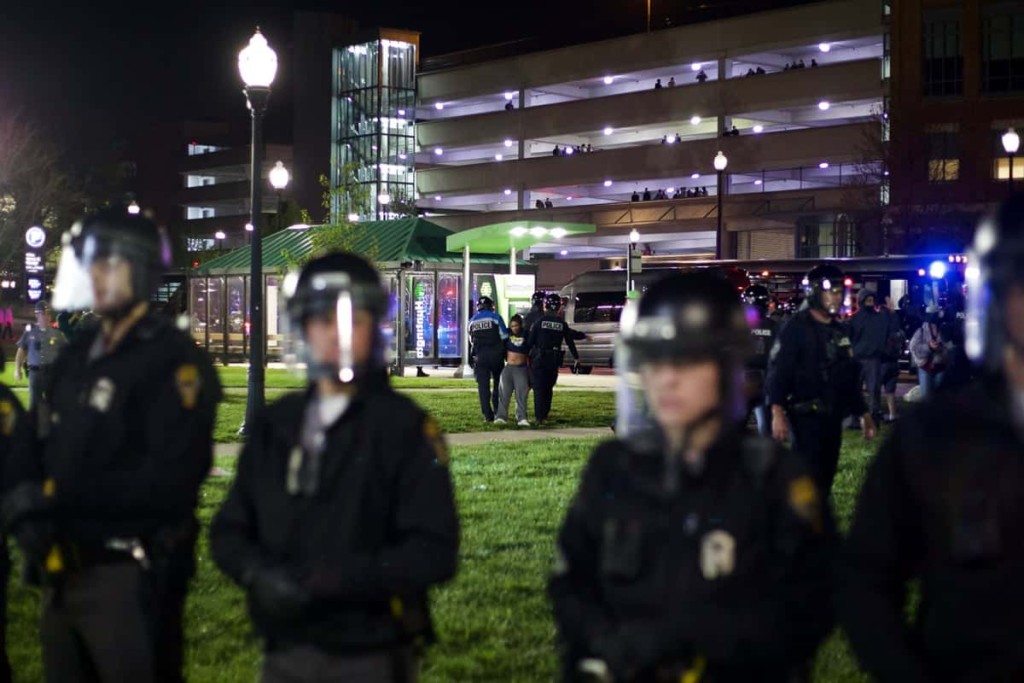
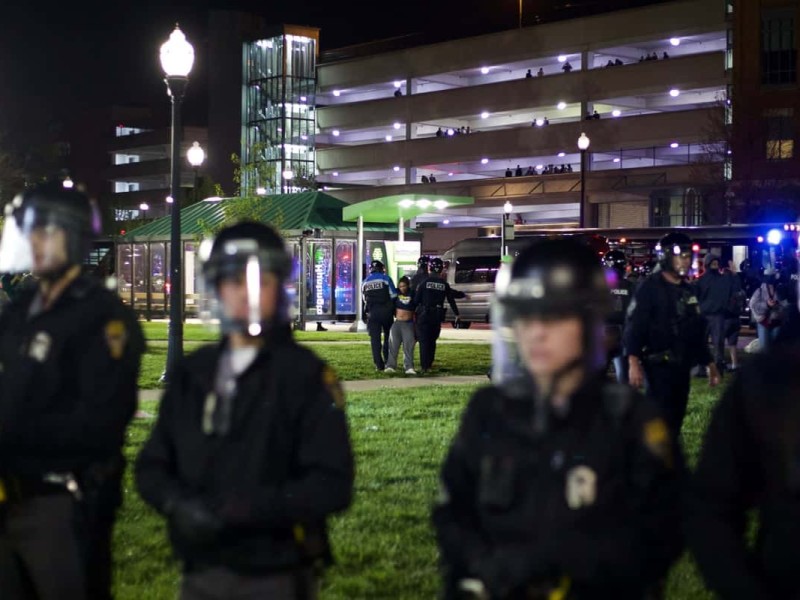
Latif said when the encampment began, the university responded quickly with a visible police presence. Officers from the Columbus Division of Police were deployed in riot gear, supported by aerial surveillance, as administrators moved to clear the demonstration site.
“CPD was there in full-on riot gear. I could never forget that,” Latif said. “I never expected them to do what they did. They literally had full on riot gear, pushing, slamming into people – innocent people who were just standing there … [and] not doing anything violent. We were doing everything peacefully.”
The encampment had been raided after only six hours, and 36 people, including 16 Ohio State students, were arrested.
In the days following the arrests, Latif said communication from administrators declined sharply. Prior to the encampment, she said student organizers had received regular outreach from university officials, but that communication ceased in the aftermath.
“After the encampment, silence,” she said. “It felt like they viewed us not just as students anymore, but as their enemies.”
In the wake of the demonstration, the university implemented additional restrictions governing protest activity, including limits on amplified sound and crowd-based demonstrations, as well as a ban of on-campus chalking. Heba said these changes have significantly altered the campus protest environment.
“After the encampment, rolling into that new semester, they implemented new rules – no microphones, no loud voices, no yelling,” Latif said. “We literally could not do anything.”
Students also raised concerns about revisions to rules governing temporary structures, including tents. Latif said language prohibiting tents was added shortly after the encampment. “In their student code of conduct, there was no mention of tents,” Latif said. “Then after two days, they added ‘no tents allowed.’ That means it was technically allowed – and then they made it illegal after the fact.”
Two years after the encampment, Latif said the effects of the university’s heavy-handed response have continued to shape campus activism.
“You probably see that SJP and a lot of protest efforts have died down. The reason is because of what happened after the encampment,” Latif said. “We were once a school that allowed voices on campus. Now, no voices are allowed.”
Related Articles
The rapid origination of Andy’s Law
Tensions between guards and the incarcerated at Ross Correctional Institution went from bad to worse following the 2024 murder of corrections officer Andy Lansing. Now, the prison could serve as a restrictive model of what’s to come under consequential House Bill 338.
Flock is on pause. What about all that other surveillance tech we use?
Columbus has had a contract with Shotspotter, an AI-powered gunshot detection microphone system, since 2018.

Opinion: Flock cameras won’t make us safer. Here’s what will
Flock Safety, the company behind the cameras, obstructs any attempt to establish guardrails, accountability, or transparency. Amazon is no one’s model for corporate responsibility, and even it cut ties with Flock.