
Big Fat Head has some questions for you
The inventive Columbus collective will celebrate the release of new album ‘Global Voyeur’ in concert at Rumba Cafe on Friday, July 24.
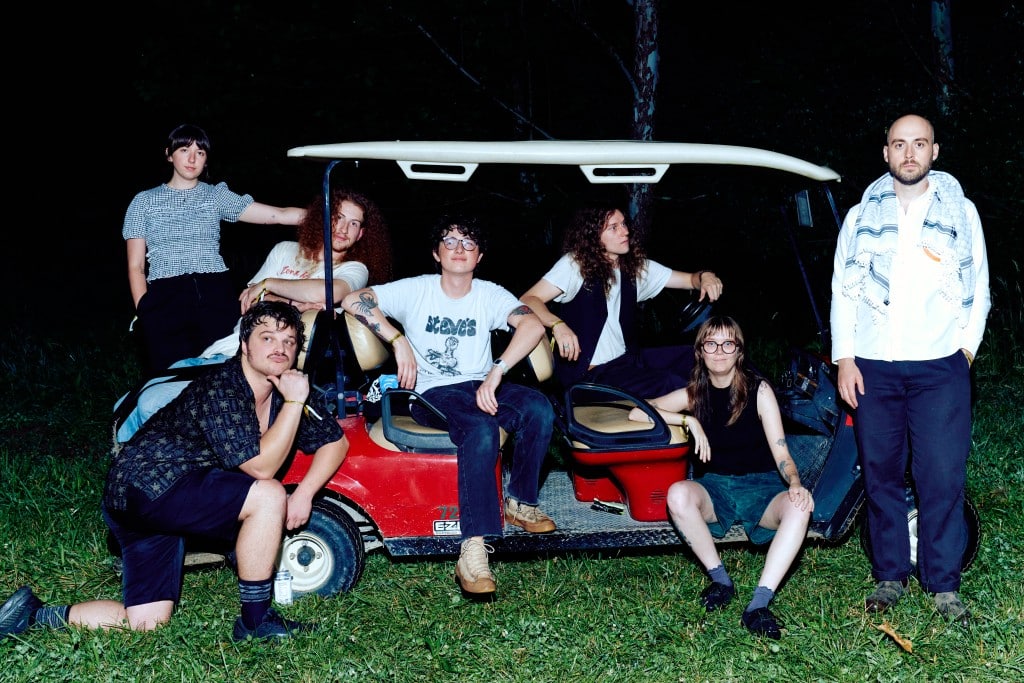
From the initial spark of creation, the members of Big Fat Head realized that the track “Questions” was something different, both in terms of its overall vibe – “It felt more vulnerable than a lot of our other songs,” singer and guitarist Nate Wilder said – and in how it took shape in the studio.
“That was one we really hadn’t gotten to practice a lot going into [recording], and so it left a lot of room to experiment,” said singer and bassist Olivia Stefanoff, who joined Wilder for an early July interview ahead of the release the band’s new record, Global Voyeur, which the musicians will celebrate in concert at Rumba Cafe on Friday, July 24, joined by Long Odds (also playing behind a new album), Xenia Eloise, and Brian Damage.
The recording of the track started with Wilder singing and playing guitar, with Stefanoff then joining on vocals. From there, other members of Big Fat Head gradually stepped in, the band deploying what Wilder described as “a building block approach,” gradually incorporating strings, keyboard, saxophone, and even piano.
A donation powers the future of local, independent news in Columbus.
Support Matter News
“We got one or two good takes, and then immediately were like, ‘Okay, what are we going to add on?’ And Jordan [Latas] was like, ‘Alright, let’s do the piano.’ And the engineer [John Hoffman] was like, ‘Goddamnit, are we really going to use this piano?’” Wilder said, and laughed. “And so, it felt pretty improvisational at moments, but it also felt very structured. … And it just felt like a different way to build a song, rather than being like, ‘1, 2, 3, go!’ and then we’re all blasting in the living room.”
Early in the making of Global Voyeur, the musicians said they viewed “Questions” as one of the record’s bookends alongside the album-opening “Kicking My Own Ass,” a loosely psychedelic surf-rock ripper that Stefanoff previously described as “that battle between getting down on yourself but then also wanting to press on because it’s worth it.”
“The whole album is trying to bridge the gap between those two songs, in a way,” Wilder said. “With the sonics but then also with the lyrics and the themes, because those were at the front of my mind in terms of what we kept and what was left out.”
At the time when Big Fat Head released its 2024 album Bobo Rising, my oldest daughter, now 9, said the musicians must have chosen the name because the band needed something to contain “their big fat brains.” The literary and philosophical concepts explored within the group’s latest bear this quip out, with Wilder penning tunes inspired by René Descartes’ Meditations on First Philosophy and Theseus’ paradox, a thought experiment that questions if an object can remain the same if all of its components are replaced one by one over time.
“Questions,” in turn, interrogates the idea of moral absolutes. “And still I have to wonder/Why do fish swim that way?” Wilder sings. “And what are good intentions/And which one leads the way?”
“Really, there is no moral rule in the end of things. Nobody likes killing, generally, but there are also plenty of times people find ways to justify it. So, if that’s not a rule, then nothing is,” Wilder said. “I mean, these are just ancient questions, and a lot of the album is dealing with the skepticism that keeps getting brought on by everything. I don’t know how to put this in words, necessarily, but the tract of our global political structure is that World War III has already started and will never end, and everything is propaganda. And so, the album is a weak attempt to grapple with these complex questions by asking the most simple ones possible.”
At their core, Wilder said these myriad surfaced questions could essentially be distilled down to a single query: Why are you thinking about what you’re thinking about? “And if there isn’t an easy answer,” he said, “then you’re probably leading yourself astray from something you’d enjoy a lot more, and that could offer you more fulfillment.”
It’s probably worth pausing to note here that the musicians marry these often-heady ideas to their best and breeziest batch of tunes yet, the collective crafting an effortlessly hypnotic, deeply textured amalgamation of art-rock, psychedelia, and melodic punk that is increasingly buoyed by the earworm vocal harmonies weaved by Wilder and Stefanoff. Where previous album Bobo Rising – one of my favorites released that year – traversed a wide sonic terrain in a way that suggested a group still trying to figure out what it could be in time, Global Voyeur feels like the work of a band that has fully come into its own without sacrificing any of this malleability.
Witness, for one, the way the punkish “Olivia’s Song” bleeds into the lush, dreamlike “Never Seen My Homeland,” a tune rooted in a longing for real-world experience in lieu of digital pacification. “There might be so much stuff that you might not feel bold enough to go out and actually experience because you’ve already quasi-experienced it … through your phone,” Wilder said. “And there’s a loneliness that’s wrapped up in all of that.”
Sessions for Global Voyeur took place in the fall of 2024 at the Lodge, a repurposed Masonic Temple located just across the Ohio River from Cincinnati in Dayton, Kentucky, falling at the end of an international tour (the shows included dates in Canada) at a point in time when things within Big Fat Head felt somewhat fractious.
“We were pretty burnt out, and we went in there like, ‘Let’s just document everything we’ve been working on before we forget it, because if this is the pace it’s been going then who knows what tomorrow will bring?” said Wilder, who described the compacted sessions as the band’s attempt to mirror those captured in the Beatles’ documentary “Get Back.” “When you watch that, you basically feel like you’re locked in a room with the Beatles for five days. And we tried to emulate that by going into the studio on Friday … and getting it all done in a weekend.”
Throughout the recording, the musicians frequently traded off instruments, meaning there are points on the record where no one is quite sure who played what. This is true of the drums on “YesYesYes,” which were captured in the wee hours on Sunday and have since left each member of the band pointing at someone else as the person behind the kit. “Almost like the Spider-Man meme,” Stefanoff said.
“The band was really founded on the idea that we’re not playing the instrument we’re most comfortable with anyway,” Wilder said. “And it was cool on this record to get back into the headspace.”
“There aren’t rules you have to follow,” Stefanoff said. “Not every song on an album has to be the same way. … We can do it all if we want to.”
Author
Related Articles

Chlorine’s Joseph Mangum lets his memories bleed through the page
The Kentucky band joins a stacked lineup at Rambling House on Thursday, Oct. 15, performing alongside the Dolphins, Son of Dribble, and Calico Boy.
Villagerrr’s Mark Scott would gladly hop off the industry ‘Carousel’
“I was getting a little frustrated with feeling responsible for promoting the album, because putting yourself out there, it’s not the most comfortable thing for a lot of people, and it definitely wasn’t for me.”
Liteweight Champion survives the fire
The Columbus rock band will celebrate the release of new album ‘Geronimo Hardstyle’ in concert at Dick’s Den on Friday, Oct. 9.