
‘Pulp Stiction’ joins the resistance
A deeply compelling new collage exhibition brainstormed and curated by Emily Morgan opens at Hopkins Hall Gallery on Monday, Oct. 26.
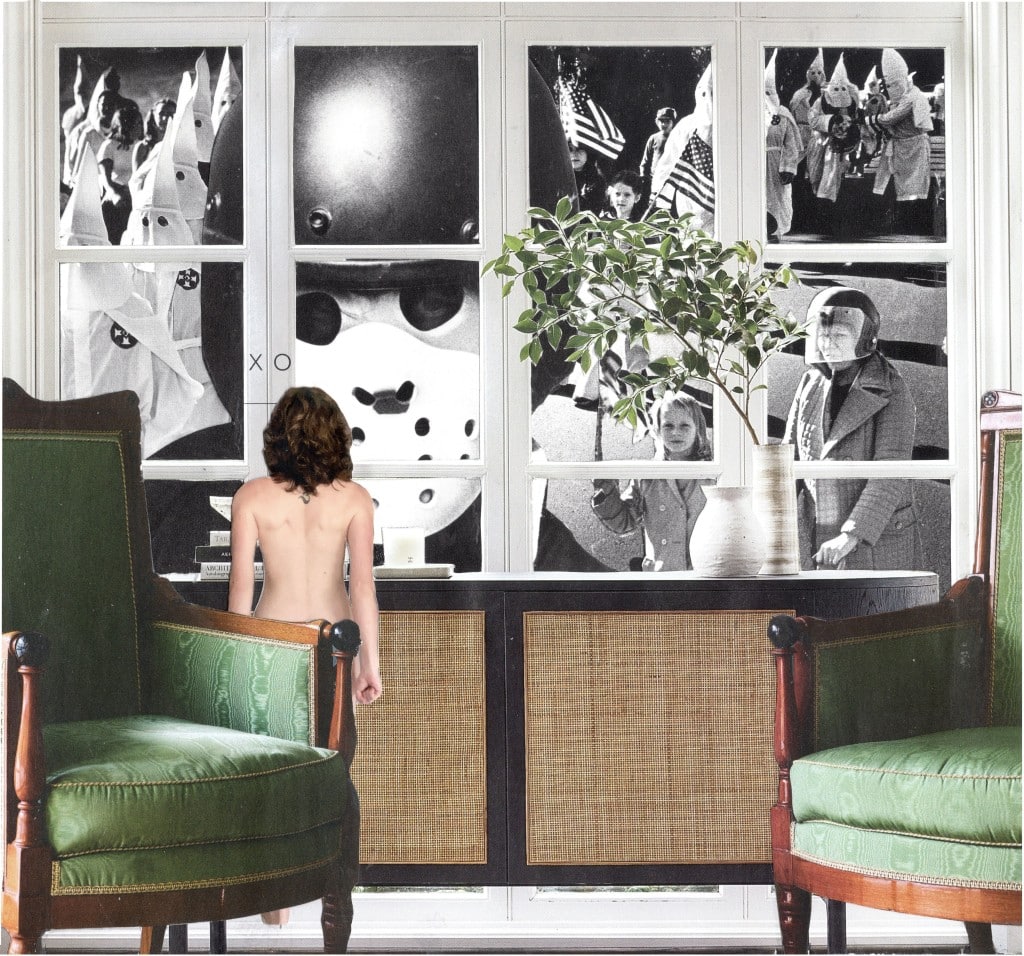
In the immediate aftermath of a 2024 election that saw Donald Trump return to the presidency, Emily Morgan, aka Lovely But Dead, said she felt completely lost.
“I didn’t know what to do, and I was in a really dark place, and I just could see any light at the end of the tunnel,” the artist said earlier this week at Hopkins Hall Gallery, where a new collage exhibition she brainstormed and curated, “Pulp Stiction,” opens on Monday, Oct. 26. “And the only thing that brought me out of it was making art.”
“Mother of Sorrows,” the first piece to emerge in those depressive early weeks, captures the anger and emotional rawness of that moment, with Morgan, whose work usually features meticulous cuts done with an X-Acto blade, incorporating rough-edged images of the Virgin Mary torn by hand from the pages of books and magazines. The canvas is also splattered in red paint (as still are parts of Morgan’s studio), the assembled pictures curled up and around the figure of a woman and over her mouth, as if to silence her.
A donation powers the future of local, independent news in Columbus.
Support Matter News
“But she still has her crown, so she still has her power even if she feels a little powerless in the moment, or a little voiceless,” Morgan said. “And obviously I’m not the only one processing this through art. So, then it was like, there has to be other work out there we can share.”
That thought served as the jumping off point for “Pulp Stiction,” an exhibition featuring nearly 70 collages from across the globe (26 states and seven countries are represented), all united around a single idea: resistance.
Going in, Morgan anticipated the bulk of the submissions would in some way speak to this political era. She was pleasantly surprised, however, at how the more open-ended theme drew out works that confronted a diversity of issues, including caregiver fatigue, Covid-era isolation, chronic illness, and the struggles that come with being a closeted queer kid left to explore their identity in secret. That’s not to say, of course, that there aren’t myriad contributions addressing dominant headlines – note contributions such as “Fuck I.C.E.” and G.E. Vogt’s “American Observer: History,” which speaks to the white supremacy that continues to exist at the core of the American project – but the diversity of exhibitors pushed both the conceptual bounds of “Pulp Stiction” as well as the art of collage itself.
Dayton-area artist Brett Nickell, who happened by the gallery to drop off artwork in the course of my early afternoon conversation with Morgan, expressed to her his interest in “trying to take collage to new places.” Fittingly, his piece, “Maximim Flux,” barely read as collage at first glance, embedded with schematics and blooms of color that to me loosely mirrored the work being made by Stanley Donwood circa OK Computer. Elsewhere, there’s a three-dimensional paper jacket constructed by Columbus artist Tim Rietenbach, a deeply layered, double-sided piece carved into the pages of a book by Ben DiNino, and a digital collage centered on the evolution of the Los Angeles River that will screen in an adjoining room within the gallery.
“It’s a video of the LA River and it’s all analog and stitched together,” Morgan said. “I don’t think I have a very academic definition of collage. I think collage can be whatever you want it to be. It wraps its arms around everything that sort of sits outside of traditional art.”
If there is a thread uniting the work beyond speaking to some form of resistance, it’s an overall weightiness, with the bulk of the artists utilizing paper and/or assorted found objects to craft pieces that serve as concrete-heavy commentaries. “If Not Now, When?” by the artist Helen O’Donnell, combines bullets and crayons alongside illustrations of children – imagery that would have resonated even if an Oregon teenager hadn’t opened fire in a special needs classroom just days before I visited the gallery, killing four.
“In the exhibition statement, the opening line is ‘this is not a nice exhibition,’” Morgan said. “It’s not the art you pick up and hang at your grandparents’ house. It is the kind of art that is expressive and visceral and sad. … But even within that, there were artists who kind of took some of those heavy things and turned it into something hopeful. … There was one artist who spoke specifically about collage being an act of resistance, being an act of joy. And they said, ‘The world wants me to feel afraid, and collage helps me out of that.’ And I think that can go with any art, right? It’s just a matter of finding your way there.”
Author
Related Articles
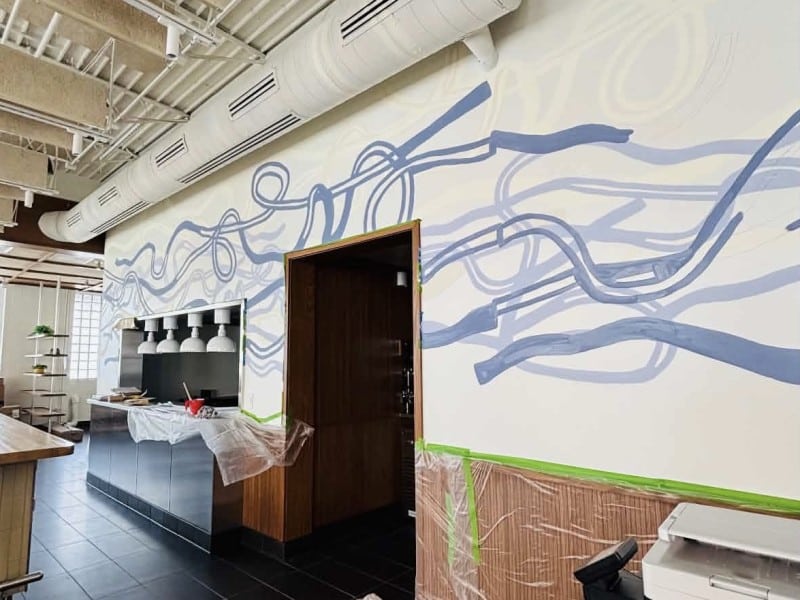
Andrea Myers comes full-circle with progressive mural at the Line
The Columbus artist once took drawing classes in the building that now houses the new restaurant and hospitality training center founded by Service!
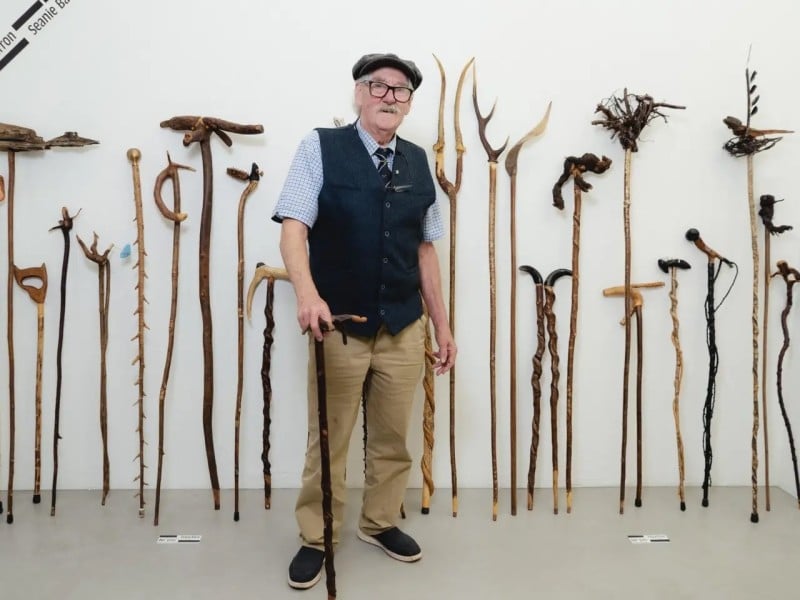
Take a leisurely stroll through the woods with Seanie Barron
The Irish artist’s new exhibition of hand-carved walking sticks kicks off at No Place Gallery with an opening reception today (Friday, Oct. 16).
New Urban Arts Space exhibition opens up a conversation about death
‘Spirit & Dust,’ co-curated by Diane Callahan and Michelle Burdine, explores grief, loss, and the weight of mortality from a wealth of perspectives.