
The preacher’s son: Daniel Budd begins to find his way back
Earlier this year, Daniel Budd wrote in a public Facebook post that he had been abused by his father, the late Charlie Budd, a pastor and missionary whose public profile differed greatly from the man his son said existed behind closed doors.
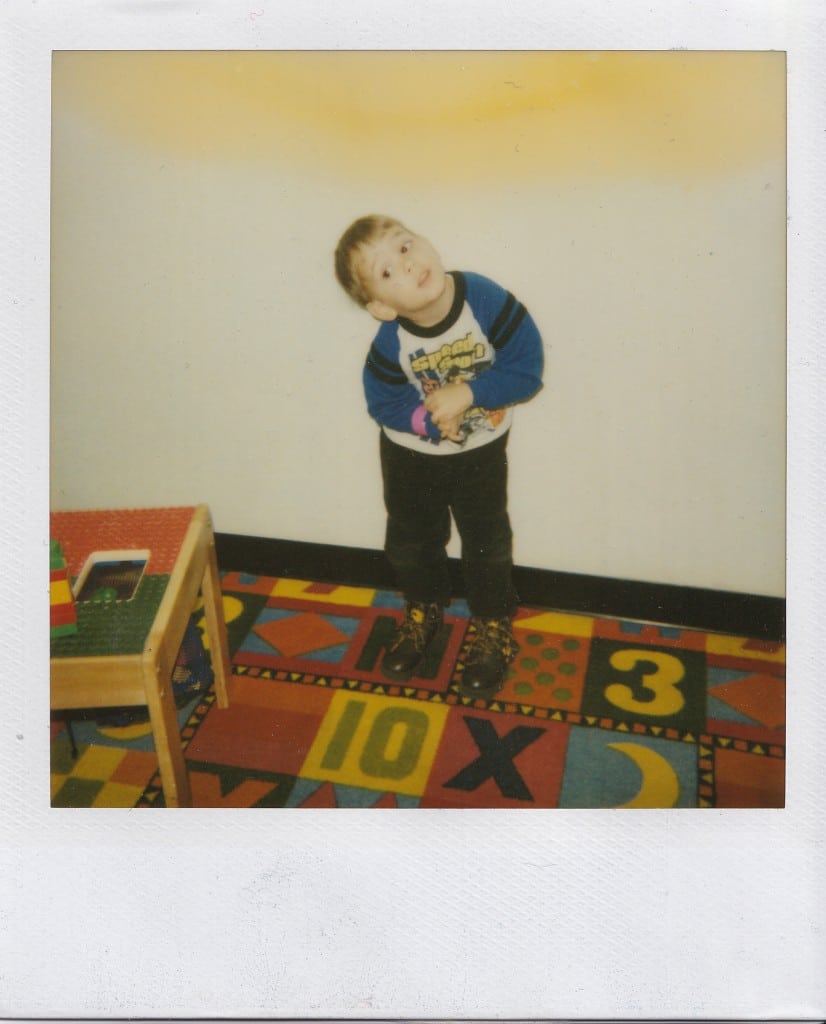
Daniel Budd keeps a picture of himself as a child on his desk at home.
In the Polaroid, which appears to have been taken when he was no older than 4- or 5-years-old, Budd stands on a colorfully tiled children’s rug dressed in dark pants and a long-sleeved graphic sweatshirt. His body is tilted and slightly hunched forward, his hands folded near his waist. His face bears the expression of a child being coaxed by an adult to smile but not quite getting there, and his eyes remain fixed on something off to the side of the camera. Combined with his posture, the effect makes the youngster look vaguely concerned, as though he wishes he could help someone standing just out of frame but doesn’t quite know how.
It’s a feeling Daniel, 27, has identified intimately with in recent years. In a series of interviews beginning in June, he repeatedly expressed his desire to help that little boy, to heal that little boy, even as he has struggled at times with precisely how to go about it.
A donation powers the future of local, independent news in Columbus.
Support Matter News
“Seeing myself so young and knowing what I was going through behind the scenes, it’s hard,” Daniel said. “That’s why I keep that photograph on my desk. It reminds me that I’m doing this for that kid, and I’m doing it so that he has a voice.”
For Daniel, a process that began in private nearly five years ago, first in therapy and eventually in conversations with family members and close friends, became public in May when he took to Facebook to write that he had been abused by his father, the late Charlie Budd, a pastor and missionary whose public profile differed greatly from the man his son said existed behind closed doors.
“My father, whom many believed to be a man of faith and character, was in reality an abusive father and a conman,” Daniel wrote in the public post. “He maintained a public image that did not reflect who he was or what was happening inside our home. He subjected me to his emotional, psychological, and physical abuse. I lived in the shadow of his public image, and had no outside support, this made coming forward feel impossible.”
Charlie Budd stood as an imposing figure at more than 6-feet tall and weighing nearly 300 pounds, Daniel said, and before he went into missionary work, he toured the globe with Team Extreme, a Christian ministry that incorporated feats of strength into its carnivalesque preaching events. In one video posted to YouTube, Charlie Budd is shown breaking shackles, biting into a can, and smashing stacks of concrete blocks with both his arms and his head as a cheesy rock refrain plays: “Don’t mess with a missionary man.”
“And all of that played into my image of him,” said Daniel, who recalled his father beating him and his siblings with belts, paint sticks, and frequently his hands. “Even when we were out and about, he had a cane with him that he admitted he didn’t always need, and he would hit us with that.”
In a July interview, Daniel’s youngest sister, Natalie, painted an identical picture of life with Charlie Budd, recalling how her father would take his cane and smack her across the back and legs. “He was physically and mentally abusive with me. As a kid, I was overweight, and he would force me to exercise,” she said. “And I still remember going to churches to watch him and thinking, ‘How can he be preaching this when he’s so awful to his family?’”
Daniel said he was also sexually abused by his father on at least two occasions during the years the family lived in Ghana, where beginning around 2004 Charlie Budd worked as a missionary based in the capital city of Accra with the nonprofit African Hope, which he founded and served as the executive director of up until its dissolution in 2011. (The family returned stateside, a year prior, settling in Lancaster, Ohio in 2010).
While in West Africa, Daniel said he and his three siblings lived largely in isolation in a large, single-story house surrounded by imposing walls topped with either spikes (the neighbor-facing walls) or barbed wire (street-facing).
“I was homeschooled, and there weren’t a lot of other kids around, so I spent a lot of time by myself,” said Daniel, who is currently working on a documentary confronting these childhood experiences titled “My Father, the Facade of God.” “Growing up, I really saw my father as a supernatural figure, and he played into that idea of a missionary that has special abilities, like he claimed he could tell the future through dreams. … But he had no oversight there. No one came and asked what our experiences were, how our lives were. I just didn’t have anyone to really talk to.”
Daniel traced his earliest memories of sexual abuse to age 5, when he said his father began showing him pornographic images on his office computer, including scenes of bestiality. And while none of Daniel’s siblings have shared with him similar stories of sexual abuse, Natalie said in a July interview that there were occasions when her father would show her sexualized images on his computer. “And I remember a few times thinking, ‘Why is he showing me this? That’s weird.’” she said.
Natalie also recalled one evening when she and her father were watching TV together and he paused while flipping through the channels on a scene that showed two women naked in the shower, kissing. “And I was maybe 11 or 12, and I remember him being like, ‘This is natural. This is what women do together in the shower,’” she said. “‘This is what God intended them to do.’”
Daniel’s memories of being sexually assaulted have returned to him in more piecemeal form in the recent years he has engaged in therapy. He said he can now recall the mattress his father set in the middle of the guest room in the family’s Ghana home, and how the elder laid him on top of it and sexually assaulted him. He can recall being alone in the shower afterwards, watching water swirl down the drain red with his blood. And he can also recall a later occasion when he said his father invited multiple others to take part in the abuse, describing how he remains tormented by the memory of “at least three people” pinning his body to the mattress and sexually assaulting him.
For decades, Daniel attempted to bury these events in his subconscious, though he said the accumulated trauma surfaced in behaviors that he now connects with these childhood assaults. “I have severe trust issues, and I’ve had trouble maintaining friends and relationships throughout my life,” he said. “I don’t go out a lot. I spend a lot of time by myself. … I can never open up to people or talk about things. I’m always holding everything in, just trying to get through it. … But over the years, I’ve just realized that I can’t.”
And so, Daniel began intensive therapy four or five years ago, eventually discovering E.M.D.R., an acronym for eye-movement desensitization and reprocessing, which combines elements of traditional therapy, exposure therapy, and bilateral stimulation, or alternating activation of the right and left hemispheres of the brain. In Daniel’s case, this was accomplished during remote therapy sessions during which he would fold his arms across his chest in an X and then tap out a steady rhythm on his shoulders, alternating between his right hand and his left. (The process can also be accomplished via guided eye movements or even by listening to a series of alternating tones through headphones.)
“When we’re processing trauma memories, that bilateral tapping helps to activate and reinforce those neural pathways into the prefrontal cortex, triggering the use of the whole brain, so those trauma memories are not just in that emotional center of the brain,” Daniel’s therapist, Lindsey Vargo, said in August. “It’s kind of based on REM sleep, actually. When we enter a REM stage of sleep, our eyes move back and forth, and that helps our brain utilize adaptive neural pathways.”
Psychologist Francine Shapiro, who validated the therapy in the 1980s, later wrote in EMDR: The Breakthrough Therapy for Overcoming Anxiety, Stress, and Trauma, from 1997, how a person’s “system becomes ‘stuck’ – as if it was choking on trauma – and often requires assistance to get moving smoothly again.”
Daniel said that within these sessions, Vargo would walk him through his childhood experiences as he kept a beat, asking questions and guiding him to narrate these memories. “And I can remember what I was feeling through my whole body, because those memories were very physically activating,” he said. “The closest thing I could compare it to is a phantom pain, where a lot of time you would feel it through your whole body, and my legs would shake, and I’d get really nauseous. It just affected your whole physical self.”
Resurfacing and confronting these memories could be overwhelming for Daniel, leading to nightmares soundtracked by disembodied screams and routine panic attacks that began to hit with jarring intensity. Earlier this year, Daniel said he experienced a panic attack so overwhelming that he believed he was having a heart attack. In the aftermath, he initiated discussions with a close friend and a couple family members, after which he voluntarily checked himself into Ohio State Harding Hospital for a week.
“And it was strange, of course, because you’re on suicide watch the whole time, which means every 15 minutes someone would check on you through the day and night,” said Daniel, who spent his time in the hospital either reading Meditations, by Marcus Aurelius, or attempting to mentally engage what he had been through decades earlier. “I was really just left with my thoughts, and I really just tried to process everything, spending those days thinking about what I’m going to have to do to move forward. And I really decided that week to try to do something about it.”
For Daniel, this has meant taking a radically different approach to the assaults he said he experienced in childhood, making public what he had long held private and immersing himself in making a documentary that has required him to more deeply research a man whom he wanted nothing to do with for years. As part of this process, Daniel has spent hundreds of hours in recent months digitizing family photos, cataloging his dad’s blog posts, and searching out interviews in which the elder presents himself as an unimpeachable servant of the Lord.
In one late 2003 interview broadcast on Lancaster Public Radio in the months before the family moved to Ghana, a copy of which was obtained by Matter News, the host introduces Charlie as “Papa Budd,” and then goes on to label the preacher “a world-traveler, Team Extreme strongman, [and] family man.”
“What are some of the dynamics of taking a wife and three, four kids [to Ghana]?” the host asks midway through the 25-minute conversation. “That’s got to be a little challenging.”
“It will be,” replies Charlie, who notes the family’s plan to spend a month at a missionary training institute in Colorado Springs ahead of the move as a means to help mitigate culture shock. “They train us on cross-culturally changing our lifestyles. Now, they’re also going to have Ghana-specific teachings for my children, so all of us will get some help in that change. So, I’m excited for the children, who will be learning some new things over there.”
While Charlie Budd embraced these interviews and his later social media pages as a chance to talk about his connection to both God and his family, his children all eventually cut the elder from their lives after reaching adulthood. Natalie said she largely stopped talking to her father after she turned 18, and in a June 2018 Facebook post, Charlie shared his disconnect from Daniel’s older brother, writing that “he has not taken my calls for many years.”
“It’s interesting to see how he portrays himself and even in his relationship with us,” Daniel said of his experience reading through his father’s blogs and the numerous posts he made to Facebook in the years before his January 2019 death from cancer at age 61. “There’s posts from him when he got visitation where he’s portraying a happy family, which wasn’t reality, but it was a big part of how he promoted his image in the later stages of his life.”
Working on the documentary has been therapeutic for Daniel, who envisions the film unfolding in two stages, the first a more straightforward depiction of the family’s time in Ghana and the second focused on the isolation and abuse he endured as a child in those years.
“It’s really become … a way I can maybe get my voice out there and speak on this matter, and maybe help other victims who have gone unheard,” said Daniel, who has always leaned into film as a means of escape but only more recently began taking it more seriously, rating and cataloging every movie he watches on Letterboxd. “I really like to break down the DNA of a film. And part of the reason I started doing that is from therapy, where I learned the idea of mindfulness, which means when you do something, you’re really doing that and focusing on that.”
Beyond the lingering mental distress, the abuse Daniel said he experienced as a child has also impacted his spiritual life. As a teenager, he connected his depression to a belief that he had been abandoned by God, which led him to investigate other religions, reading their spiritual texts in search of some potential anchoring point.
“And I would say now I’m a determinist, which says that since the beginning of the universe, everything has played out in its one specific way. So, everything in the past is absolute and it couldn’t have happened any other way,” said Daniel, who then connected this belief to the man whose abuse he said instigated his spiritual evolution. “In determinism, consequences and outcomes are the whole thing. So, there will be consequences for what he did, and there will be outcomes for what he did. And it makes them absolute and not optional.”
Author
Related Articles
The Worker’s View: Dough Mama temporarily closes after half the staff quits
‘This was obviously a big wake-up call that something needed to change,’
The Crew comes up just short in electrifying U.S. Open Cup final
Columbus nearly delivered a highlight in what has been a challenging season, playing St. Louis City SC to a dead heat for 120 minutes on Wednesday before falling in penalty kicks.

‘Pitchfork Populism’ Over Data Centers Rattles Ohio’s U.S. Senate Race
The issue, which barely registered with candidates last year, looms large in a race that could determine control of Congress.