
Your participation is mandatory at S.T.A.T.I.C.
The success of the monthly experimental music showcase, the next of which takes place at Cafe Bourbon Street on Tuesday, Feb. 25, is predicated on the larger community that has grown around it.
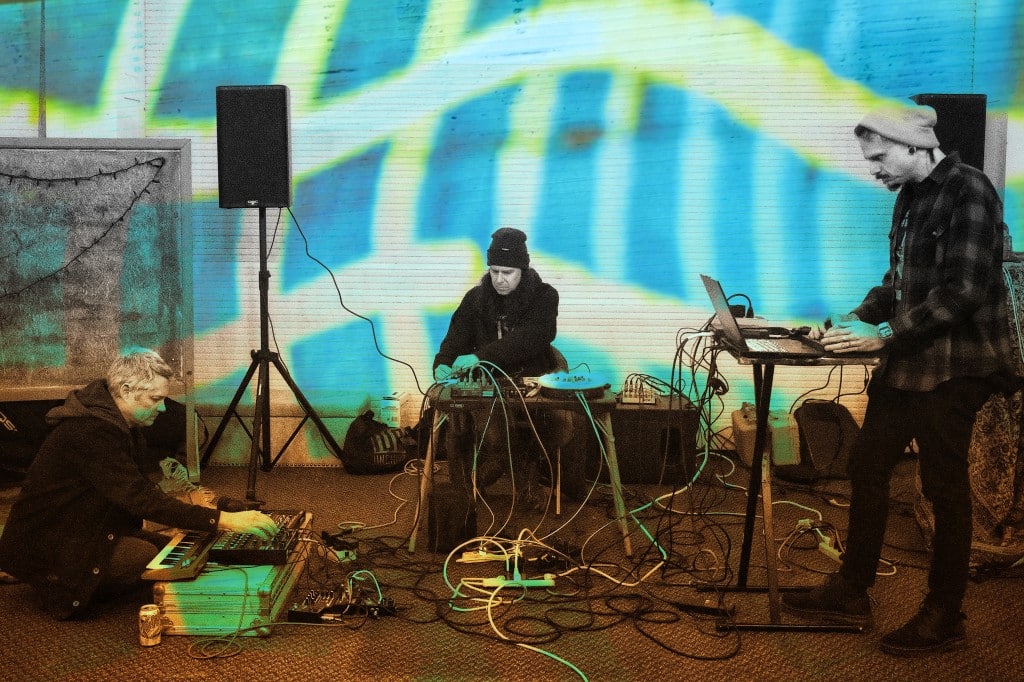
In curating the monthly experimental music showcase S.T.A.T.I.C., cofounders Ty Owen and David Reed have employed principles adopted in part from a lifelong love of professional wrestling.
“I think about organizing the shows like this: If every set in S.T.A.T.I.C. is a harsh noise set, it’d be like going to a wrestling show where every match is a bloody death match, where by the fourth time you’ve seen it, it’s like, whatever,” said Owen, who joined Fatal Gaze conspirator Reed for a mid-February interview at a downtown coffee shop. “You need the comedy match. You need the high-flying, acrobatic match. You need the harsh, physical match. And that’s what we’re trying to build out with S.T.A.T.I.C. – a variety show. If you don’t like what you’re seeing as an audience member, wait 30 minutes and you’re going to hopefully see somebody else try something that’s very different.”
The January showcase, for instance, featured everything from Fred Foxtrot’s textured, ambient soundscapes to the music of Der Kunklegartner, a duo that Owen said traversed the line between jazz and dub. It’s this type of sonic expanse the duo hoped to bridge when they founded S.T.A.T.I.C. nearly two years ago, inviting experimental musicians working across a range of disciplines to share the stage with one another.
A donation powers the future of local, independent news in Columbus.
Support Matter News
“There’s a tendency for scenes to become more and more insular, like: ‘We’re the free jazz scene’; ‘We’re the trad jazz scene’; ‘We’re the experimental scene,’” said Reed, who has harbored a fondness for fringe sounds from childhood, tracing the lineage from heavy metal through the likes of Throbbing Gristle, John Zorn and Merzbow, and who first cut his improvisational teeth alongside the city’s premier jazz players onstage at Dick’s Den. “And all of these different scenes are in Columbus, but they haven’t really been interacting.”
“I think the umbrella idea of S.T.A.T.I.C. is that we don’t care what micro-niche you fall under as long as you fall into the niche of trying new things, experimenting, and being open to collaboration,” Owen said. “I mean, clubhouse is a weird word, but that’s what we wanted to build, and not in an exclusionary way, like, ‘Oh, this is for you and you’re on the inside of it and everyone else is on the outside.’ … It was to create a clubhouse where everyone could get better, and where you could try new things and swing for the fences without being afraid to fail.”
The event debuted with modest aims at Dirty Dungarees in March 2022, Owen and Reed initially hoping the series could extend for at least six months as a break-even proposition. “If we can make or lose zero dollars, then it’s an abject success,” Owen said.
S.T.A.T.I.C. has long since blown past these early goal posts, thriving on the same collaborative spirit and creative daring that can be witnessed onstage at each event, the next of which takes place at Cafe Bourbon Street on Tuesday, Feb. 25. In the last two years, the organizers have expanded to produce a monthly physical release (the March CD features music from the Swappers), curated a home and away series with improvisational musicians from Akron, Ohio, and most recently introduced a recurring visual challenge brainstormed by musician and artist Doug Leed and rooted in his undergraduate experiences at Miami University.
“Way back then, some of my art major friends were assigned a project where they were given a word and then challenged to visually represent it in some type of medium,” said Leed, who plans to issue an identical challenge to participating artists at Bourbon Street this week. “I originally anticipated it being a video or slideshow-type thing, but really, I’ll take whatever someone wants to submit. There are no rules, no wrong answers.”
This anything-goes attitude is deeply embedded within S.T.A.T.I.C., which maintains a loose framework – five acts feature at each event – inside of which almost anything is free to happen.
Part of this volatility is intrinsic to improvised experimental music, which offers performers unique sonic freedoms. “Coming from playing in bands where everything was really regimented, this idea that there were no wrong answers was really freeing,” said Leed, who traced his fascination with the form to a workshop he attended years ago taught by Bela Fleck and the Flecktones bassist Victor Wooten, who instructed attendees that there were no wrong notes. “And that really opened me up to the idea that there were no mistakes, and if you did [something unintended], you could just follow it and see where it takes you.”
Often unfolding as a series of in-the-moment responses, the music at S.T.A.T.I.C. can hinge on everything from the chemistry (or not) between the players to any outside baggage a performer might carry with them onto the stage. “If I’m fired up about something, some of that is going to come out naturally in what I’m doing,” Owen said.
The unpredictable nature of the event is further magnified by its curation, with organizers routinely brainstorming ways to feature previously unheard combinations. In the past, the cofounders have staged showcases in which musicians were paired randomly the night of the event via blind draw, and each S.T.A.T.I.C. typically involves at least one collaboration that has never before taken place.
“I want to see people’s new projects. I want to see their new ideas. I want to see people who have never played together,” said Owen, who might have helped to found S.T.A.T.I.C. but understands its success is predicated on the efforts of the larger community that has since developed around it. “We joke and say, ‘Your participation is mandatory,’ but it also really is. If the community wants this to exist, then people have got to come out. … It’s all about opening the door to those people who are saying, ‘I want S.T.A.T.I.C. to be this.’ And then us saying, ‘Yeah, let’s make S.T.A.T.I.C. that.’ That’s what it should be; whatever people want it to be.”
Author
Related Articles
Prison finds freedom in sprawling psych-rock jams
The New York band’s current tour hits Rich Street Records on Saturday, Aug. 15.
Curiosity, community continue to fuel Oneida
The long-running experimental rock band will visit Cafe Bourbon Street for a concert on Friday, Aug. 14.
Angela Autumn attempts to find heaven on Earth with ‘Believer’
The Nashville-based country singer performs a free concert at the Snow Fork Event Center in nearby Nelsonville on Thursday, Aug. 13.