
Lesley Jenike scrapes away the veneer with ‘City of Toys’
In her new essay collection, out today (Monday, March 9), the Columbus author said she opens up ‘in a way I don’t in my everyday life.’
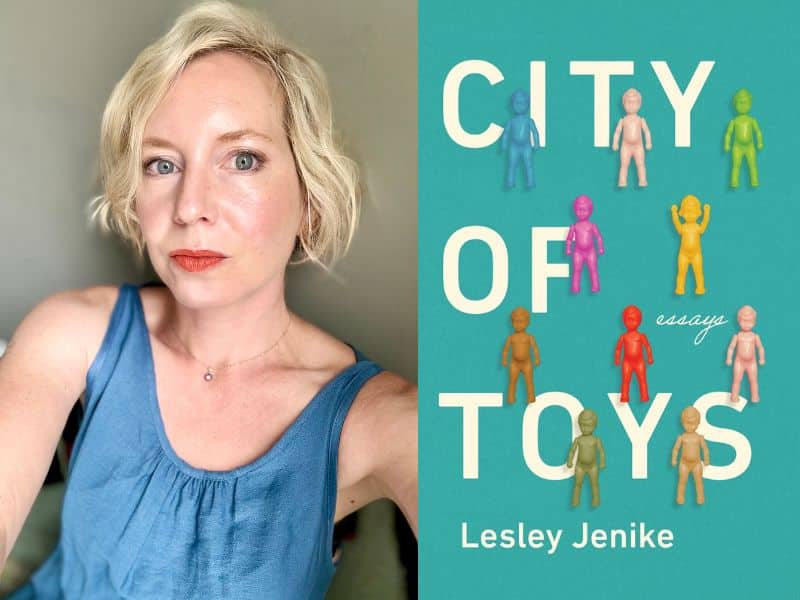
Lesley Jenike often weaves elaborate webs within her essays, tying together deep historical research, far-flung references to pop culture, and vivid scenes pulled from her own lived experiences.
In her essay “The Teaching Emotion,” for instance, the Cincinnati-raised, Columbus-based writer manages to connect the 1959 Edward Albee play The Zoo Story; the construction and early history of the Cincinnati Zoo; an elaborate painting done on the ceiling of an Italian villa by Renaissance artist Andrea Mantegna; her childhood crush on zookeeper Thane Maynard; the death of lowland gorilla Harambe, who was shot and killed by a zoo worker after a child fell into the gorilla’s enclosure in 2016; the very public torrent of ugliness to which that child’s mother was subjected in the immediate aftermath of those events; and how even her own step-grandmother paused from drinking a can of Ensure to offer up her own deeply misguided commentary on the whole affair.
“The sun is streaming in behind her and everything is quiet, even angelic, a stand of tall trees in the background and in the sprawling front yard a little weeping cherry where, in summer, lightning bugs go off like tiny bombs, weeps, and she says to me, ‘Jesus,’ she says. ‘What an awful woman! What a bad mother,’” Jenike writes in the essay, included in her new collection, City of Toys, out today (Monday, March 9). “She shakes her head slowly for effect.”
A donation powers the future of local, independent news in Columbus.
Support Matter News
It was that brief exchange that initially inspired the essay, with Jenike absorbing the comment and then squirreling it away, intent on later exploring why the remark ignited in her such an immediate visceral reaction.
“If something weird happens to me, or I overhear a weird thing, or somebody says something weird to me and it disturbs me, that, to me, is a good opportunity for an essay, because I want to get to the bottom of why it makes me feel this way,” Jenike said by phone in early March. “And when [my step-grandmother] said, ‘What an awful woman,’ it pissed me off in the moment, but it also struck me as something that people say all the time about mothers, where it’s like, oh, they shouldn’t have done this, or they shouldn’t have done that. And it’s like, dude, if you could see what it’s like in the moment to deal with a toddler or even a school-aged child, maybe you would have a little bit more sympathy. … And I think that’s a good example of, hmm, the thing this woman said makes me upset, so I could yell at her and tell her she’s wrong, or … I could write an essay where I get to say all of the things I want to say and feel freer in doing so.”
While the process can vary by the essay, Jenike said each generally begins with her creating a new file in Microsoft Word where she can then dump anything even tangentially related, including research notes, links to other features, quotes she might want to incorporate withing the text, and bits of personal history that could connect in some way to the subject at hand. Admittedly, this last point can be a challenge to parse, at times, with Jenike pointing to an in-progress essay she’s currently building around the Donner Party, whose experiences fall at a significant remove from her own.
“Obviously, I’ve never been a pioneer, and I’ve never been in a wagon train, and I’ve certainly never been a cannibal,” Jenike said, and laughed. “So, it’s almost like, where am I going to go with this? … And it remains to be seen where I’m going to find a connection, though I’m interested in letting the idea play out.”
Within City of Toys, these connections repeatedly stem from the years she spent onstage as an actor beginning in childhood. At one point, Jenike recalls a scene in which her shortcomings as an improv performer were revealed when in pretending to look for a lost contact lens she began to scavenge far and wide and was nearly laughed out of the studio. “Would it really fall all the way over there?” she writes. “I had no real sense of reality.”
As a writer, however, the opposite routinely proves true, with Jenike burrowing into the curiosities, insecurities, frustrations, and wonders that are inherent to the human experience, her essays connecting these more intimate details with the larger world around her in a way that feels both incredibly vulnerable and deeply resonant.
“I think as a little girl growing up, you realize everybody is constantly performing for everybody else and masking, and it can be really hard to see what’s underneath all of that,” said Jenike, who in more recent years has leaned into writing as a means to scrap away the veneer and more fully interrogate those parts that exist beneath this visible surface. “I’m a really shy, quiet person, and I’m kind of a homebody. … But when I’m writing, I feel free. … There are aspects of my personality that I allow the time and space to speak in my essays in a way I don’t in my everyday life.”
Jenike acknowledged it has been a process getting to this point, with her earliest attempts at writing tending to feel more buttoned-up, hemmed in by the lessons she absorbed in graduate school and for too long treated as sacrosanct, including the idea that academic writing and creative nonfiction couldn’t comfortably coexist. “There was this huge line of demarcation,” she said. “And nobody told me that if I mashed them up it could be super cool.”
A turning point arrived with the 2014 birth of her first child, which Jenike said shifted her worldview in such a way that she finally abandoned those concepts that for so long had left her feeling creatively stifled.
“You spend your life as the student, and then you realize, wait a minute, I’m the professor now,” she said. “And it took me a really long time to figure that out, because I’m the youngest kid, the baby of the family, and I tried to be nice and accommodating all the time. But I think once I had my own kids … it was like, it’s me now. I can do whatever I want.”
Author
Related Articles
Edward Julian Sr. embraces poetry as a means to release and reflect
Ohio’s poet laureate features at Urban Arts Space tonight (Thursday, Sept. 24), appearing as part of the Poetry Festival, which continues through the weekend at Thurber House and the Grange Insurance Audubon Center.
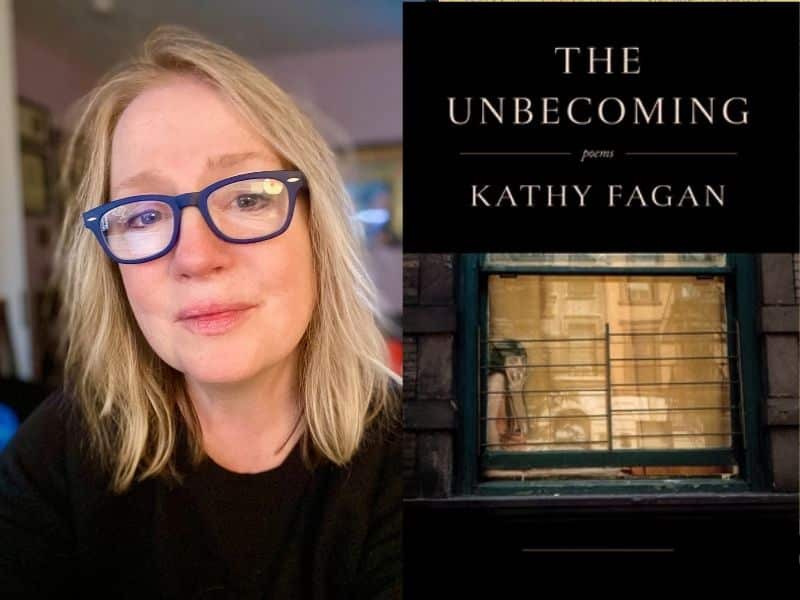
Kathy Fagan takes stock with ‘The Unbecoming’
The poet will celebrate the release of her new collection with a reading at Gramercy Books on Thursday, Sept. 24.
Derf Backderf delves into the past, finds lessons for the present with ‘The Dissidents’
The Cleveland cartoonist will celebrate the release of his sprawling, deeply engaging new book with an appearance at the Wexner Center for the Arts on Wednesday, Sept. 23.