
‘What message are we sending when we reward work with no humanity whatsoever?’
After an AI-created image won the grand prize in the Ohio State Fair poster competition, organizers announced their intent to reconsider the use of the technology in future contests amid vocal backlash from the state’s arts community.
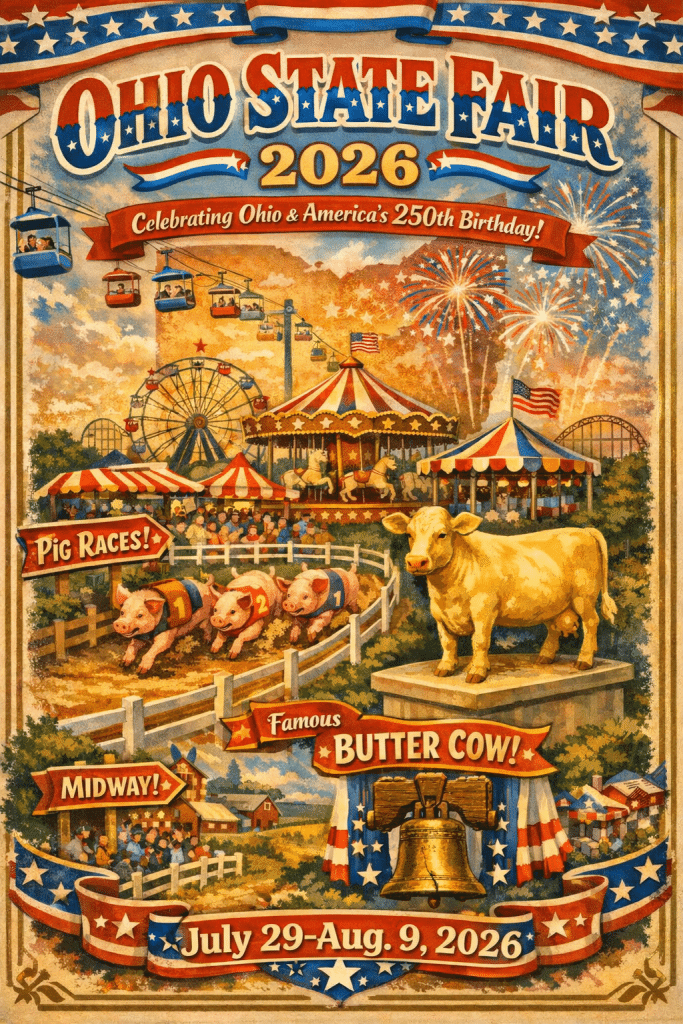
Organizers announced on Friday their intent to reconsider the use of artificial intelligence in future editions of the Ohio State Fair poster contest after receiving widespread condemnation for awarding the $1,000 grand prize to an entry created using generative AI.
A spokesperson for the fair told The Columbus Dispatch that use of AI has been allowed in the contest if it is disclosed by the artist as part of the application process. And of the 39 entries submitted this year, seven disclosed the use of AI, including the runner-up, Gene Strickland, a professor of digital art, media, and design at Columbus State Community College who utilized AI for “design refinement.”
The decision to reward AI-created and -assisted works drew a swift rebuke from artists across the spectrum, including Victoria Sellers, a comics artist and instructor of illustration at CCAD who served as a judge in the state fair’s fine art competition. In a viral post made to social media on Friday, Sellers wrote that the winner of the poster category was “judged internally, handled outside of the regular categories.”
A donation powers the future of local, independent news in Columbus.
Support Matter News
“As a judge of the 2026 youth category … I unequivocally condemn the decision,” they continued, and then added, “What message are we sending when we reward work with no humanity whatsoever?”
“We just have collectively chosen to not value that anymore, and I think that’s why I feel so compelled to be loud about it,” Sellers said by phone on Sunday, noting that the poster competition, now in its third year, has traditionally operated independent of the fair’s fine arts program, with judging led by members of the executive board, upper management, and the PR team. “[The poster contest] is handled entirely differently. It’s not part of the fine art competition, and it was also decided months and months ago. … It’s such a black box, and … people on the fine arts side were expressing a lot of discontent at the real lack of transparency across the board.”
Sellers said there are many ways to assign value when judging fine arts categories, with craftsmanship and content featuring heavily in their considerations of a given work. “It doesn’t need to be a hyper-realistic oil painting to win a category, but it needs to be compelling and resonate with people, and that becomes my metric,” they said, adding that the AI-generated posters “have none of this.”
“With the content, they’re not choosing it, or if they are choosing it, they’re not choosing it well,” continued Sellers, who pointed to the random inclusion of the Liberty Bell in the contest-winning poster – a historical artifact with no connection to Ohio – as well as the three racing pigs numbered 1, 2, and then 1 again. “And, yeah, these prompts can get to be pages long, and the specification can be really in depth, but that’s not judging someone based on their artistic prowess. It’s judging you on if you can project manage.”
Cleveland comics artist Derf Backderf more bluntly dismissed the winning entry as “visual excrement” in a public Facebook post, describing it as “obvious AI slop with all the tell-tale signs. The garbage palette, overcrowded layout, the usual cheesy AI typography, and typical horrible AI rendering.”
“AI art being allowed is bad enough,” said Pale Grey Lore musician Donovan Johnson, “but then a panel of judges looking at that monstrosity and going, ‘Oh yeah, this is the best one,’ is the part that’s unfathomable to me.”
Similar responses rippled across social media, with Ohio artists offering up a range of condemnations for the fair administrators whose rules allowed for the use of AI in the poster category. “The rules were the problem,” said Columbus artist Alan Reeve, “not the submitter, not even the judges.”
Columbus artist Sara E. Adrian said that allowing the use of AI devalued the competition and eroded its cultural purpose, adding that “typing in a series of prompts no more makes someone an artist than it makes me a chef when I order toppings on a pizza.”
“I work a corporate data analytics job and I have to use and understand AI in my field. However, I never condone using AI for image generation of any kind – especially to submit to a competition designed for artists,” said the collage artist Emily Morgan. “I do find it endlessly frustrating that AI is chipping away at the already thin financial opportunities and resources for artists and is being championed by organizations that should know better.”
The intensity of the response to the fair’s decision could be attributed to a number of factors, including widespread public fear and mistrust of AI and the relative paucity of targets at which to direct these frustrations (a reality that has helped to make data centers one face of AI backlash); the nature of state fairs, which author and historian Joy Ellison described as one of the country’s “few remaining local spaces where all of us are encouraged to share our art, from cookie jars to quilts to posters”; and the attachment of a cash prize to “something that seeks to function as art, but isn’t,” as poet, author, and cultural critic Scott Woods explained it.
“Awarding AI suggests that art is negotiable,” said Woods, the founder of the East Side arts space Streetlight Guild. “Art may always be subjective, but its function shouldn’t be negotiable to the point of redefinition. If you don’t care about how art is defined, then don’t call it an art contest.”
Others drew a direct line between the influx of AI entries and this particular era in American, with musician and Our City, Our Say campaigner Mike Strandberg describing the contest as “an overall demoralizing event that signifies the specific cultural and political moment we’re currently in.”
Indeed, it’s arguable that few have embraced the aesthetics of AI art as effusively as President Donald Trump and his administration, which also has a presence at the Ohio State Fair in the shape of the so-called “Freedom Trucks” parked on site and offering right-wing propaganda in the guise of presenting American history. Trump’s Truth Social account, in particular, exists as a running fever dream of AI slop art (one recent posting depicts a “painting” of Trump seated alongside George Washington and Abraham Lincoln), and departments ranging from the Department of Homeland Security to the Department of Labor have increasingly utilized AI to create white nationalist videos and images for use as promotional tools.
“It takes a certain type of person to be a working artist who is super down to make this kind of propaganda art,” Sellers said. “So, you can just have the computer make the art and it cuts out the moral question of whether or not this is worth producing.”
The writer Gareth Watkins delved into the right wing’s current fascination with AI-generated imagery in a February 2025 article for New Socialist headlined “AI: The New Aesthetics of Fascism,” in which he posited that this fondness for “slop,” as he termed it, is rooted in “the right’s hatred of working people, its (more than) mutual embrace of the tech industry and, primarily, its profound rejection of Enlightenment humanism.”
“AI imagery looks like shit. But that is its main draw to the right,” Watkins writes. “If AI was capable of producing art that was formally competent, surprising, soulful, they wouldn’t want it.”
Similar criticisms were lobbed at the fair administrators who selected the grand prize-winning poster, with artist Kent Grosswiler drawing a distinction between the AI-generated images and those entries “made by actual artists with their actual hands that brought their imagination to fruition.”
It’s these runners-up that Ambry Library co-founder Teresa Ann Gipson hopes to spotlight in a future exhibition at the Linden arts space. “Our gallery wants to feature them in a special showcase,” Gipson wrote in a Saturday post on the Art and Artists of 614 Facebook group, “and give them 100% commission to try and right what was taken from them.”
Author

Related Articles
Henry Hess says goodbye to his longtime Chromedge studio
Faced with a rent increase of more than 30 percent, the Hess family opted to move on from the artist’s creative home of the last eight years. And while the next steps remain uncertain, they stressed that Henry would maintain a presence in Franklinton. ‘We’re not going anywhere,’ Sophia Hess said.

Nick Stull adopts a quieter approach
With his latest collection, on view at Sarah Gormley Gallery beginning today (Friday, Sept. 11), the Columbus artist hopes to entice viewers to linger a little longer in his world.

Melissa Vogley Woods slows things down for ‘When the Earth Bends we Bend’
The artist’s new exhibition opens at Brandt Gallery on Friday, Sept. 11.