
Schyler Butler refuses to tiptoe around difficult subjects
The Columbus poet will celebrate the release of her debut collection, ‘Phantom Hue,’ with launch events at Prologue Bookshop on Thursday, Nov. 12 and Streetlight Guild on Saturday, Nov. 14.
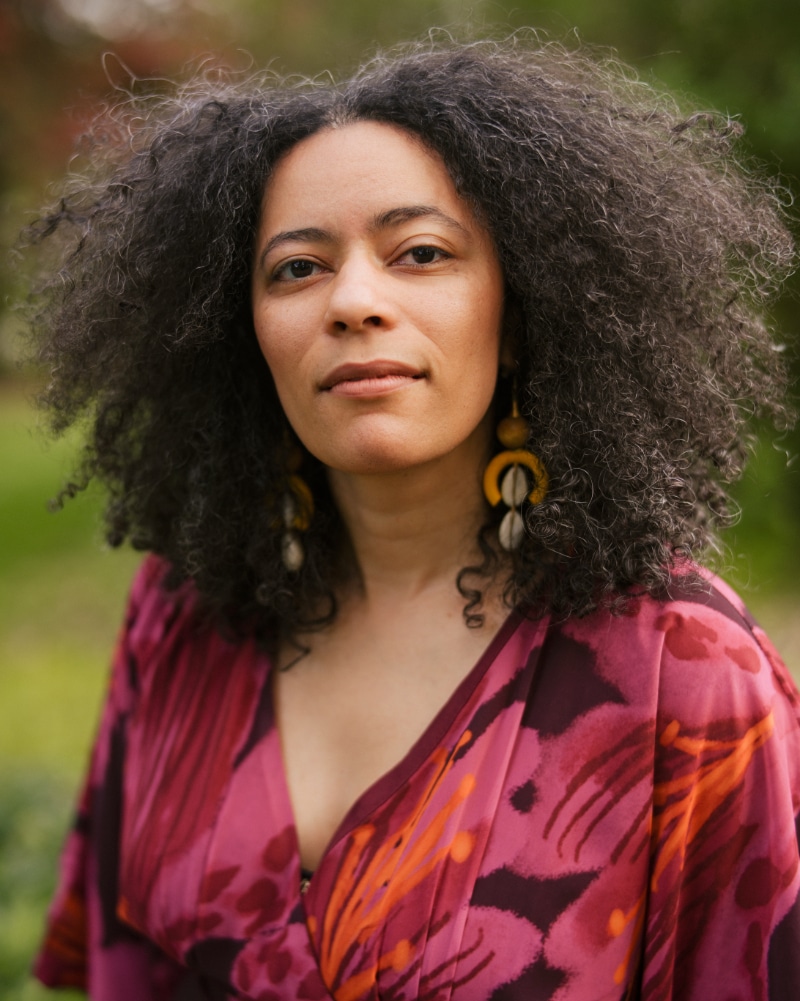
“It’s better to tiptoe around such a memory,” Schyler Butler writes in her poem “Like Pontius Pilate washing his hands,” “than look at it for what it is.”
And yet, the Columbus writer spends the bulk of her debut collection, Phantom Hue, unflinchingly staring down her most challenging memories. Throughout, the poems wrangle with generational trauma, Butler’s complicated relationship with her parents, the way emotional bruises that can linger long after physical wounds have healed, and how as a younger person in a romantic relationship she found herself so in thrall to the concept of whiteness that she nearly lost who she was in the process.
Witness the searing “Pulled Pork,” in which she writes:
A donation powers the future of local, independent news in Columbus.
Support Matter News
Never do I bring up all the Black men and women dying across these streets; never do I mention their children gunned down in Mickey Mouse beds. Instead, I learn appreciation for your precious beer, focus on your translucent green eyes, and gulp down chip after chip of stringy meat that ferments in my stomach, sucking in the bloat as if you won’t notice.
In spite of the oft-heavy subject matter, there’s a deep clarity and resolve that reverberates within the writing, as though Butler and/or her narrators are addressing past events having finally reached the other shore. This, it turns out, was no accident.
“So many of these poems took so many drafts to get down. So, in the second draft, third draft, it’s just pure emotion, where a lot of what came across was anger at the other party in the poem – finger pointing, name calling, really wanting to inflict pain and harm,” said Butler, who will celebrate the release of Phantom Hue with a pair of launch events this week at Prologue Bookshop (6:30 p.m. Thursday, Nov. 12) and Streetlight Guild (6:30 p.m. Saturday, Nov. 14). “And as I got deeper and deeper into each poem, and as the drafts went further and further and became cleaner and cleaner, I realized with a lot of help that the message gets lost if the poem is being led by pure emotion. … And that made me have to take a step back, which meant that if I was writing about something that actually happened to me, I had to make peace with it in some way, shape, or form. And so, there was a lot of forgiveness work happening in the writing.”
Much of this early anger surfaced as Butler began to unpack issues related to racism – a pull she attributed in part to the disparities she said she first noticed in returning to Columbus following her undergrad studies. (The writer was born here but grew up moving all around the country owing to her father’s military career.)
“And I’m sure that I experienced [those disparities] elsewhere, but something about being in a bigger city and seeing, for example, the difference between a Linden and a Victorian Village as it relates to the infrastructure, to the people who live there, really brought to my mind that racism was still a thing, and that I, for whatever reason, had been oblivious to it,” said Butler, who also credited the influence of her partner, the poet Akhim Yuseff Cabey, whose verses tread similar terrain. “We discovered that a lot of our stories were just so similar. We’d both spent a lot of time dating white people or having predominantly white friend groups, and he suggested I write about it, and I was like, ‘That’s not a bad idea. I probably should.’”
The healing work sparked by the writing exhibits itself in the arc of Phantom Hue, which includes an early poem recording how the concept of race is often casually introduced in childhood (“Amongst Children”) and closes with an expression of hope for the future, Butler writing in “Star-Crossed Daughter at 23 Months” of her infant child standing comparatively “surefooted” against the world’s ills when compared with previous generations.
For the poet, part of breaking this cycle involved acknowledging how the impacts of racism can ripple through a family line – an idea expressed most explicitly in the gutting “Intersectional Guillotine,” where Butler addresses the rape of her great-great-grandmother by a white man and questions its impact on her own existence. “What did he annihilate that shimmers in my blood,” she writes, later adding, “Do I consider the oppression I might carry/Do I wear it like the earth upon Atlas.”
“I mean, [racism] isn’t something that started last night, and it’s been going on hundreds if not thousands of years. And if that’s the case, and I grew up experiencing this and not being told about it or taught what it is, then what does that mean for my parents? What did they grow up knowing or not knowing, learning or not learning?” Butler said. “And so, I began to ask questions of my family members just to learn their stories, and to sometimes even look between the lines of what they were sharing with me and to see them not just as people related to me by blood, but as Black people, and in some cases white people, who had lives, who had experiences that deeply affected them.”
Though Butler grew up with a deep fascination for language, she didn’t warm to poetry until later in life, tracing her fondness for the form to her post-undergrad discovery of writers such as Rita Dove, Natasha Trethewey, and Tiana Clark, among others. Even in its earliest forms, however, Butler said her poems always resonated as her own, her struggles coming not in shaking these various literary influences but in determining what it was she actually wanted to say with her writing – a discovery that arrived as she learned to strip away the more flowery language she once favored.
“I tended to use a lot of pretty words, just putting things together that sounded nice or that looked cool together. And sometimes being forthright was difficult, and it was something I had to train myself to do,” said Butler, who pointed to “Bonnaroo, 2012” as one of the first poems she wrote that abandoned this approach in favor of language that cut to the bone. “And once I learned to write about myself in that vulnerable way that I’ve embraced, it became easier to figure out what it was I wanted to say.”
Author

Related Articles

Laura Larson and Christine Hume discover collective power in ‘portraits of refusal’
Columbus photographer Larson will join writer Hume in celebrating the release of new book ‘All the Women I Know’ at the Center for Print and Collaborative Arts on Friday, Nov. 6.
A decade later, Matthew Erman and Lisa Sterle revisit ‘Long Lost’
First released in 2016, the husband-wife duo’s first collaborative series was recently reissued as a graphic novel by Vault Comics. To celebrate, the couple will appear in-person at the Book Loft on Wednesday, Oct. 28.
Eric Shonkwiler wants to help you survive societal collapse
The Columbus author will celebrate the release of ‘Red Prepper: Building Collective Resilience in an Age of Collapse’ with an event at Prologue Bookshop on Thursday, Oct. 22.