Laura Ellstrom masks up for Alley Islands
The Columbus illustrator and painter often creates works that feature masked figures reflective of everything from isolation to whimsy, including a new mural featured at this weekend’s Alley Islands.
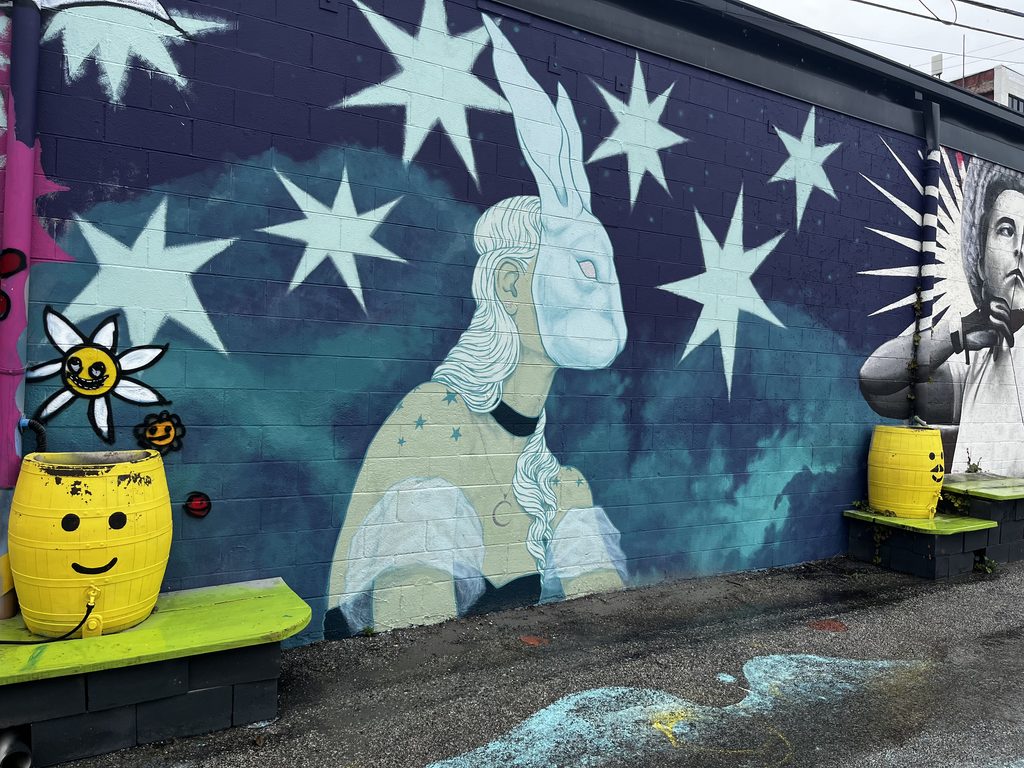
Artists will often say that inspiration can arrive from anywhere, but Laura Ellstrom currently has proof to this idea painted on the exterior wall at the downtown gallery Blockfort, her masked figure having initially emerged when she spotted a loose strand of hair stuck to her shower wall in a shape suggestive of a rabbit.
“I am a firm believer you can find inspiration from anything,” Ellstrom said on a rainy May afternoon at Roosevelt Coffeehouse just days before the gloomy weather postponed Alley Islands, a daylong celebration of art and music that takes place annually in the streets and alleys surrounding Blockfort. (The rescheduled event takes place from noon to 10 p.m. on Saturday, Aug. 22, and a full lineup of artists and performers can be viewed here.) “And it’s kind of an odd inspiration for it, so the title for it is ‘Pareidolia,’ which is this phenomenon of seeing faces in random stimuli. … And the hair looked very much to me like an elegant woman wearing a rabbit mask.”
Ellstrom’ style is deeply rooted in line work, the artist having grown up with a fondness for illustration, and in particular the work of artists such as Arthur Rackham, Kay Nielsen, and Edmund Dulac, each of whom displayed an uncanny ability to capture “the sense of magic that happens with limitations,” as she explained it. “I think it’s the ability to make something with just lines, where it’s almost the impression of texture,” Ellstrom said. “And that’s how I started drawing, doodling in class with mechanical pencils, to many teachers’ chagrin.”
A donation powers the future of local, independent news in Columbus.
Support Matter News
While masks have frequently featured in the artist’s past work, she said “Pareidolia” is more whimsical than these earlier concealed figures, which often spoke more to the idea of what was being hidden, be it feelings like an outcast or a more generalized sense of detachment. Looking back, Ellstrom now sees more of herself in some of these earlier images, recalling herself as a lonely adolescent who tended to be hyper aware of her inner-world and how it impacted on her, owing in part to having grown up with a psychologist father.
“I got a lot of intellectualizing and gaslighting, like, ‘Oh, you’re not actually feeling this way, it’s just a projection of this,’” said Ellstrom, who eventually entered into therapy where she was diagnosed with ADHD. “And then kind of sharing that with my dad and helping him understand what he put on me. … So, he’s definitely been better on that front, and I think it’s been nice to see the ripple effect of healing.”
A number of these more personal experiences surfaced in a solo exhibition last year at 934 Gallery that the artist centered around being both neurodivergent and queer, and which included a piece based on ornithomancy, or the practice of divining omens by observing birds, that depicted seven magpies swirling around a woman’s head in a tornado of wings and feathers. “And it was a piece I had done before that didn’t have a mask, and I decided to make it into a mask,” Ellstrom said. “And the mask is actually a mirror, and it is specifically about masking as a neurodivergent person. … And it was very much about the anxieties one feels related to who you are supposed to be, and those wars within and wars without. I really struggled with my identity when I was young, because I was very preoccupied with who I was supposed to be, or who other people wanted me to be, and it truly did feel like a war of how much of myself am I supposed to reveal, how much I am supposed to conceal, what is allowed, what is acceptable, and what is worth fighting to keep.”
While her masks can at times speak to the artist’s interior world, they can also inject a level of ambiguity into a work that Ellstrom said she is often drawn toward, hiding a figure’s expression so it becomes more difficult to ascertain if they’re feeling jovial or melancholic, and better allowing a viewer to project their own histories and emotions onto a given image.
“I really prefer people to be able to step into it and see themselves,” Ellstrom said, “and for it to mean whatever it needs to mean for them.”
Author
Related Articles
Scrawl meets Scrawl
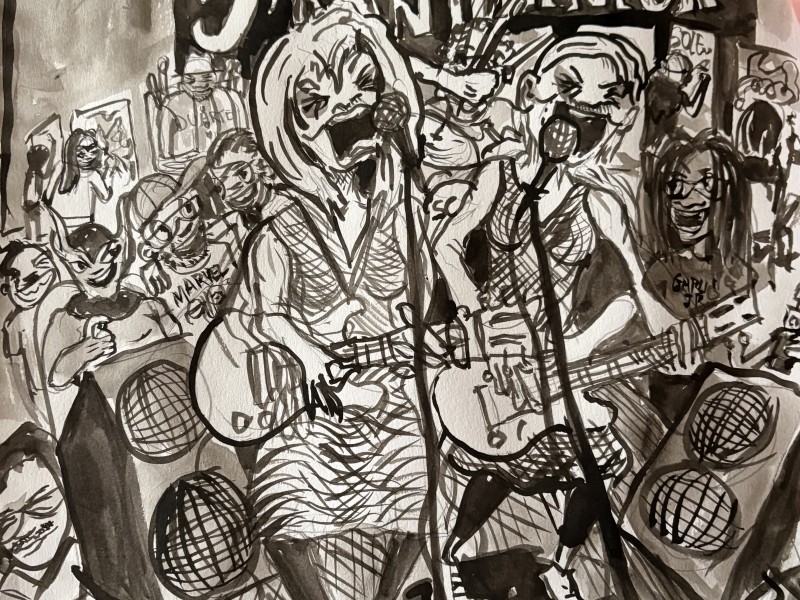
Marcy Mays and Sue Harshe recently joined pioneering Urban Scrawl artist Dan Gerdeman for a conversation ahead of the band’s performance at the Franklinton art event that has been a longtime source of confusion for some of their fans.
‘Immigration: A Journey of Belonging’ seeks deeper understanding
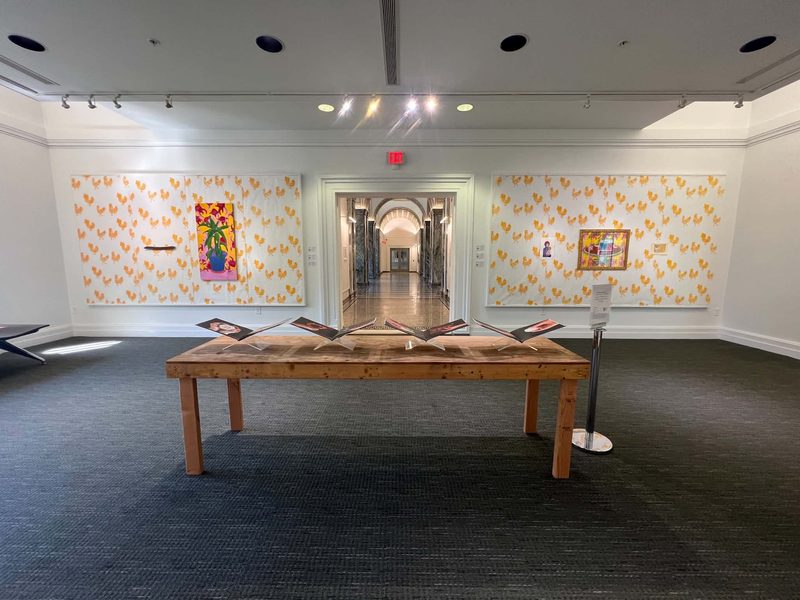
The new group exhibition, open now at the Losinski Gallery at the Main Library, will host a reception from 2-4 p.m. on Saturday, Oct. 3.
Deep conversations pave the way to ‘Chasing the Light’
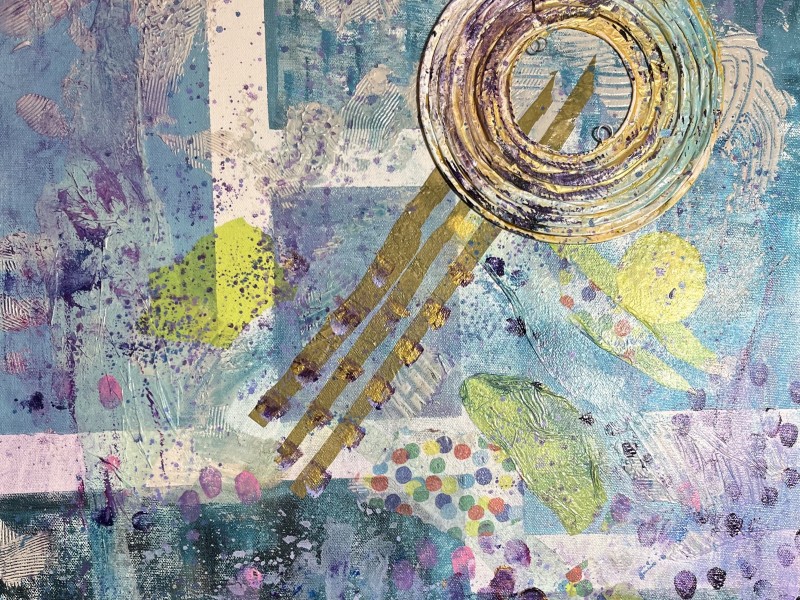
A couple of years ago, Loren Bucek invited a group of artist friends to her Clintonville home. The gathering soon evolved into regular meetups that shaped the creation of a new exhibition opening this week at McConnell Arts Center.