Scrawl meets Scrawl
Marcy Mays and Sue Harshe recently joined pioneering Urban Scrawl artist Dan Gerdeman for a conversation ahead of the band’s performance at the Franklinton art event that has been a longtime source of confusion for some of their fans.
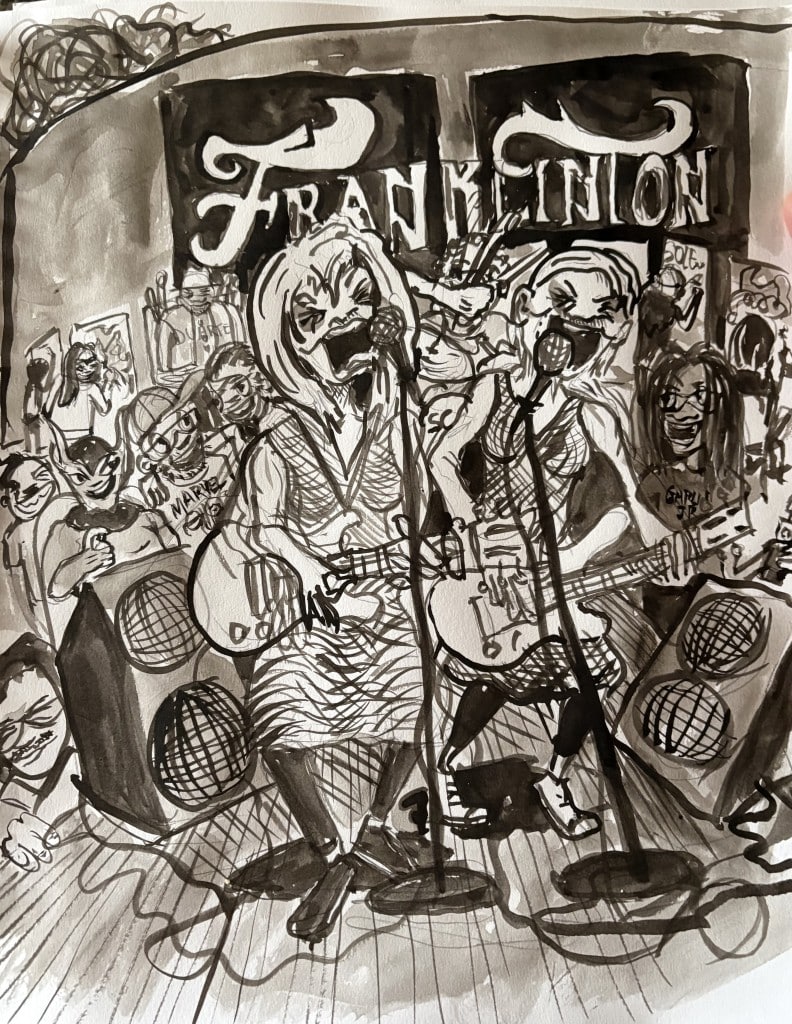
Singer/guitarist Marcy Mays said there have been numerous occasions where the yearly art event Urban Scrawl, more commonly referred to as Scrawl, has caused confusion for fans of the band she founded alongside singer/bassist Sue Harshe in 1985, also named Scrawl.
“I mean, all 20 of our fans get so pissed,” Mays cracked, making reference to the disorientation experienced by those who see the Scrawl name and immediately anticipate a concert from the local legends. “Every year, people start texting me, ‘You guys are playing?’ No.”
This coming weekend, however, these perpetually disappointed music lovers won’t have to worry about navigating their annual case of mistaken identity, since Scrawl (the band) will headline Scrawl (the art happening) for the first time in the event’s 20-year history, performing at 7 p.m. on Saturday, Oct. 10, and preceded by sets from Lydia Loveless, Magnolia, and Steve Tabatowski. (Friday’s equally stacked lineup includes Joey Aich and the Headband, Lily Bloom, and Mistar Anderson; click here for a full slate of participating artists, musicians, and set times.)
A donation powers the future of local, independent news in Columbus.
Support Matter News
As a means to help mark the momentous occasion, the two Scrawl vets joined another Scrawl vet – artist Dan Gerdeman – for a late September conversation in an effort to dispel any lingering confusion and perhaps boost the group’s online search ranking.
“I was trying to send someone an old article [on the band] and it sent me information on Urban Scrawl,” Harshe said. “And it was like, oh, so we’re down the totem pole on search engines.”
“I’m always terrified to type in ‘Scrawl’ to see,” Mays said. “I don’t think my self-esteem can handle it.”
Though intimately familiar with the Urban Scrawl owing to its name, both Mays and Harshe have had minimal exposure to the actual event, leading the pair to pepper Gerdeman with questions about its roots, its overall vibe, and what the weekend actually entails.
“It’s going to be a collision of wonderfulness,” said Gerdeman, who will again be painting alongside his longtime artistic partner-in-crime, Rob Jones, the two hashing out a massive mural in tribute to another living local artist while simultaneously navigating hundreds of conversations with any passersby. “Especially in the early days, people would just walk up and talk to us, because where it was set up, the people from the retirement home, the high rise there, they would come over to watch, because they were so delighted to see people making things. And then you’d also have all the kids from the neighborhood. And I think what it’s really become is a good conversation between the community that lives there and the people who come in and make the work, not all of whom live in Franklinton.”
Both Mays and Harshe expressed a fondness for the sense of connection Gerdeman described as central to Urban Scrawl, recalling how they came up in an era when the various artistic scenes felt comparatively siloed.
“I went to school at [Ohio University], and I was a painting and printmaking major, and it was such a small school that everyone hung out together: visual art, dance, music,” Mays said. “And a dancer might come in and ask me to do something in a dance they were choreographing, so there was this overlap down there that was freaking great. And I never experienced that here, at least not in the campus area.”
“I moved here in 1982, and there was this sense of like, okay, the artists were the artists, the musicians were the musicians, and the writers were the writers,” Harshe said.
Thankfully, the two said, these previously drawn lines have long since blurred – “And certainly Franklinton helped with that,” Harshe said – and both welcomed the opportunity to perform alongside dozens of working muralists, noting that the invitation arrived at a point in time when both were desiring a greater sense of connection.
“Personally, it’ll feel really good to get out and feel like part of something,” Mays said. “Stuff is hard right now. … But this will be nice. I mean, this should be our community, right?”
That’s not to say of course that the musicians immediately glommed to every aspect of Scrawl, with one potential fracture revealing itself as Gerdeman spoke with awe of the kids who each year throw down cardboard to breakdance as the early afternoon DJs spin breakbeats. “And when the kids come out to breakdance, you have to leave your painting and watch,” he said. “That’s one of the unspoken rules.”
Scrawl concerts, in contrast, tend to be a place where dancing is viewed with a more jaundiced eye. “It’s so rare that when someone does dance at our show that we’re both like, ‘Oh, my god,’” Harshe said, her voice a mix of horror and bewilderment.
“It’s a distraction. Kick that person out. They need to go out in the back.,” Mays said, and laughed. “Sue, I keep thinking of that guy in Brooklyn who kept doing a capitol-I interpretive dance until his friends came and kind of pulled him away. … I guess it’s just one of those hazards of being a performer.”
Author
Related Articles
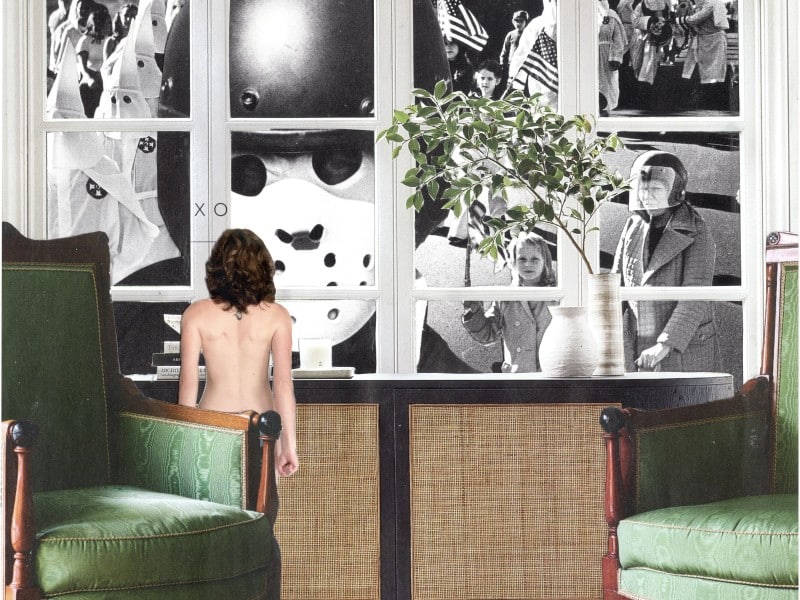
‘Pulp Stiction’ joins the resistance
A deeply compelling new collage exhibition brainstormed and curated by Emily Morgan opens at Hopkins Hall Gallery on Monday, Oct. 26.
Andrea Myers comes full-circle with progressive mural at the Line
The Columbus artist once took drawing classes in the building that now houses the new restaurant and hospitality training center founded by Service!
Take a leisurely stroll through the woods with Seanie Barron
The Irish artist’s new exhibition of hand-carved walking sticks kicks off at No Place Gallery with an opening reception today (Friday, Oct. 16).