
Matthew Ellis reckons with the impacts of religion in ‘Little Heresies’
The Columbus poet will celebrate the release of his debut collection with a reading at Two Dollar Radio Headquarters on Tuesday, Aug. 25.
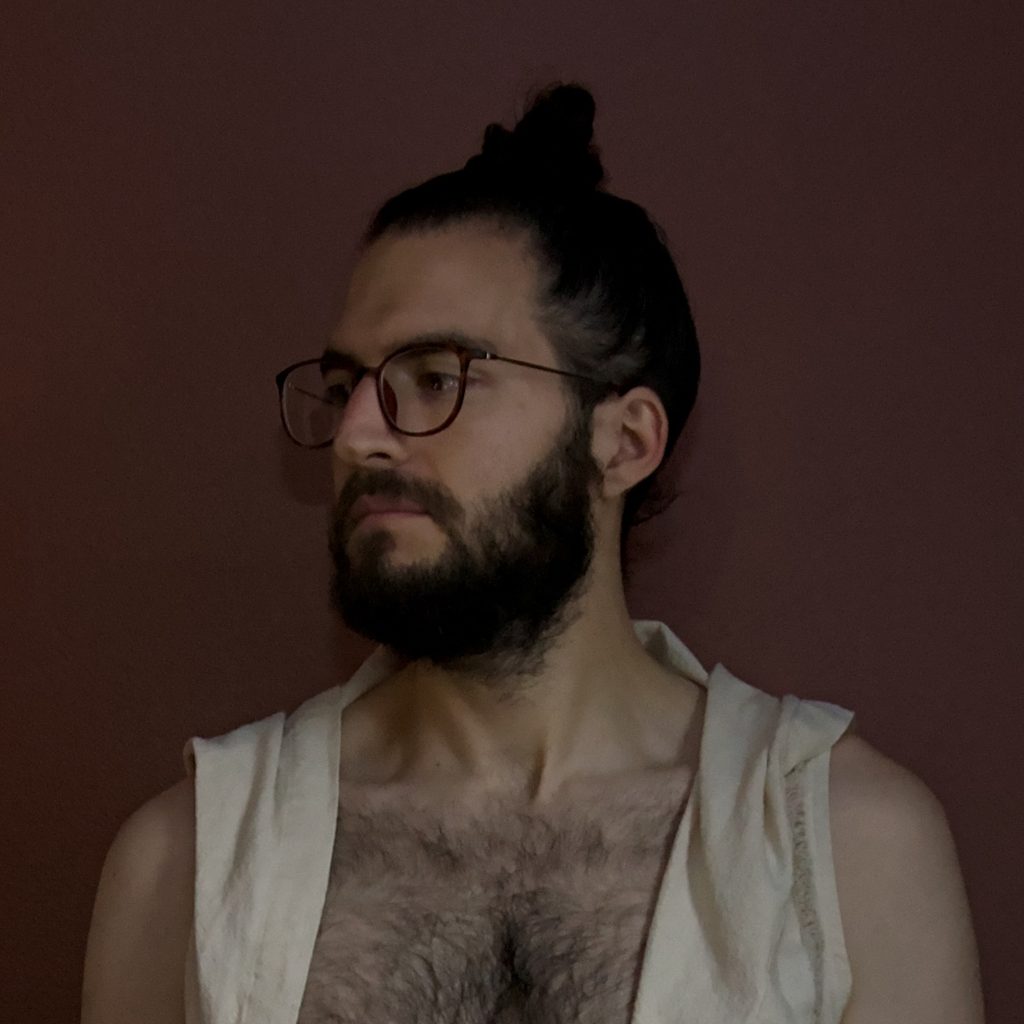
In the late teenage years before Matthew Ellis broke from the fundamentalist Protestant church in which he was raised, he often found he was the one dragging his family to weekly services, consumed from an early age, he said, with “a driving desire to be good.”
“And raised the way I was, the right thing was believing in God and going to church,” Ellis said in the days before the release of his debut poetry collection, Little Heresies, which he’ll celebrate with a reading at Two Dollar Radio Headquarters beginning at 7 p.m. on Tuesday, Aug. 25. “And when I look back on it, it’s like, oh, the church can weaponize children to bring in their parents. So I have a different perspective on it now.”
Ellis traced his split with the church to the realization he was queer and a knowledge that this would be viewed as sinful by those in his congregation, though it took years for the musician and writer to begin to deprogram himself. For a stretch in college, he tried attending services at what he described as “a trendy progressive church,” but it never clicked. And eventually he just resigned himself to his spiritual life existing in this state of unresolve. “It just kind of sat in the back of my mind as this thing I needed to spend more time and energy on,” he said, “and then also not really wanting to do that.”
A donation powers the future of local, independent news in Columbus.
Support Matter News
A turning point arrived during a 2024 writer’s conference hosted by Literary Cleveland, during which Ellis hit on the idea to write a creation poem from Eve’s perspective. This concept expanded in an April 2025 residency, which he initially embraced as an opportunity to read and respond to the entire Old Testament via poetry – an exercise he quickly scaled back after he emerged from the revisiting of a single book, Genesis, with more than 30 poems.
And so, for Little Heresies, Ellis traverses the first five books of the Old Testament – Genesis, Exodus, Leviticus, Numbers, and Deuteronomy – wrestling not just with the contents of the texts but also how the writings have been interpreted and wielded by those in power to subjugate women, demonize queer people, and advance violence.
“Turns out your god/was no different from the others,” Ellis writes in “Shame on You, Abraham,” “and sometimes gods/require a human sacrifice.”
In undertaking the project, Ellis also managed to untangle many of the unresolved issues of faith that had long been knotted within him. “And that’s part of why I wanted to do it, because I felt it was something I needed to address for myself,” said Ellis, who began taking poetry more seriously around 2022, having previously leaned more heavily into songwriting as his creative outlet. (Fittingly, Little Heresies is also being released as a spoken word collection set to music.) “This project was kind of a forced reexamining of my belief systems in a way that I was uncomfortable with. … As a child, I was taught that everything in the bible is a historical fact, and I believed it. And now, I’m not religious. And I would say I’m an atheist. And part of my goal with the project was coming back to respond to it as an adult who has a voice and can say these things now, because I couldn’t then.”
Further inspiration arrived from the weight of this political moment, with Christian Nationalism having emerged as an increasingly powerful force in shaping American policy. “And that’s part of the reason I wanted to do it, seeing this Christo-fascism on the rise and impacting life for everyday people, targeting everything from abortion access to trans people,” said Ellis, who establishes this backbone in the dedication that opens the collection, writing, “For those born into the church who didn’t fit its mold. For the rejected, the pariah, the queer, the transgender — the oppressed & persecuted. … This one’s for the heretics.”
As a poet, Ellis said his work has always been rooted in form, seeing in these structures a blueprint that could help give better shape to his words and ideas, whether in condensed means (the collection features a number of haikus, with Ellis noting his draw toward the “problem-solving” required to boil a poem down to a handful of syllables) or in more expansive verses. Witness the slightly more sprawling “Commandments,” which captures the hypocrisy of those biblical “laws” religions adopt as sacrosanct.
“Form is definitely an architecture I can grasp onto to use, even if it’s not a formal poetic form, and even if it’s like, ‘I’m going to have alternating three-line, four-line stanzas,’” Ellis said. “Then I start to come up with an idea, and then I’ll start to have a portion of the poem, and as I lay it out … I’ll make the rest of the poem fit the structure that I decided it’s going to be.”
Within Little Heresies, the poet applies these varied structures to a consistent spiritual interrogation, emerging, he said, with a greater sense of empathy for his younger self, and a renewed awareness that his earlier views were a product of the environment in which he came up. “Being raised in the church was harmful, and it was not good for my mental health, especially as I’ve turned out to be a queer person,” said Ellis, who in this transformation held tight to his childhood desire to do good. “And I don’t think that’s a bad thing, right? Because now the way I do that in my life, it’s like, what causes can I promote? And I think opposing Christo-fascism is a good thing. So, it takes on a different form, as I’m a more mature person who has better critical thinking skills than I did as a child.”
Author

Related Articles
Rachel Moss finds deep cultural connection ‘In the Girls’ Room’
‘When I think of my bedroom now, it was almost this little incubator for what my life would become as a writer and researcher, getting to explore things I liked without anybody watching or commenting on it.’

‘The whole time we were chasing our dreams, we were actually living the dream’
Long-running Columbus power-pop band Watershed will celebrate the reissue of Joe Oestreich’s memoir ‘Hitless Wonder’ with a conversation at Used Kids Records and a sold-out concert at Natalie’s Grandview.
Read Rob Harvilla’s foreword to the 15th anniversary edition of ‘Hitless Wonder’
‘[This] is a book about how and why this wonderful and awe-inspiringly resilient band won’t ever stop.’