
‘The Male Animal’ finds fresh relevance amid university crackdowns
During a February screening at Wexner Center for the Arts, the audience broke into applause both times the film’s main character defied university administrators who were attempting to clamp down on academic freedom.
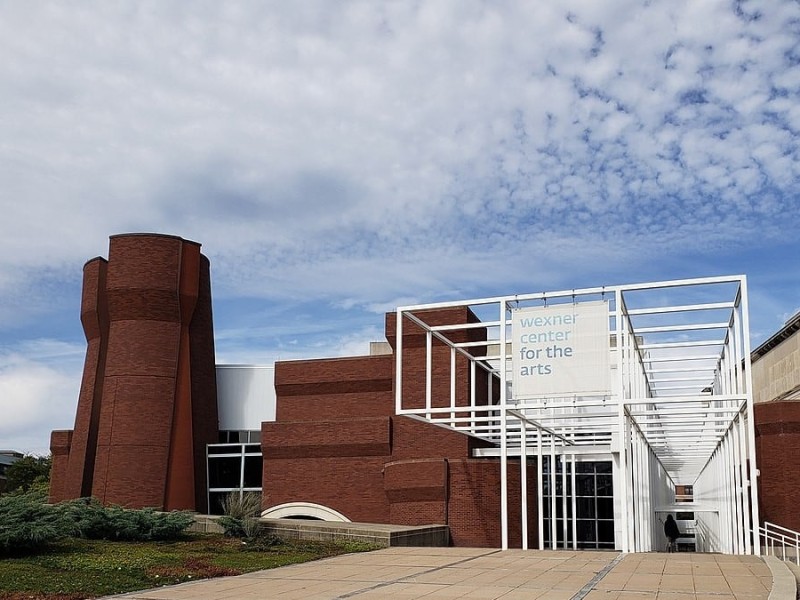
Almost 80 years after the 1942 premiere of the film “The Male Animal,” an audience of Ohio State University students, professors, and community members filled the Wexner Center for the Arts to watch a 35mm screening where multiple rounds of applause could be heard throughout the showing. The film, based on a play written by former OSU students Elliott Nugent and James Thurber, centers on academic freedom and has found revived relevance in the wake of crackdowns on universities emanating from both state legislatures and the White House.
In March 2025, Ohio’s state legislature signed the expansive Senate Bill 1 into law, which among other provisions prohibits public universities from taking positions on “controversial beliefs or policies.” The legislation has led to the closure of diversity centers at universities across the state, fueling a general fear among faculty who fear punishment for discussing politically contentious topics.
Writers Thurber and Nugent first met at Ohio State, where Nugent graduated in 1919 – a year after Thurber dropped out. In the decades that followed his graduation, Nugent became a famous playwright, actor, and director, with films such as “The Cat and the Canary” (1939) and “Never Say Die” (1939). Meanwhile, Thurber became a famous writer and artist with his short-form humor and cartoons for The New Yorker.
A donation powers the future of local, independent news in Columbus.
Support Matter News
In 1940, they co-wrote a play, “The Male Animal,” about Tommy Turner, a fictional English professor at an OSU-like school (thinly disguised as “Midwestern University”) who faces termination over suspicions of being a communist. When he decides to read a letter written by Bartolomeo Vanzetti to his class as an example of prose, trustee Ed Keller demands that he cancel the lesson. As this unfolds, Turner’s wife, Ellen, invites her ex-boyfriend to visit for homecoming weekend. The comedy balances themes of academic freedom and maintaining self-respect in a relationship.
Vanzetti’s speech was not selected randomly by Thurber and Nugent. Vanzetti and Nicola Sacco were two Italian immigrants charged with murder and robbery in 1920. The trial was condemned by many as being politically motivated due to the radical politics of the pair, who were both anarchists. Appeals were made citing conflicting evidence, new testimony, and recanted testimony, but all appeals were denied and in 1927 both were executed. Fifty years later, in 1977, Massachusetts Gov. Michael Dukakis issued a proclamation that “any disgrace should be forever removed from their names,” declaring Aug. 23 as Nicola Sacco and Bartolomeo Vanzetti Memorial Day.
In the final days of Vanzetti’s life, he delivered some of his last words in a letter in which he explained that he would’ve died an “unmarked, unknown, a failure,” but the trial and his death sentence had changed that. “Now we are not a failure,” he wrote. The world knew about their lives and struggles.
Over the course of those seven years between their arrest and execution, a global movement grew in defense of Sacco and Vanzetti. In 1927, multiple songs sung in Italian were released. H.G. Well’s 1928 novel Mr. Blettsworthy on Rampole refers to the case. Ben Shahn produced a series of paintings featuring the two in the 1930s. Marc Blitzstein wrote an opera in the 1960s that was finished by Leonard Lehrman and premiered in 2001. Joan Baez’s 1971 song “Here’s to You” was written in tribute. And writers such as Dorothy Parker, Upton Sinclair, John Dos Passos, and Mike Gold were writing about the trial while also protesting on the streets of Boston.
Thurber wrote about issues of censorship in his own time in Columbus. He called attention to efforts to ban Percy Shelley’s works due to the author’s sexuality, the attempt to ban the teaching of German in 1917 owing to anti-German sentiment during WWI, and the political support of classes hosted by fraternities to counteract the literature of Goethe. Thurber described OSU as “one of the chief fortresses of the academic army to liberal education.”
In the 1930s, the politics of the country had shifted to the left. With the Great Depression came a radical political movement fueling unionization efforts and strikes that peaked in 1934. That year, the Minneapolis teamsters strike, the San Francisco general strike, and the nationwide textile strike all coalesced to signal a new era for the labor movement.
The economic and political shift had an undeniable effect on the literature of the decade. Books such as Jack Conroy’s The Disinherited, the stories in Richard Wright’s Uncle Tom’s Children, and John Steinbeck’s In Dubious Battle and Grapes of Wrath all focused on working-class struggles.
“Authors privileged to live in this age must write novels about the workingman,” Thurber wrote in his 1934 article, “Notes for a Proletarian Novel.” He complained that the subject was a dead end for him – his only real interaction with factory workers consisted of a visit to the Buckeye Steel Castings Company in Columbus and his only memory of the experience was that of a strong feeling of embarrassment after stumbling over an iron bucket.
Although Thurber was never a part of this movement, he recognized its influence. In his review of Proletarian Literature in the United States, Thurber agreed with the importance of covering working-class stories and praised reportage from John Dos Passos and Albert Maltz, but criticized the fiction works as being “slovenly done.”
By the time “The Male Animal” debuted on Broadway in 1940, war was ravaging Europe due to the rise of fascism. With the economic success of the Soviet Union abroad and the economic crisis at home, the usage of Vanzetti’s letter as a representation of free speech fell on more receptive ears.
In a New York Times review published Jan. 10, 1940, Brooks Atkinson wrote that the school’s “Red-hunting” trustees forbade the professor to read “Vanzetti’s moving declaration of faith.” “If you want to be grave about it,” he wrote, “you can perceive under the rumble of comedy a satire on the general helplessness of the civilized man in a world dominated by primitives.”
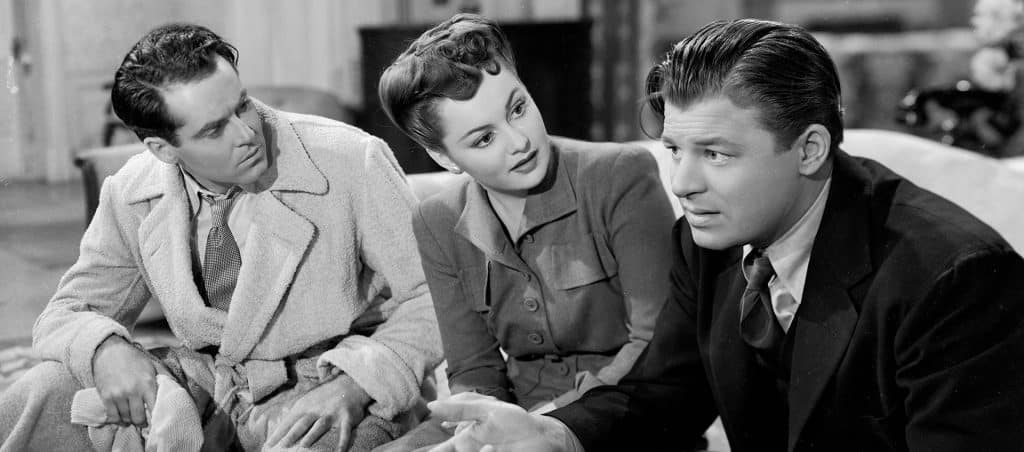
The play was a success and was subsequently adapted into a film that started shooting in 1941. Released a year later, the film starred Henry Fonda, Olivia de Havilland, and Joan Lelsie. “The Male Animal” received positive reviews and made $1 million at the box office.
While the film was considered one of Thurber and Nugent’s greatest big screen successes, “The Male Animal” isn’t available on any streaming services today. To watch the full film, one has to either find a DVD distributed in 2009 or catch a screening on 35mm film, such as the one that took part at the Wexner Center in late February as a part of the Ohio Goes to the Movies series.
The crowd applauded twice during the screening, both scenes in which the main character defied university pressure not to read the declaration. “There’s a lot of people who are clapping,” Wexner Center director of film/video David Filipi said in a postscreening discussion. “So I think there’s a lot that still resonates today.”
Related Articles
A newly restored ‘Riverbend’ finds fresh resonance in the modern era
A series of unlikely events collided to give new life to the 1989 film, which will screen at the Wexner Center for the Arts on Friday, Oct. 2.

‘Ice Cream Land’ balances fantasy, reality in making its way to the big screen
More than two decades in the works, the new documentary from artist David Denniston lovingly traces the life and experiences of Ricky ‘Ice Cream’ Jackson, who will be on hand when the film premieres at the Lincoln Theatre on Thursday, Sept. 17.

‘Wood Street’ was filmed in Oakland but it could have been made in Columbus
The new documentary from California journalist and filmmaker Caron Creighton screens at the Drexel Theatre this weekend as part of Cinema Columbus.