
Ohio Expo Center display draws scrutiny to the world of Third Reich collectors
On a recent visit to Scott Antique Markets, Jenny Sigler encountered one vendor whose Nazi flag display left her feeling that ‘the tone of that booth was inconsistent with the idea that this is just World War II memorabilia.’
On a Saturday in mid-November, a dozen neo-Nazis marched through the Short North in Columbus, setting off a media firestorm that resulted in President Joe Biden releasing a statement in which he condemned the group’s actions.
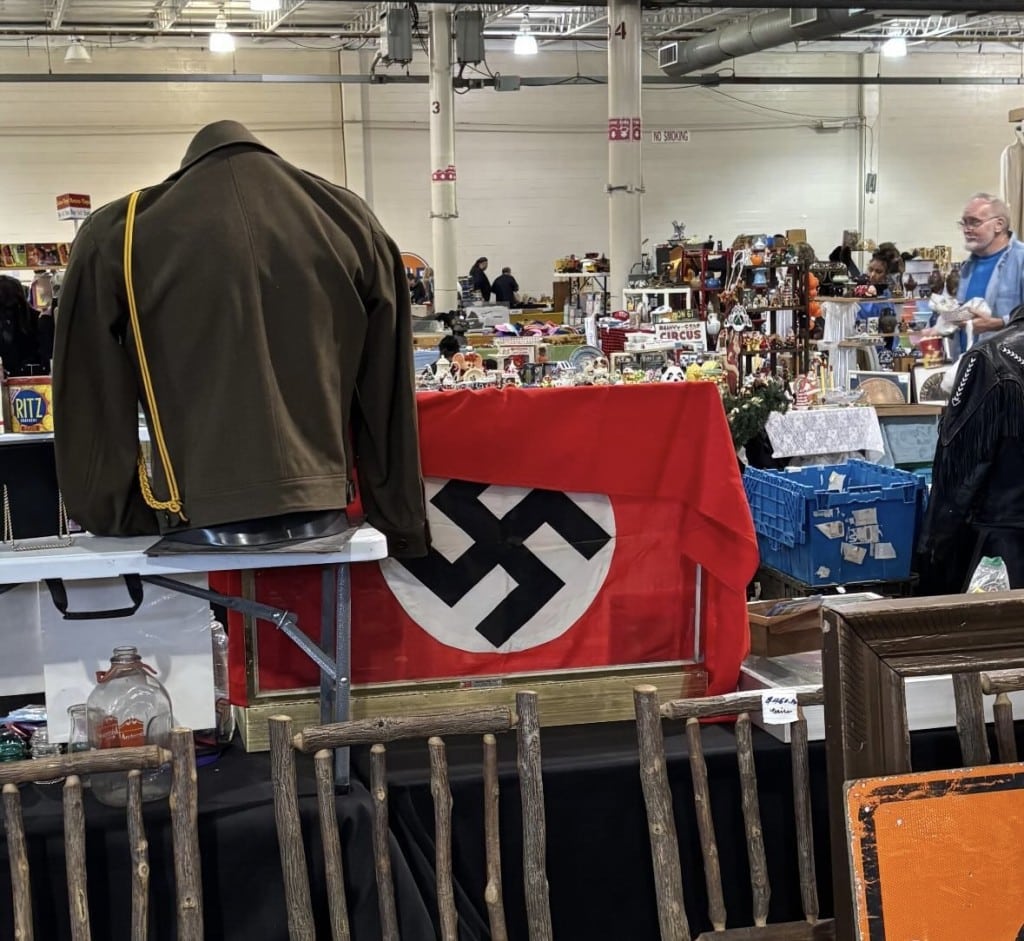
Two weeks later and roughly two miles to the north, Jenny Sigler attended Scott Antique Markets at the Ohio Expo Center, where she encountered one vendor whose booth prominently displayed a Nazi flag that could have easily been hoisted by the same marchers.
“There were hundreds of vendors, and some of them, a minority of them, had Nazi memorabilia, but it would be small things, like a button or a patch or a booklet,” said Sigler, who has encountered these types of Third Reich artifacts while antiquing in the past, describing their presence as relatively common within the collector world. “But [at Scott Antique Markets] there were two booths that had Nazi flags. And one of them, you could tell it was an antique, and that it had a historical context to it based on the age and the wear of it. But the second one, it was prominently displayed, and it was a new flag, like a reproduction, so it felt different.”
A donation powers the future of local, independent news in Columbus.
Support Matter News
The respective flags were also exhibited in ways that Sigler said drew out radically different meanings, with the aged flag set on a table next to other World War II artifacts, which added a degree of historical context. The second flag, however, was displayed adjacent to what Sigler described as “racist memorabilia, like Black people in mammy situations.”
“So, the tone of that booth was inconsistent with the idea that this is just World War II memorabilia,” she said. Yet, her concerns were summarily brushed aside when she raised the issue with on-site management. “She told me that people need to coexist,” Sigler said.
Ty Dewitt, who handles press for Scott Antique Markets, said the company fielded multiple social media complaints related to the flag in the days after the market in Columbus and he has since notified show management to make sure the vendor in question is displaying legitimate historical items when the market returns to the Ohio Expo Center on Friday and Saturday, Dec. 21 and 22. (The market, like most antique shows, allows the selling and trading of genuine Nazi memorabilia, with such items regarded as historical artifacts.)
“Reproductions have their own political nuance in modern times, so we do our best to make sure any pieces of that nature … are authentic,” said DeWitt, who added that the context in which the items are displayed would also be taken into consideration, expressing discomfort with the Nazi flag being positioned adjacent to caricatures of Black Americans. “I can definitely see why that would be an issue. … If it’s displayed next to stuff that is also vulgar, in that sense, then yes, it will be taken care of.”
In general, however, Nazi artifacts are a routine presence at these types of shows, protected under the First Amendment and serving as one of the backbones in the thriving trade that exists for virtually anything connected to the Third Reich. LiveAuctioneers, the leading online platform for antique dealers, has published more than 30,000 listings for Nazi memorabilia in the last 15 years, according to 2023 New York Times analysis, and rare items can fetch astronomical prices for sellers. In 2022, a watch said to have belonged to Adolph Hitler sold at auction for $1.1 million.
The long-running market for Nazi artifacts can be traced back to the war itself, when Allied soldiers looted memorabilia from sites across Germany and Europe at the war’s end. Chris William, who bought his first piece from an antique shop at age 12 and has collected Third Reich artifacts for more than 50 years, said he made some of his earliest purchases directly from the U.S. soldiers who fought in World War II, and then later from their children and grandchildren.
“I used to go to veteran’s houses, because they’d get older and want to sell their stuff, and I would sit there and record their stories, which was really nice,” said William, a writer for Military Trader magazine who also authored Third Reich Collectibles: Identification and Price Guide. “Some people are in it strictly for the money, and I know people who flip stuff, but I’m more in it for the historical significance. I really love to dig into things and look at the history behind them, and who was involved, and how it affected people. … It doesn’t do us any good to forget.”
Even collectors who claim an interest in this history have growing awareness of how the hobby can be perceived by the general public, particularly in an era when white supremacists and neo-Nazis have grown increasingly emboldened. In Columbus alone, recent years have given rise to both Andrew Anglin, the Worthington native who founded neo-Nazi website the Daily Stormer, and Christopher Brenner Cook, a Hilliard teenager who was sentenced last year in a white supremacist plot to attack the power grid in the hopes of sparking a larger race war.
“I know a lot of medical professionals and businesspeople who collect,” William said, “but you’ll never know about it because they understand it’s bad for business.”
In reporting for the New York Times last year, writer Menachem Kaiser wrestled with this conundrum, attempting to unpack the motivations driving those who accumulate Nazi artifacts while also exploring the flawed principles on which the larger market is built, calling attention to the complete erasure of the Holocaust from these collector spaces. Part of this is purposeful, Kaiser explained – Holocaust items are typically viewed as beyond the pale within this community of collectors. But it also “puts into relief the void at the center of this approach to this history,” he wrote.
In the feature, Kaiser also wrote of his belief that Nazi memorabilia should ultimately wind up in the hands of institutions such as museums, which by their nature can present a fuller picture of the atrocities that took place under the Third Reich than the one-sided portrait offered within the realm of collectors. He notes, for example, that the Holocaust Museum doesn’t purchase or display Nazi weaponry – a central focus for collectors – and the impact that has on the type of story being told in those respective spaces. At the same time, Kaiser doesn’t demonize collectors or portray them as closeted Nazis, describing the people he encountered as good-intentioned if sometimes misguided. (William presented a similar defense of this historic collectors with whom he has crossed paths, describing them as “pretty much no more racist than the average person on the street.”)
“A helpful insight for me was when I started to realize they were fundamentally collectors first and foremost, and if you think of them categorically it’s easiest to put them on the spectrum with people who collect Beanie Babies,” Kaiser said by phone in early December. “Therefore, they do look at these things, on some level, without any context. And I think it’s really myopic, and there is a perniciousness, even if it’s not intentional. … I don’t have a huge sample, but I have a somewhat significant sample, and there is this myopia of, ‘Oh, what on Earth could this have with anything going on today?’”
William, for one, fits this classification on a number of fronts, explaining that his historical interest in the Third Reich is tied in part to the myriad paramilitary groups that existed within the empire, with splinter groups sometimes creating their own insignias by modifying existing patches, which drives the collector in him to continue digging. “You could collect paramilitary stuff forever and never hit it all,” said William, who also expressed his belief that zero connection exists between Nazi Germany and the hate groups that have emerged to prominence in more recent years. “The NSDAP died in May of 1945, and the things going on today, that neo-Nazism, it’s completely different.”
It’s this attitude, Kaiser argues, that can make efforts to frame artifacts from this era in purely historical terms so misguided. “Sure, this particular artifact may be a piece of history,” he wrote, “but what it espouses is very much not behind us.”
“It’s like, hello? Look what’s happening,” Kaiser said. “This is a reality where Nazi symbolism is really flourishing. And what is our collective response going to be to that?”
Author

Related Articles

If you start from a place of love, you can’t go wrong
A vigil for an unhoused community member who recently died in Newark served as a call to not look away.
Henry Hess says goodbye to his longtime Chromedge studio
Faced with a rent increase of more than 30 percent, the Hess family opted to move on from the artist’s creative home of the last eight years. And while the next steps remain uncertain, they stressed that Henry would maintain a presence in Franklinton. ‘We’re not going anywhere,’ Sophia Hess said.

Barbara Fant returns to Columbus ready to leave her mark on Thurber House
The poet and newly minted executive director of the literary nonprofit will take part in a community reception welcoming her to the role on Thursday, Sept. 17.