
Uncertainty, frustration accompany planned closure of Loyalty Inn warming center
‘The harsh reality we face now is a stark contrast to the promise we were given – we’re left with no choice but to return to the streets due to a sudden withdrawal of funding from the assistance program.’
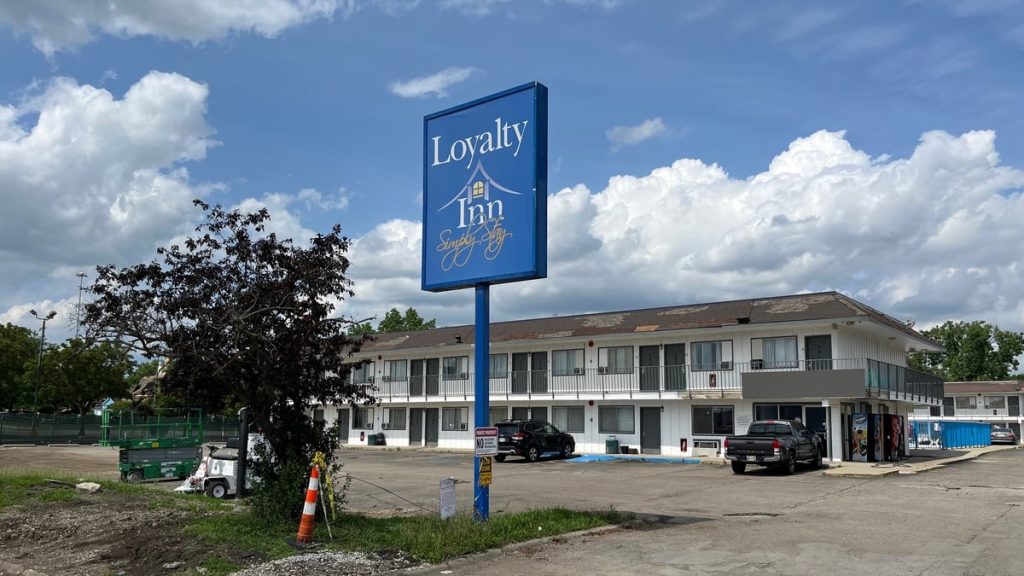
In mid-December, Amara, a pseudonym, was living in a South Side tent encampment near the Scioto River behind Dan’s Drive In on South High Street when she received what she believed to be a needed lifeline. As Amara was about to be displaced from the camp by a planned sweep, members of the mutual aid group Heer to Serve were able to direct her to a new emergency warming center operated by Community Shelter Board (CSB), which she said promised to provide accommodations through March 31 at Loyalty Inn, a motel located off of Brice Road on the city’s East Side.
“It’s what I figured I needed – someone to give me a chance,” Amara said from the Loyalty Inn a week after CSB planned to cease warming center operations on Feb. 5 and less than two weeks after she received written notice on Jan. 29 informing her of the impending closure. (Amara said she has managed to remain in the motel with her boyfriend of seven years by paying $60 a day for their room with money he makes collecting and selling scrap metal.) “Some of the people that came here when we first got here, they are no longer here, and I don’t know if it was by choice or what. But some of us were actually trying to work the program so we could get back on our feet and be self-sufficient. We just needed someone to give us a hand, and it’s not easy to get that opportunity.”
The day the warming center at Loyalty Inn closed, a Change.com petition was launched asking CSB to reinstate funding for the program, which focused on people not accommodated by other local warming centers and shelters, including unmarried couples and those with pets. “We were promised assistance, the comfort of a roof over our heads until the end of March, housed in a motel as a temporary abode,” reads the petition, initiated by Mary Jo Bruce. “However, the harsh reality we face now is a stark contrast to the promise we were given – we’re left with no choice but to return to the streets due to a sudden withdrawal of funding from the assistance program.”
A donation powers the future of local, independent news in Columbus.
Support Matter News
The experiences shared by Amara and others mirror those of more than 14 people interviewed by Matter News in May 2024, all of whom were part of a pilot program initiated by CSB and staged at Loyalty Inn. Going in, the residents said they were told they would be provided shelter until they could locate permanent supportive housing, but CSB issued notice in May that the program would be terminated at the end of June.
“This was a big change for me to come and do this, and now it’s like – poof! – and I’m going to be right back out there on the streets,” said Brenda, a pseudonym, who had been living in a tent encampment off of South High Street prior to agreeing to take part in the pilot. (CSB reversed course in late June and has continued to fund the pilot on a month-to-month basis.)
Amara traced a majority of her frustration with the sudden closure announcement to what she described as mixed messaging and consistently poor communication from CSB. Amara said the organization initially told her the housing at Loyalty Inn would remain available through the end of March — a date corroborated in a phone interview with Heer to Serve founder Emily Myers. CSB disputed this point, though, with chief communications + government affairs officer Niel Jurist writing, “There was no official commitment that individuals would be able to stay at the hotel until March 31.”
CSB has also offered multiple rationales for the decision to close the hotel warming center, heightening the sense of confusion felt by Amara and others.
A letter distributed to roughly 200 residents on Jan. 29, a copy of which was provided to Matter News, linked the Feb 5 termination to a break in the weather. “The hotels were provided beginning in mid-December … and through the severe weather we recently experienced,” it reads. “Because the severe weather and extreme temperatures have passed, we will no longer be able to provide the current hotel stays.” (Temperature this week again plunged into the single digits.)
Jurist described this letter as an attempt “to provide transparency about the temporary nature of the hotel accommodations.” She also wrote that CSB had since reconsidered its position in light of the return of extreme cold, and that all transitions out of the hotels had been paused until “temperatures stabilize, which we estimate will be around February 24.”
In a report posted on Feb. 12 by NBC4 Columbus, however, CSB cited a lack of resources for the decision to end the program, which was not included in its initial $2 million dollar budget for winter response but instead came from internal funds.
“So, the note they gave to campers as to why the program was shutting down did not give the same reasons as what they told the public,” said Heer to Serve’s Myers. “There are all of these conflicting answers here and nobody is held accountable. … People just want to know what’s happening. These are their lives, you know, they need to be able to make plans. But they’re getting a piece of paper on their door telling you that you have five days to leave. Do you have transportation? Who helps you? Where do you go? And nobody will answer these questions. And nobody will sit down and say, ‘Well, we expect them to go back outside in a tent,’ because that’s the reality.”
These same issues surface in the 2024 pilot program. Seated in a coffee shop across the road from Loyalty Inn last May, Richard, a pseudonym, expressed his fears that the decision later reversed by CSB to terminate his stay would put him back on the streets with less than he had coming into the pilot. The reality deepened a belief that his life was expendable, he said, and caused him to lose even more faith in those institutions meant to provide comfort and aid. (“We understand that consistency and reliability are critical in building trust with individuals experiencing homelessness,” Jurist wrote.)
“None of it’s fair. None of it’s right,” Amara said in relaying her belief that CSB failed to deliver on promises. “That’s how trust gets broken.”
Myers has seen the impact of this firsthand, sharing the challenge of rebuilding a level of trust with people who attempt to work within the system, only to have it fall short of promised aims. “When people get kicked out of the hotel, where do they go? They go back to the woods, back to the camps, where we serve them,” said Myers, who with other Heer to Serve volunteers runs recurring 6 p.m. Saturday serves at 151 W. Williams Rd. on the city’s Far South Side. “We’re still engaging with them, and I will tell you it’s been extremely hard, and it’s been very emotionally labor intensive, because now people who trusted you, they feel that trust has been betrayed.”
Amara said she benefited from the stability the motel housing offered in the short-term, particularly in being able to more easily maintain a needed level of self-hygiene while looking for a new job, having previously worked as a shift supervisor at a restaurant. At the same time, she raised similar concerns as those who participated in the pilot program last year related to the conditions at Loyalty Inn, which was operating under a nuisance abatement order filed against the motel’s previous owners in 2021.
“I’m not trying to complain, because it’s better than being in a tent, but there’s no heat and there’s a big hole in my ceiling where I can see the pipes going through the walls,” said Amara, who outfitted her room with space heaters. The East Side location is also isolated from the parts of Columbus with which she is most familiar, and Amara said it took 90 minutes one way and multiple buses for her to visit Open Shelter to get a needed copy of her birth certificate.
Furthermore, Amara lamented that more than a month passed before a caseworker visited her in the hotel, slowing the potential progress that could have been made to advance her cause in the six weeks she was housed by CSB. “The caseworkers came out a couple of weeks before [the eviction] went down,” she said. “It felt like Heer to Serve were the only ones going door to door asking what people needed help with, like, ‘Do you need your birth certificate? An ID? Your Social Security card?’”
Myers, a former social worker, traced this disconnect in part to a shortage of central Ohio caseworkers, while also lamenting the opportunities missed in not establishing these points of contact in the window made available. “The warming stations give them until March 31, which is a short time frame,” she said. “However, in those few months that people have relative stability, it doesn’t make sense that agencies aren’t coming directly to them and working with them. You know the room number. You know the address. You know who the folks are. Why wouldn’t you come?”
At its core, Myers said the issue with last year’s pilot program and the abbreviated warming shelter stem from the reality that the city does not have enough housing to accommodate the growing population of unhoused individuals. Jurist echoed this point, citing a study conducted by Focus Strategies that projects a 68 percent increase in the unhoused population by 2028 absent significant new investments. “CSB is actively working on solutions, including securing additional funding and expanding resources to better address the growing need,” wrote Jurist, who added that CSB is developing plans to acquire a hotel to serve as a non-congregate shelter, hoping to reduce the organization’s reliance on temporary hotel partnerships.
“It’s a smoke and mirrors show, right?” Myers said. “We don’t have enough caseworkers, but the reality is even if every organization beefed up the number of caseworkers and had 20, 30, 40 people who could go out, it wouldn’t matter, because we don’t have the housing. … That’s why we have so many people outside, because the big secret is there isn’t enough housing for all of these folks.”
Author

Related Articles

If you start from a place of love, you can’t go wrong
A vigil for an unhoused community member who recently died in Newark served as a call to not look away.
Henry Hess says goodbye to his longtime Chromedge studio
Faced with a rent increase of more than 30 percent, the Hess family opted to move on from the artist’s creative home of the last eight years. And while the next steps remain uncertain, they stressed that Henry would maintain a presence in Franklinton. ‘We’re not going anywhere,’ Sophia Hess said.

Barbara Fant returns to Columbus ready to leave her mark on Thurber House
The poet and newly minted executive director of the literary nonprofit will take part in a community reception welcoming her to the role on Thursday, Sept. 17.