Echo Martin learns to begin again
The Columbus artist’s new exhibition, ‘Proof of Life,’ which opens at 934 Gallery today (Friday, March 21), sets works informed by self-discovery aside drawings that give monstrous life to those encroaching forces increasingly determined to erase trans people from existence.
Up until a few months ago, Echo Martin struggled to find the will to create, describing a blur of days lived in a near-catatonic state that sometimes made it a challenge to rise from bed to complete even the most menial of daily tasks.
“It was just getting hit with wave after wave of depression,” said the artist, who attributed the extended lull to a mix of factors both internal (Martin is bipolar) and external. “I came out as a nonbinary trans femme a couple of years ago, and so I’ve been in this crazy place feeling incredibly euphoric about becoming this new person that I’m supposed to be – and I’m 39, so it took me a while – but then it was also like, ‘Oh, my God, this is the worst timing ever for this.’ … I had been living as a cis-het white guy for most of my life, and I think it needs to be acknowledged that I’m coming from a total place of privilege, but suddenly I found myself in one of the most harassed, degraded demographics you can think of.”
The works on display in Martin’s new exhibition, “Proof of Life,” which opens at 934 Gallery today (Friday, March 21), find the artist reconciling with these new realities, setting pieces informed by self-discovery and defiance aside richly detailed ink drawings that give monstrous life to those encroaching forces increasingly determined to erase trans people from existence.
A donation powers the future of local, independent news in Columbus.
Support Matter News
Martin’s current output is a marked departure from the work they created previously, and which they described as comparatively complex, involving CGI to develop compositions that doubled as commentaries on the more violent aspects of Western art history. The artist included the most recent of these pieces in “Proof of Life,” displaying it next to a more stripped-down self-portrait titled “Signature Search,” the bottom half of which is covered in the name “Echo” written repeatedly in cursive.
“Because I’ve changed my name, I don’t really know how to do a signature yet,” said Martin, who set the two works side by side as a means of highlighting the emotional distance they now feel from this earlier approach. “These are really complex paintings where the process takes a long time. And in the last year up until now, it’s been like, I don’t even know what this means anymore. And it almost feels a bit trite, which is why I was interested in putting these in competition a bit, to see which one is actually saying the most. And, to me, this one (‘Signature Search’) is much more meaningful and honest, where [the earlier painting] feels overly prescribed, overly produced. … I wanted to use these as a turning point, like, this is where we started, and this is where we’re going.”
The simplicity at play in these newer images emerged in part as a reaction to the self-described fussiness of earlier works, but also from Martin’s desire to reconnect with the techniques they first adopted in their practice decades back. “I’ve been resetting myself and resetting my life … so it makes sense to go back to the basics,” said the artist, who returned in several pieces to a style they first learned taking figure drawing classes as a teenager growing up in South Bend, Indiana. “And that became very fundamental to me, working from the figure, working in this classical way. … So, this one (‘Point Kicker’) looks like a throwback, and it looks like the style I had when I was an undergraduate almost 20 years ago. But then I’m taking the perspective and training I have now to say, ‘Okay, that’s cool. Now how do I actually make this a piece that says something?’”
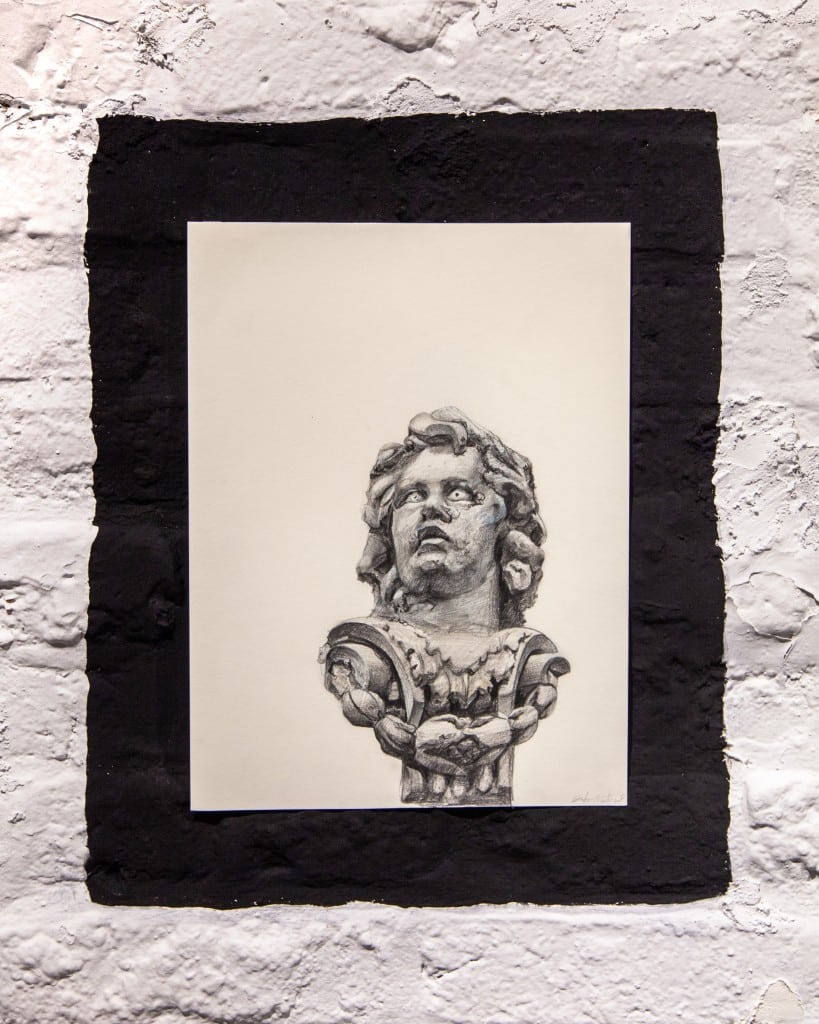
Generally, Martin said, these overarching themes begin to emerge once they’ve completed a body of work and are able to step back, distance and time combining to bring certain ideas into sharper relief. With “Proof of Life,” many of these concepts gelled most cleanly in a drawing titled “Incoming,” which features a statue-like bust frozen in a state of horror, its eyes fixed on some encroaching terror just out of frame – an apt metaphor for this political and social moment, particularly for the members of the trans community.
Other works give face to these horrors, including a twisting, many mouthed monstrosity whose maw is modeled on that of Rudy Giuliani, and a buzzsaw of circular teeth suggestive of the “Star Wars” Sarlacc and inspired by those politicians “who talk out of both sides of their mouths,” Martin said. A third portrait started with the artist creating a Photoshop composite from a baboon threat display, which they then transposed to the paper using charcoal and a variety of comparatively primal techniques, scoring the page with a needle, covering sections with tape and then ripping it off, and otherwise rubbing, tearing and gouging the image to draw out greater texture and dimension in the picture.
“There’s always been a throughline [in my work] thinking about the violence beneath the surface of things,” said Martin, who embraced The Body in Pain by Elaine Scarry as a seminal text, recalling an early chapter in which the author described the act of torture in transactional, world-altering terms. “The person going through the torture, at a certain point all that exists for them is pain, which means the person torturing them, their world has grown to dominate. And that idea of the world being unmade, that’s really potent, and I think it says a lot about what’s happening to every marginalized group right now as we’re going through this fascist stretch in our history, erasing and eliminating anyone who doesn’t fall under this prescribed identity. Saying shit like, ‘There are only two genders,’ that’s an act of trying to unmake the world of queer people, to make that world smaller, to shrink it down.”
Despite the sometimes horrifying imagery on display, the exhibition is shot through with a defiance that reveals itself in everything from the repeated Echos scrawled in “Signature Search” to the raised fist of “From My Cold, Dead Hands,” which depicts a hand clutching tightly to a prescription bottle of hormone pills – both more suggestive of the direction Martin hopes to take their art moving forward.
“I’m trying to shift over to work that pushes back against these overwhelming horrors and says, ‘Yeah, all of that is going on, but we can still laugh, we can still party, we can still love,’” Martin said. “I think what this moment needs, and the most important thing for a queer artist now, is actually to find some joy, you know, and then throw that in the face of the violence.”
Author
Related Articles
Jaylen Fultz makes space for joy in ‘It Gets Better’
The Columbus artist’s debut solo exhibition will remain on view at MPACC BoxPark through mid-July.
Afi Lane explores concepts of memory, migration in stirring 934 Gallery exhibition
The Houston-based artist’s ‘Northbound’ will remain on display at the Milo-Grogan gallery through Saturday, June 27.
WIT Gallery celebrates turning five while keeping an eye on the future
Poet, artist, and gallery founder Larry Robertson will celebrate the Franklinton art space’s anniversary with a sprawling group exhibition opening on Friday, June 12.