
Time and pressure help Diamond Young unearth vulnerability, beauty in her canvases
The Columbus artist, who in recent years has adopted a more personal approach to painting, currently has work on display in a pair of Franklinton galleries: ROY G BIV and Wild Goose Creative.
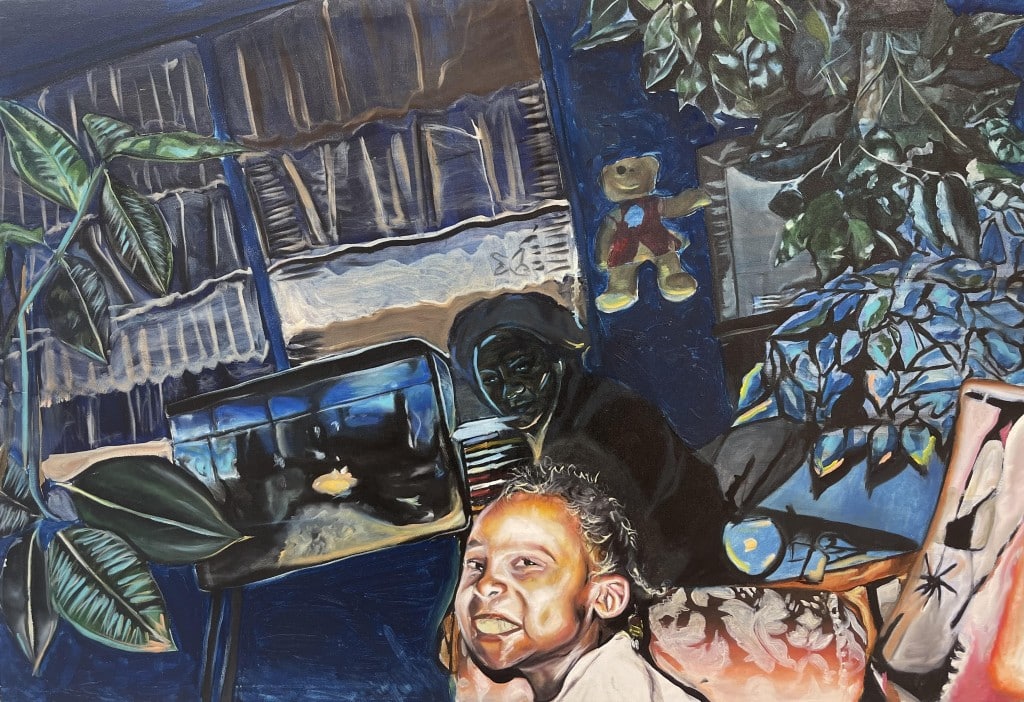
Early in Diamond Young’s time at CCAD, she took a more fantastical approach to creation, filling her paintings with superhero-esque figures set in otherworldly backdrops.
“For one of my paintings, I remember I created a storm of clouds with almost a rainbow-type vibe to it,” Young said in late July from ROY G BIV, where she currently has a trio of pieces on display. “It always felt like an alter ego, taking someone out of that human form and putting them in an entirely different sort of realm.”
But during Young’s junior year, she took a class in art theory taught by Julie Abijanac, which led her to reconsider her entire approach to her craft, abandoning these earlier, more metaphysical works in favor of realistic portraits drawn from her own life and experiences.
A donation powers the future of local, independent news in Columbus.
Support Matter News
“We were talking one day in class about the things we see as important and how we can put that in our pieces. And I was like, okay, I take a lot of pride in my personality and who I am. And where do I get that? From my family,” Young said. “And so, I started with my grandmother, because she was very inspirational to me. … Her name was Barbara Young, but we called her Buba-loo, and she was a very interesting human being.”
Young initially created two paintings of her late grandmother, who died when the artist was 15 but played a key early role alongside Young’s father in helping to raise her. The first of these is a more vivid, colorful portrait reflective of the louder aspects of the elder’s personality, while the second is a comparatively muted work dubbed “The Mourning of Buba,” in which Young’s grandmother almost fades into the background.
Young said the photo on which the latter is based was taken during a transitional point in her grandmother’s life, when her long-term drug habit exacted an almost physical weight. “Looking at the photo now as an adult, I can see what she was dealing with,” Young said. “So, in this one, I wanted to turn her into almost this ghostly figure, where you can almost tell she’s fading. … She was really good at hiding things when it came to her drug abuse, but you can see in her eyes what she was feeling in that moment.”
Revisiting those years, the artist said she was forced to confront the reality that she never properly reckoned with her grandma’s death. In the days immediately after her passing, Young cried only once, and briefly, struck by the sight of her father’s tears. Otherwise, she said she walled herself off from any sense of grief and largely carried onward. In creating the dual portraits, however, Young surfaced these old wounds, describing the creative process as one of healing in which she engaged in needed spiritual dialogue with her late grandmother.
“There are certain things in life that I wish I’d done differently before she passed away,” Young said. “Maybe two weeks before she died, she was talking to me about how I don’t call her often. And I don’t think she ever held that against me, like it was something I had to ask forgiveness for. But at the same time, these pieces do feel like I’m having a conversation with her. And they do help me get clarity on how I handled her death, and with that some sense of closure.”
When Young first presented the finished painting to her class at CCAD, she also played with it a recording of her father relaying his memories of his mom. “And hearing the pain in his voice, I could barely talk to the class because I was so busy crying,” she said. “It felt like I was pleading for forgiveness in this piece that day. It was such a vulnerable moment. And it was beautiful.”
In the months and years since, Young has continued to pursue work that captures a similar emotional rawness, creating portraits of friends and relatives in which the physical and emotional scars aren’t obscured but rather radiate with beauty, reflecting the artist’s belief that the people we are today is deeply rooted in having overcome past traumas. A portrait of Young’s aunt, for instance, is based on a photograph taken at a time earlier in her life when she struggled with drug addiction and a damaged sense of self. And yet, Young paints her relative with such care and tenderness that it grants her a sense of grace and an elegance that she couldn’t see in herself at the time.
“With this piece, it’s about how she was judged for her skin color, her hair texture. She used drugs then – she’s recovered now and has been clean for more than 12 years – and you could see how it changed her physical appearance. And how people judged her for that and made her feel not beautiful,” Young said. “But now when people see this piece, a lot of them will say, ‘Your aunt is so beautiful!’ And I know that 10 years ago she would have loved to hear that.”
Though Young centers her attentions on others in her work, she said there are aspects of her own personality that inevitably bleed onto the canvases. Taking in the portrait of her aunt, for one, Young can also see how she herself feels alienated in certain spaces, and how there have been times in her own life when she’s been made to feel in some ways like less of a woman.
“I really relate to her because there are times when I feel … I’m not beautiful enough or I’m not the desired woman,” said Young, who further explored this idea in a more recent series of paintings now on display at Wild Goose Creative. “Especially with her being my age in this painting – I believe she was 24 when the photo was taken and I’m 23 now. It was me relating with her on how we both can sometimes see ourselves as less than. But I’m working to not feel like that anymore.”
Author
Related Articles
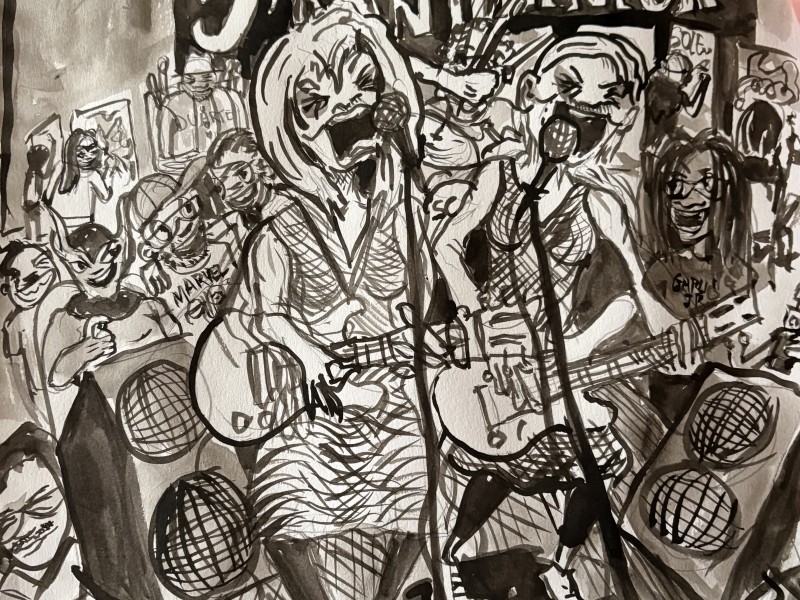
Scrawl meets Scrawl
Marcy Mays and Sue Harshe recently joined pioneering Urban Scrawl artist Dan Gerdeman for a conversation ahead of the band’s performance at the Franklinton art event that has been a longtime source of confusion for some of their fans.
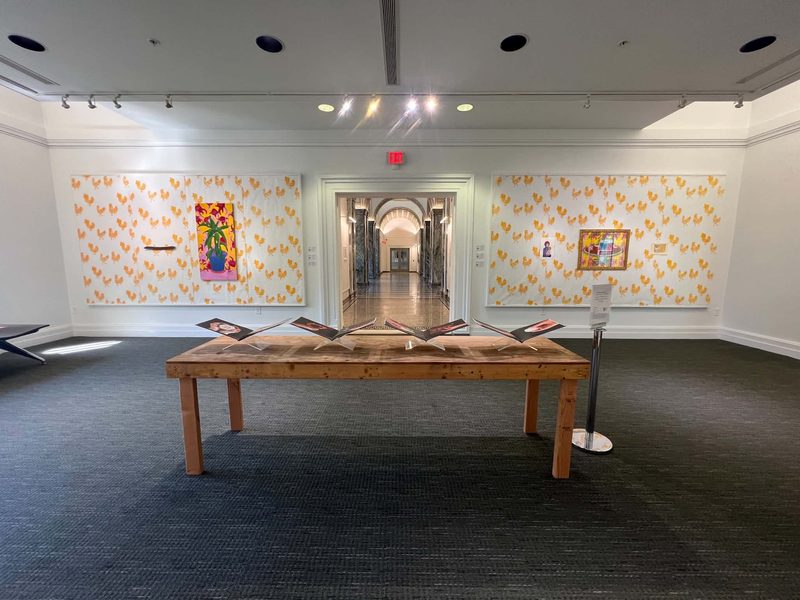
‘Immigration: A Journey of Belonging’ seeks deeper understanding
The new group exhibition, open now at the Losinski Gallery at the Main Library, will host a reception from 2-4 p.m. on Saturday, Oct. 3.
Deep conversations pave the way to ‘Chasing the Light’
A couple of years ago, Loren Bucek invited a group of artist friends to her Clintonville home. The gathering soon evolved into regular meetups that shaped the creation of a new exhibition opening this week at McConnell Arts Center.