
In Ohio, who really gets a say in Anduril weapons factories?
Newly released emails show the strength of Anduril’s legislative influence in Ohio.
This article is provided by Inkstick Media, an award-winning nonprofit newsroom that covers war where it lands: in people’s lives. You can sign up for the Inkstick Media newsletter by clicking here.
Last November, Ross Larue, an Ohio farmer and former member of his small township’s zoning board, noticed something he’d never seen before in an application filed by a real estate developer. The Larue family had been farming in Madison Township (population: 1,461) for two centuries. The fertile green pastures had been a quiet place where neighbors referred to their whereabouts by the names of the family farms that anchored the community: the Henson family farm, the Scarborough farm, the Fagan farm. When Larue began his stint on the zoning board, around 2010, the meetings were pretty uneventful. The kind of applications they’d get were things like a homeowner wanting to start a mom-and-pop business from their garage.
This application, however, was for something far more transformative. It was for a development he’d been watching for some time, which, according to the papers in front of him, had “been qualified as a megaproject,” a legal category Ohio uses for large corporate ventures. The application went on to say that zoning changes sought by the developers were “exempt” from local referendums due to newly revised Ohio law.
A donation powers the future of local, independent news in Columbus.
Support Matter News
For several years, Larue had been watching commercial real estate agents buy up farmland around Walnut Creek for warehouses and manufacturing facilities. Larue and a neighboring farmer, Paul Loar, didn’t know what kind of business was trying to set up shop in their hometown, but they knew the plans would irreversibly change their way of life. The farmers gathered the necessary signatures to put zoning changes to a popular vote — Larue on his own in 2022, and together in 2025 — but each time, the developers intervened and local officials blocked the ballot measures.
In the meantime, the pair learned who was behind the land buying spree in their hometown. It was Anduril, the nine-year-old weapons manufacturer founded by a video game developer who formerly worked at Facebook. The California-based company has become the leader of the pack of a new cohort of tech firms-turned defense contractors rapidly gaining influence and contracts from the Pentagon, including, most notably, for the “Golden Dome” missile shield that’s become the hallmark weapons project of the second Trump era.
Anduril’s own valuation doubled to more than $60 billion over the past year as investors saw the company as a key beneficiary of the administration’s eagerness to ramp up weapons purchases and expand the military-industrial base with a swath of new facilities. The company has established or acquired facilities in Rhode Island, Georgia, Mississippi, and California. Its Ohio plant was announced in January 2025 as a flagship factory for drones and cruise missiles. The developer whose application Larue was reviewing sought to rezone 170 additional acres of that future weapons plant from rural and residential to business.
Larue and Loar were shocked. The change in state law felt as though it had been in response to their ballot initiatives, but suggesting that someone in the statehouse had targeted two small-town farmers felt far-fetched.
It wasn’t.
According to hundreds of pages of emails released in May in response to a public records request, the amendment came directly from one of Anduril’s registered lobbyists, Levi Gross. Gross sent an email with the subject line “Anduril-Zoning Amendment” to an aide for Larue and Loar’s statehouse representative just days before the provision appeared in a 5,000-page state budget bill.
“Most citizens in this area don’t want it,” Loar said of the Anduril factory. “Citizens are opposed to something that a government higher than us appears to be pushing through with their own will.”
Larue concurred. “It’s not fair for other people to come in and dictate what happens in this rural community.”
The emails were obtained via a public records request by Bill Lyons, a democratic, community, and environmental rights activist who is a co-organizer for the group Columbus Community Bill of Rights and president of the Ohio Community Rights Network. Lyons shared the emails with Inkstick Media.
On April 3, 2025, Gross wrote an email to Jared Ysseldyke, a legislative aide to state Representative Brian Stewart. The lawmaker represents all of Pickaway County (as well as other territories in his district), the site of the Anduril plant, and also chairs the powerful House Finance Committee, where the state’s annual budget bill is marked up before it goes to a vote in the full chamber. In the email, Gross told Ysseldyke that “Bill” had spoken with Stewart in the morning and that the lawmaker had indicated he was “supportive” of the proposed amendment. The lobbyist, Gross, described the amendment: “The property owner where Anduril is to be located has experienced several citizen initiated referendum[s] attempting to overturn properly approved township zoning of adjacent parcels. This poses a significant risk to the Anduril project, which must be rezoned. The amendment provides that a zoning properly adopted by the township trustees that is part of a megaproject is not subject to a referendum.”
The amendment was not present in a version of the annual budget bill, HB 96, introduced in February. Six days after the email was sent, the House passed its first version of HB 96, which, on page 811, included language that said that zoning for “any property involved in a megaproject” in a township would be exempt from referendums.
Stewart and his aide did not respond to requests for comments. Neither did spokespeople for Anduril. Madison Township trustees did not respond to a request for comment about why Larue was removed from the zoning board.
The citizen ballot initiatives Gross referred to date back to 2022, when Larue first gathered enough signatures to challenge a rezoning proposal through a referendum. The measure initially qualified for the ballot but was later thrown out after a protest by the developer and a dispute over the accuracy of a map and acreage figures.
In January last year, Larue finally found out what was behind all the zoning machinations: Anduril was planning a 5,000,000-square foot facility dubbed “Arsenal-1” in his hometown. Governor Mike DeWine claimed that the plant would be the largest job creation project in state history.
Anduril’s 33-year-old founder, Palmer Luckey, told reporters the factory needed to be built quickly because the United States could be at war with China as soon as 2027.
“This is the arsenal of democracy for the modern era, and it’s being built right here in Ohio,” Luckey said.
Two months after that announcement, Larue, now joined by Loar, tried the ballot initiative again. A new developer had approached the township government seeking to rezone 178 acres for warehouses and industrial use. The farmer pair gathered signatures to get that zoning put to a referendum. An attorney for the developer again protested, requesting that election officials expedite their review of the signatures. The Board of Elections disqualified dozens of them, and the referendum never occurred. In an email to Inkstick Media, the Board of Elections denied that pressure from a developer led them to scrutinize and disqualify signatures.
At the same time they were organizing the second referendum attempt, they both ran for township trustee — and each came within five votes.
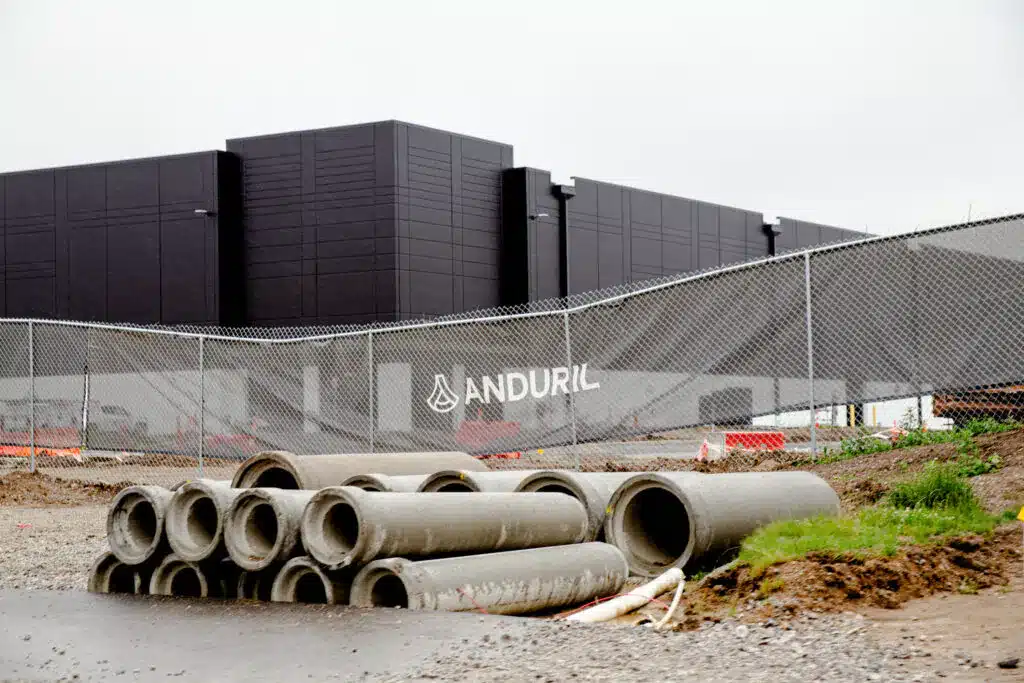
Beyond Madison Township, a diverse coalition of watchdogs and activists have come together to stage what’s sometimes known as a “site fight” against the planned weapons factory, uniting under the name No Ohio Anduril Plant. The company has just one facility up and running, a preexisting warehouse that Anduril leases and painted black, while most of the future plant site is still soybean fields and pasture. Their concerns range from hyperlocal to international ones, such as the potential erasure of Indigenous archeological sites on the plant’s premises and outcry over Anduril’s ties to the Israeli and Emirati arms industries, as both countries stand accused of committing genocide in ongoing conflicts.
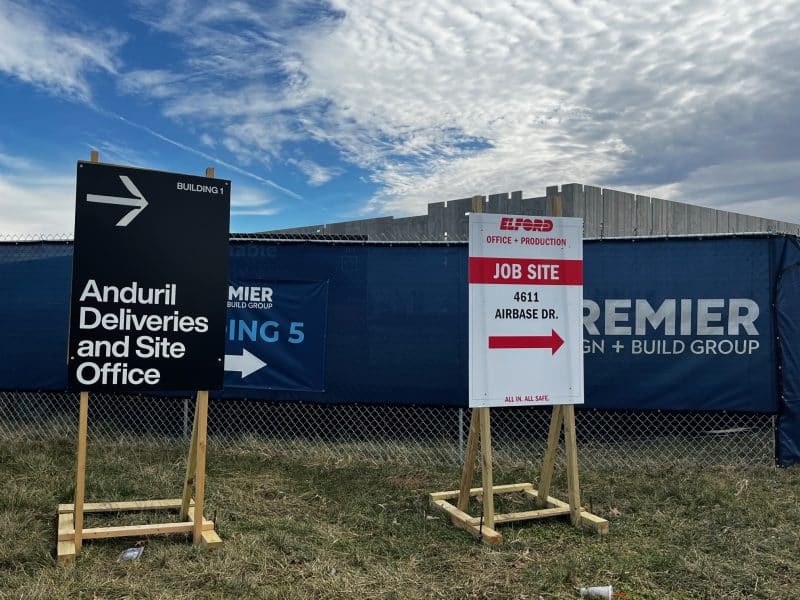
The closest neighbor of the warehouse Anduril leases, where it began producing the YFQ-44A drone (also called “Fury”) in March, is a trailer park with several hundred homes called Country Estates. Residents there expressed a variety of views about Anduril and the development boom in the area, including fears that the investor who owns the park would sell the land and evict them.
“It’s inevitable, but I don’t want it,” said one father, who requested anonymity in order to speak frankly on a sensitive issue. “They’re going to do whatever they want because they got the money.”
One neighbor said having military installations, such as the Rickenbacker Air Field, nearby made her feel safe. “As far as Anduril, I am for them because that is our defense,” the grandmother said. “We don’t know what these other countries are trying to do.”
Another resident said he didn’t have any strong opinions about living near a weapons plant (“I don’t care as long as they don’t shoot this way”), but that the warehouses taking over the agricultural lands had cost him one of his favorite hobbies and sources of dinner, deer and pheasant hunting, which he used to have free reign to do on the Fagan Farm. The building boom attracted coyotes and crowded them into ever-narrower areas, where they then ate the pheasants before he could get to them.
As developers and investors take over the area, he said: “Everybody’s just going to have to get up and go.”
Loar, like the hunter, said he was frustrated that Anduril is taking over fertile agricultural ground, greenfields rather than so-called brownfields, where mothballed commercial and industrial facilities sit vacant.
“With the contamination of groundwater, you’re going to see crop quality diminish, you’re going to see traffic lighting affect the health of livestock, so the people who still do make their living through agriculture, they’re going to see their livelihood impacted,” he said.
Despite the struggles faced by small family farms, Loar said he still earns about a quarter of his income from agriculture. And for him, the value of carrying on his family’s heritage and growing crops is more than monetary. “It’s something that, when you grow up with it, it becomes a part of you,” he said. “And you feel like when the seed goes in the ground, your heart goes with it.”
The local battle over Anduril’s planned weapons plant and the role of the company’s lobbyist in thwarting local referendums points to a broader issue that pits locals against special interest groups at the statehouse, according to Lyons, the democracy activist who obtained the lobbyist emails.
The issue is known as “preemption,” which is when lawmakers pass state-level legislation to counteract local laws. In Ohio, a constitutional provision referred to as “home rule” means that municipalities have the right to pass and enforce local laws for their health, safety, and welfare so long as they don’t conflict with general laws. Past attempts to use “home rule” have included locals who banded together to ban flavored tobacco products in Columbus, concerned that the products appeal to children, and animal welfare advocates who passed bans on so-called “puppy mills” in Toledo and Grove City. Both were overturned when state legislators passed tailor-written provisions banning such laws.
Lyons, seeking broad legal change that would stave off such preemption, now spends his free time gathering signatures for a city charter amendment called the Columbus Bill of Rights that reaffirms local self-governing rights. Advocates say that reinforcing “home rule” would give locals a greater say about what kind of community they want to live in, including whether that includes a drone factory.
Laure and Loar’s local democracy battle also lives on in the legal sphere. Larue sued township officials and the commercial real estate developer in March, alleging irregularities in the rezoning process meant that the reclassification of the land should be invalidated.
Loar said seeing the Anduril lobbyist’s role in crafting the amendment quashing local voters felt insulting.
“It proves the point that these people were very, very concerned that the subject of their Anduril plant was going to make it to the ballot here,” he said. “Two farmers, regular people, can make a difference if you get enough people to stand up with you, and we can defeat these things.”
He added: “I’ll say, it also put a little bit of wind in the sails.”
Reporting for this story was supported by the Fund for Investigative Journalism.
Related Articles
Inside Ohio’s Revolt Against Data Centers
A colorful crew of activists helped spur moratorium votes in 10 communities next month. Now, they’re aiming for a statewide ban.
Ripped to Shreds is ready to hit the runway
The new resale shop, created in partnership between artist and musician Courtney L. Hall and Used Kids owner Greg Hall (no relation), will celebrate its grand opening on Sunday, Oct. 11.
Two Dollar Radio HQ reopens with an expanded ownership group and a similarly expanded vision for the future
‘I think a big part from opening was to give authorship of the space to people with good ideas, to open the doors to people to try different things.’