
Diamond Young continues to scale up with ‘Southeast Shine’
Embracing larger canvases and an expanded approach to storytelling, the Columbus artist delivers in a staggering new exhibition opening at Streetlight Guild on Saturday, July 18.
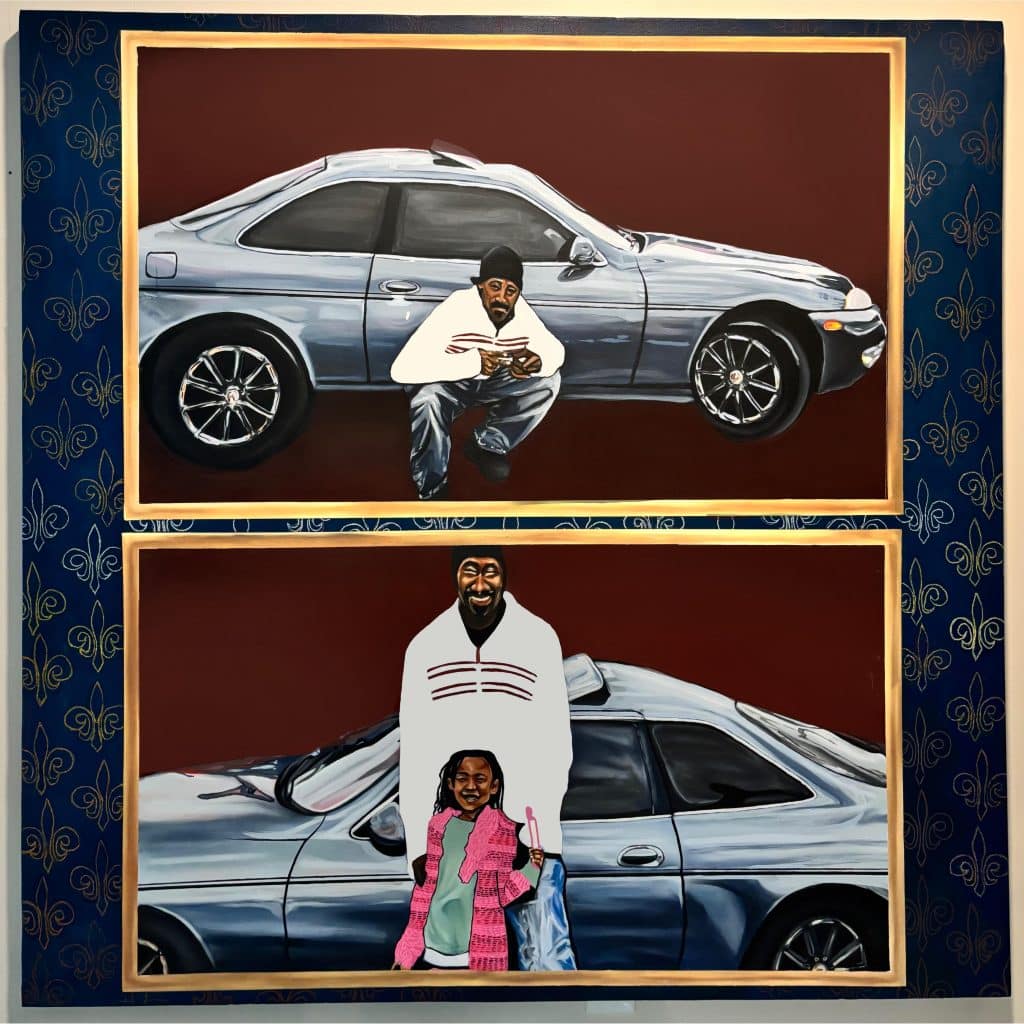
The works that Diamond Young exhibited at the Franklinton gallery ROY G BIV a couple of years back often centered on one-on-one familial relationships, painted on a smaller scale that reflected this sense of intimacy.
With the artist’s new show, “Southeast Shine,” which opens at Streetlight Guild on Saturday, July 18, Young’s family again takes center stage, though both her approach to storytelling and her awareness of the social and political factors that can shape a life have since expanded along with the size of the canvases on which she crafts her increasingly staggering works.
“With the pieces you saw at ROY G BIV, it felt like there was still so much I could talk about, and I felt like I’d just scratched the surface,” Young said in an early July interview. “So, with ‘Southeast Shine,’ I wanted to speak about the part of [Washington] D.C. I was raised in, and the stories my family members were experiencing in that southeast area – the drug abuse, and the gang violence, and … how those can impact everyone in a community. And I think the magnitude of the story I wanted to tell forced me to work on a bigger scale.”
A donation powers the future of local, independent news in Columbus.
Support Matter News
Based on photographs of Young’s father, grandmother, sister, and cousins, among others, the paintings on display through September at Streetlight Guild are first rooted in the artist’s desire to explore these bonds and to honor and preserve aspects of her family story, with the social commentary sometimes arriving as a result of these interrogations. “With half of the paintings, I’m not even trying to do anything political or to [wade into] controversy,” Young said. “But in the process of painting … I start to notice connections. And, honestly, there’s just a knowledge that I continue to get in growing older as a young Black woman.”
Take as one example “Tell Me, What’s a Dollar Really Worth?” which began with the artist crafting a portrait based on a photograph of her cousin and his friend setting fire to a dollar bill. After the two were arrested, however, Young began to make subtle changes to the work, incorporating snippets of text (“FreeTaxUSA”) and growing the story to speak to the ways people from underserved communities are negatively impacted by generations of neglect, their paths shaped by a combination of underfunded schools, excessive policing, and economic abandonment.
Similar ideas are threaded throughout the striking “To Be Free,” which reflects the disparate paths that blood relatives can be driven down by these collective forces, depicting Young’s father alongside his cousin, who was sentenced to 20 years in prison for a crime he committed at age 19.
“And when I was painting it, I started having more conversations with my father, and he opened up to me about that story and … how he got to a space of forgiving his cousin,” said Young, who shared how her relative has schizophrenia that had gone untreated as a younger man. “And my dad understands now how his cousin has grown from that situation. He’s changed, and he has a whole new mindset, and he seems much healthier mentally. And me creating that piece was a way to have grace and understanding of him.”
The portrait is embedded with photographs taken of Young’s father and his cousin during various prison visits throughout the years, helping to capture the relative stasis of incarceration, the cousin’s life essentially put on pause for decades while her father continued to navigate the larger outside world, having children and then eventually grandchildren.
“His cousin spent 20 years incarcerated in Mansfield, and the day he was released, he came with my father to see the piece I made of him at Urban Arts Space, and he still had his prison outfit on,” said Young, who displayed a trio of the “Southeast Shine” paintings in the recently concluded “We Just Still.” “And experiencing that full circle moment, seeing themselves as children and how much their lives have changed, there were a lot of emotions in that room. And it made me realize how powerful talking about these experiences and creating can be, and how important it is to hold space for different demographics of people and their ways of life.”
For this coming exhibition, Young challenged herself to work with new materials, incorporating acrylic paints, which presented a hurdle in how quickly they dried. She also experienced the odd misstep, such as when she sanded the gesso on one canvas too smooth, leading it to absorb more paint than she had anticipated.
“And so, I had to do layers and layers of everything,” Young said of the painting that would become “Hartford St.,” a reflection on grief created in the wake of her grandmother’s death, and one in which the accidentally prolonged creative process came to mirror for the artist the lingering sorrow she experienced in the wake of this loss. “And it’s crazy how that worked, and how it went along with the storytelling.”
There also exists within the exhibition a tension between the damages wrought by these deep-rooted societal ills and the sense of safety Young always felt at home, which is reflected in the artist’s decision to most often portray herself in her paintings as a child.
“II think I was happiest at that time. And when I paint myself as a child, it always puts me back in that peace and brings me back to how hopeful I was as a kid,” said Young, who credited her parents with preserving an environment in which her creativity was given room to flourish. “And I think something I’ve noticed more through my creation is that my parents were definitely going through it [at that time]. But even though I knew as a kid my father was selling out of our home trying to make ends meet, and I knew that my grandmother was an addict, in an odd way things were still very peaceful for me. And my nervous system always felt very well regulated within those spaces in a way it doesn’t now as an adult. … And I think that just gives me so much more respect for the people I held those delicate times with, and who I held closer in the painting.”
Author
Related Articles
‘Blood Pressures’ goes deeper at No Place Gallery
The exhibition, which closes on Saturday, Aug, 22, finds a group of artists engaged with interior worlds.
Amber Groome finds resilience in ‘Internal Garden’
The Columbus artist’s new exhibition will remain on display at Sarah Gormley Gallery through Sept. 5.
Artists seek out ‘A Common Thread’ with the late Sue Cavanaugh
A new group exhibition curated by Char Norman and celebrating the life and work of the late Columbus artist will remain on display at the Ohio Craft Museum through Sept. 26.