
‘It was a holy and sacred experience to speak for them’
Stacy Schwab had submitted a victim impact statement weeks earlier, but she wasn’t prepared to speak when she entered the courtroom with others who testified about the harms done by Purdue Pharma.
When her name was called, her heart raced.
She told the court that she did not know she would be asked to speak, so she didn’t come prepared.
“I’m going to wing it,” she said. “Four foot eleven morphs into six foot eleven when forced to stand on a mountain of dead bodies.”
A donation powers the future of local, independent news in Columbus.
Support Matter News
And then, she added, “I’m shaking.”
“That’s okay,” the judge said, “speak from the heart.”
That’s when Stacy Schwab, like dozens before her, told her story, speaking about the ways Purdue Pharma impacted her life and all that she had to overcome.
The day before the hearing, Schwab left Buffalo, New York, and drove three hours east to the Binghamton home of her friend and mentor, Alexis Pleus. Pleus is the founder and executive director of Truth Pharm, an advocacy organization that seeks to “reduce the stigma, educate the public and advocate for policy changes to reduce the harms caused by substance use.”
Schwab said that as she drove, she felt something like closure. She was listening to the Grateful Dead, her favorite band. Her go-to recording is Winterland 1977, a treasure trove of songs from a stint at Winterland Ballroom in San Francisco.
Their music grounds her, she told me.
From Binghamton, she piled into a big van with a group of activists. She sat in the back row, loving the camaraderie, the connection she felt with a community of people who have also lost but are with her in the fight.
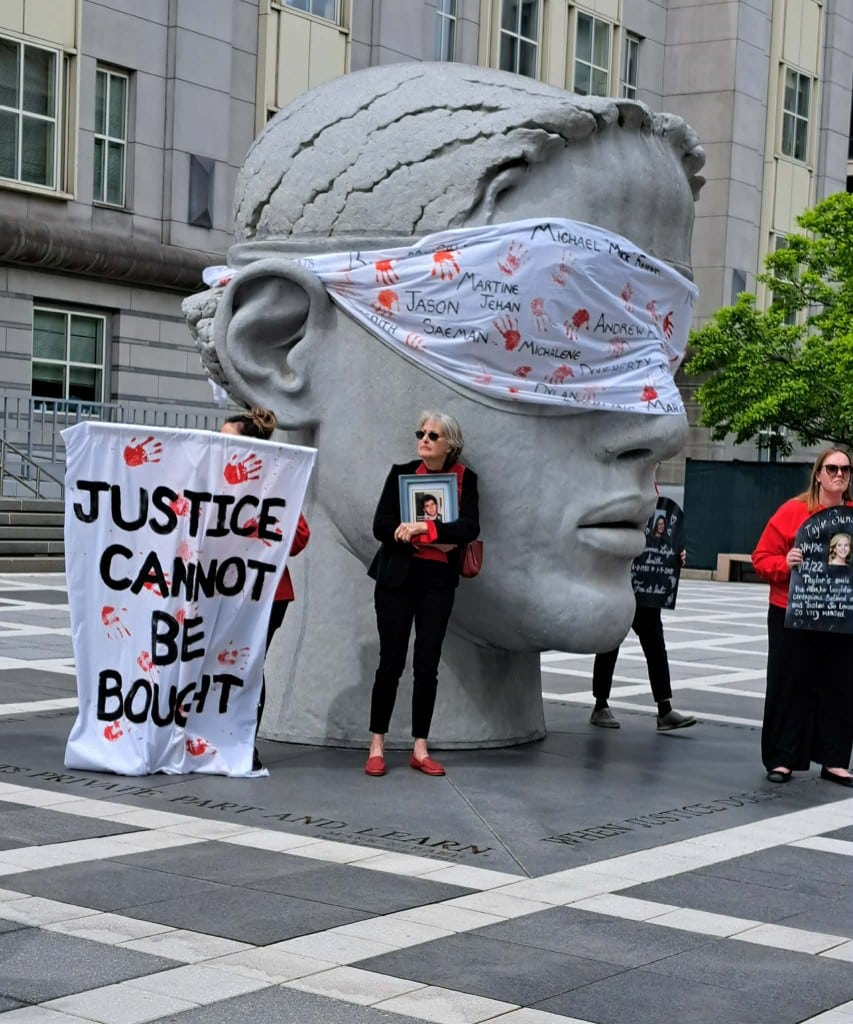
The next morning, folks gathered at the courthouse where they blindfolded a statue and placed a sign next to it that read, “Justice cannot be bought.”
Schwab talks about these gatherings like they are family reunions, describing how links are made with new members and bonds are reformed with old ones. These people share her experiences. Some have struggled with opioids, and some have lost loved ones to overdose.
“We meet, and we are family,” Schwab said, “but we were family long before we met.”
Schwab had submitted a victim impact statement weeks earlier, but she hadn’t been asked to speak, so she wasn’t prepared to do so when she entered the courtroom with the others. She planned to listen as folks shared their victim impact statements in court, and she would support them.
But she was not prepared to speak. She was not planning on it.
Around 2:30 p.m., Schwab stepped out to make a phone call. While she was outside, Pleus yelled for her to come back into the courtroom. Pleus had passed a note to the clerk to ask if some of the people present could fill the spaces of those who had been slated to speak over Zoom but who had decided against it at the last moment.
Schwab returned to the courtroom and sat there waiting.
“I was very nervous,” she said. She held a photo of her late father, James, who died in January. In the photo, which she clutched like a talisman, her dad is wearing a ballcap and sunglasses and looks like he’s resting. It’s a calming photo, and she needed to remain calm.
“I was trying to self-soothe,” she said.
And then her name was called.
She was nervous, but she felt like the judge heard her, was respectful.
She told her story. She spoke about how after a back injury her doctor suggested OxyContin and sent her out the door with some Oxy merch and a script. She spoke about how she became addicted, how she needed more and more to address the pain. She spoke about how she struggled to get help, and how she went into treatment and lost people she was in treatment with – one from an overdose and another who died by suicide. She spoke about how she stopped using, but how her sister continues to struggle. She spoke about how she lost her cousin, Andrew, to overdose. And she spoke about being inspired by Alexis Pleus, and how this community she’s connected with has saved her life.
And then she offered these lines from the Grateful Dead song, “Throwing Stones,” maybe directed at the Sacklers, who weren’t present in the courtroom: “Rich man in your summer home/ Your pants are down/ Your cover’s blown/ It’s all too clear we’re on our own.”
It’s a song about the harm that humans do to one another, about cynical rich people taking advantage of people, of the earth.
Schwab said that when she went to sit back down, she was shaking.
“You know that moment in ‘Young Guns’ when Billy the Kid says, ‘I shall finish the game’?” she said. “I had finally done something all the way through from beginning to end.”
It felt good, she said. She had finished something, and it wasn’t for her alone.
“It was a holy and sacred experience to speak for them,” she said.
But Schwab knows she still has work to do. The settlement money needs to get into the hands of the people who need it most. “We have to stay vigilant,” she said. “It didn’t end in Newark.”
Author
Related Articles
Opinion: Trifectas are only good for racing and the lottery
The legacy of Ohio’s Republican Party is corruption, scandal, and culture wars. Our votes could put an end to their occupation of state government.

If you start from a place of love, you can’t go wrong
A vigil for an unhoused community member who recently died in Newark served as a call to not look away.

On Development: Rapid-transit is moving slowly. Maybe we need a new model
Our policies suggest a willingness to spend any amount to add lanes and bigger (towering!) interchanges for major highways, while transit spending is too often regarded as frivolous.