
‘Wood Street’ was filmed in Oakland but it could have been made in Columbus
The new documentary from California journalist and filmmaker Caron Creighton screens at the Drexel Theatre this weekend as part of Cinema Columbus.
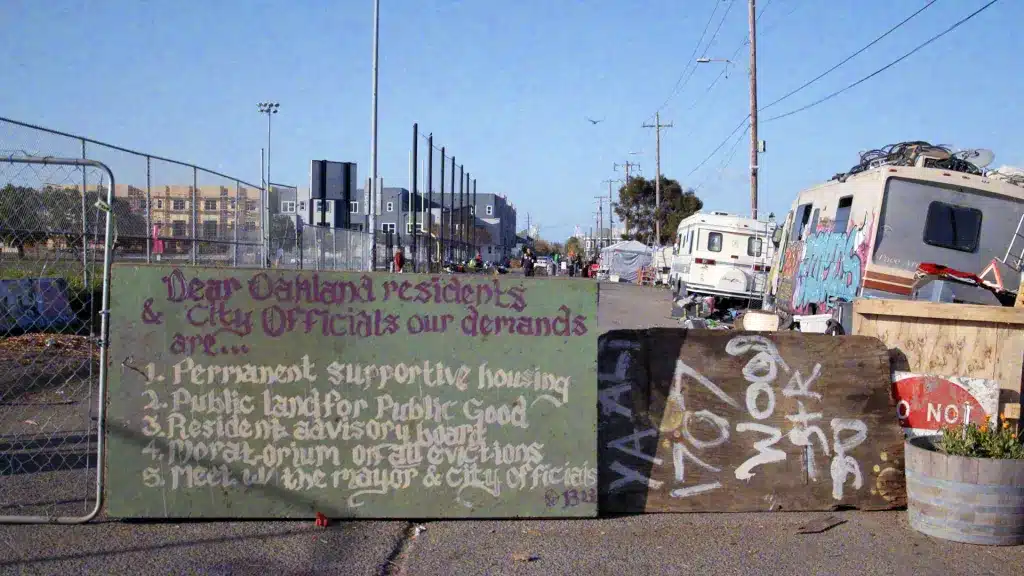
The new documentary from journalist and filmmaker Caron Creighton opens with the residents of Wood Street Commons, an unhoused encampment in Oakland, California, engaged in a peaceful standoff with state authorities.
Creighton then jumps back in time, delving into day-to-day life in the camp as its residents face the slow, inevitable build toward eviction, which the encampment fought via civil disobedience only after all legal routes had been exhausted.
Over the course of 100 minutes, “Wood Street,” which screens at the Drexel Theater at 2 p.m. on Saturday, Sept. 12 as part of Cinema Columbus, surfaces a moving portrait of civic action and community survival, Creighton centering the perspectives and voices of those unhoused people who are often left completely out of the conversation, particularly when it comes to the city development that impacts them.
A donation powers the future of local, independent news in Columbus.
Support Matter News
The idea of making a documentary coalesced for Creighton when she started visiting Wood Street in 2021 in her former capacity as a journalist for The San Francisco Chronicle.
“And I kind of started getting to know some of the advocates and some of the people who live there, and then in June or July of 2022 they got eviction notices from the state of California,” Creighton said. “And they had gotten notices before, but this felt more final. And then I saw the community take the state to court, and they were doing Zoom hearings with lawyers under the highway overpass, and I was like, this feels uniquely interesting, the idea of people really fighting back on this.”
The film resists the urge to delve into the backstories of the people living at Wood Street, with Creighton explaining that the sob stories that tend to make up the bulk of mainstream coverage of the issue held little appeal for her. “It’s always like, ‘How did you become homeless?’” she said. “Like we need all of this information before we can become empathetic to them.”
As the documentary unfolds, however, peoples’ personalities emerge, and in particular those of Wood Street residents John Janosko and LaMonte Ford, whom Creighton homed in on early as dynamic voices. At the time the director started filming, Janosko had already been making videos about the camp’s plight and posting them to social media, positioning him as a thoughtful, if soft-spoken leader. Ford, in contrast, wears his heart on his sleeve, his advocacy existing almost as an exposed nerve.
In one moderated conversation between Wood Street residents and neighboring community members, for instance, Ford engages in an emotionally complex back and forth with one woman that in a span of 90 seconds manages to cover the resentment some in the area feel toward the unhoused, the desperation that comes hand in hand with living on the street, and the sense that a broken system is leaving everyone somehow worse off. The dialogue ends with the two embracing, both of them in tears. “You guys are pushing us to where? Where are we going to go?” Ford says. “We’re not trying to. … We’re trying to help y’all,” the woman replies.
“As I was filming that, I think in my mind I was just like, ‘What the fuck is happening?’” said Creighton, who acknowledged that it took her several months to begin to unpack the nuance present in the emotional exchange. “And it was realizing it was very Oakland-specific, but also broad and understandable by anyone who’s facing economic inequality and challenges in their own communities.”
The same could be said of the film, which lives at a very specific intersection in West Oakland but speaks to the way those in power have addressed the growing number of unhoused in the United States at both the federal level (a July 2025 executive order framed the unhoused as a threat to public safety) and within localities (there are strong echoes of Columbus’ approach to camp “abatements” in how the Wood Street residents are treated).
Creighton’s film benefits greatly by hewing to the perspective of the unhoused, the voices of city officials, including former Oakland Mayor Sheng Thao, coming through only in their limited interactions with Wood Street residents, whether in one-sided presentations or in questions shouted at them on the street from a distance. In one memorable scene, a small group of activists and the unhoused dress up and board a bus to attend Thao’s inauguration at her behest, only to view her acceptance speech from a remove in the crowded ballroom, drawing attention to the distance at which the group rests from those with the power to make the decisions that impact their collective existence.
“I think at a certain point I realized that in order to get sit-down interviews with the city, I’d need to be kind of chummy with those people, and if I were being chummy with the city, the Wood Street folks would lose trust in me immediately,” Creighton said. “And I think it’s better for it. There’s plenty of media that highlights the city’s voice and opinions. I don’t think not having that in the film is any loss for them.”
One throughline that ripples throughout the film is the sense of community present at Wood Street, and which the residents stress the importance of holding to both internally and in meetings with city planners, who have enticed some from the encampment to move to an adjacent village of tiny homes hastily erected on a barren concrete plot absent common areas.
“And it was interesting to me to show this aspect of community and street family that I think a lot of housed people have no concept of,” Creighton said. “Often, housed people don’t even have a real deep sense of community for themselves. So, it felt important to me to show those connections.”
Author
Related Articles

‘American Doctor’ asks viewers to not look away
The gut-wrenching documentary from director Poh Si Teng, who will be on hand when the film screens at the Wexner Center this weekend as part of ‘Unorthodocs,’ takes viewers inside Nasser Hospital in Gaza.
A newly restored ‘Riverbend’ finds fresh resonance in the modern era
A series of unlikely events collided to give new life to the 1989 film, which will screen at the Wexner Center for the Arts on Friday, Oct. 2.

‘Ice Cream Land’ balances fantasy, reality in making its way to the big screen
More than two decades in the works, the new documentary from artist David Denniston lovingly traces the life and experiences of Ricky ‘Ice Cream’ Jackson, who will be on hand when the film premieres at the Lincoln Theatre on Thursday, Sept. 17.