
Listen to the birds before it’s too late
Our columnist recalls the nightingales he heard singing outside of a former Nazi concentration camp a decade ago and sees lessons that apply to this political moment.
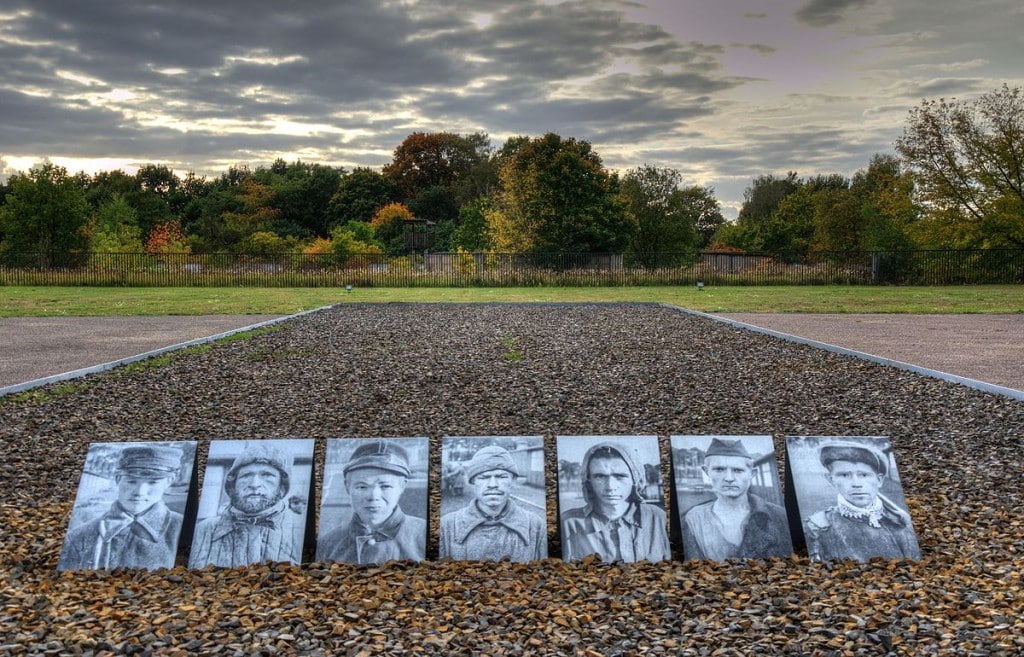
The birds were so loud.
I was having trouble hearing my guide, a researcher at Sachsenhausen Memorial & Museum.
Between 30,000 and 50,000 people died in this concentration camp, located in Oranienburg, Germany, about 22 miles north of Berlin. The camp was designed in a semicircular style for better monitoring. Heinrich Himmler, a leading politician in Nazi Germany and an architect of the Holocaust, called it the prototype, the ideal.
A donation powers the future of local, independent news in Columbus.
Support Matter News
Now it is a memorial and research facility dedicated to documenting the atrocities of the Holocaust and maintaining the memory of the millions who died. Listening back to recordings of my interviews that spring day a decade ago, the birds still seem so loud, so present.
I later learned that they were nightingales passing through for the summer. The juxtaposition of their joyous calls and the gloom and horror of the setting is almost too easy to write about. At the time, I was in Germany researching the history of lethal injection in the wake of botched executions in Ohio and elsewhere. Sachenshausen was one of the earliest camps and was known for medical experiments, as well as for experiments on methods of execution.
My guide noted that lethal injection was also used in “Aktion T4,” an early plan to kill humans the Nazi party deemed “life unworthy of life,” or Lebensuwertes Leben. Those involved with T4 targeted people with mental illnesses and disabilities and murdered them via lethal injection and gas, among other methods. They called these so-called “mercy killings” euthanasia. More than 200,000 people were killed under this program in Germany and Austria, including 5,000 children.
And all of this – the camps and Aktion T4 – was preceded by the proliferation of a fascist ideology undergirded by pseudoscience that separated humans, that created categories of people who were deemed inhuman, that spit slogans like “life unworthy of life.”
I’ve been thinking about those birds a lot lately, about juxtapositions, about creeping fascism.
It begins with punching down on the most vulnerable people, the cruelty being the central point. The blows accumulate, hardly detectable if you’re not the one targeted, and the bruises spread.
In Ohio, transgender youth are mocked and shamed and deprived of healthcare. People who use drugs or those with substance-use disorder are criminalized and stigmatized. Unhoused people are labeled, targeted and arrested. Haitian immigrants in Springfield are dehumanized and threatened.
We are in a place where hate is so strong.
“The dangers of fascist politics come from the particular way in which it dehumanizes segments of the population,” wrote philosopher Jason Stanley. “By excluding these groups, it limits the capacity for empathy among other citizens, leading to the justification of inhumane treatment, from repression of freedom, mass imprisonment, and expulsion to, in extreme cases, mass extermination.”
“The most telling symptom of fascist politics is division,” Stanley continued. “It aims to separate a population into an ‘us’ and a ‘them.'” There are humans. And then there are non-humans.
On the train back to Berlin that day 10 years ago, the sky was overcast and a light rain beaded down the windows. Spring had settled in nicely, and green shoots already crowded the train tracks.
A woman carrying a box of ripe, red strawberries missed her stop. She shook her head. Outside the window, everything was so green. The trees blurred, and I tried to burn images from the Sachsenhausen Memorial out of my mind: a poster that read “Life Unworthy of Life” with images of disabled children and adults, and a room where people were killed.
The word “fascism” conjures some of the greatest horrors of the modern world: state-empowered thugs on the streets; concentration camps; unimaginable death.
A smiling woman in a hijab sitting next to me on the train watched videos on her iPhone of her laughing son. My thoughts returned to the birds, who hold fast to their routines and are the first to sense the light. They wake us.
Fascism despises humanization and connection. It divorces one human from the other. It is a state of complete and total enmity – destroying in thought and, potentially, in deed, the body of the other. “The suffering of strangers can solidify the structure of fascism,” Stanley wrote. “But it can also trigger empathy once another lens is clicked into place.”
As it did when the Universal Declaration of Human Rights was written and signed in the wake of World War II, affirming human dignity. Or when transgender people and their allies testify at the Statehouse. Or when unhoused people speak at city council meetings to oppose camping bans. Or when Ohioans flock to Haitian restaurants in Springfield and break bread with their neighbors.
This kind of empathetic response, this feeling with others, can dismantle fascism. It is the song of nightingales outside of the camp walls.
The birds are loud. Listen to them.
Author
Related Articles

On Development: Rapid-transit is moving slowly. Maybe we need a new model
Our policies suggest a willingness to spend any amount to add lanes and bigger (towering!) interchanges for major highways, while transit spending is too often regarded as frivolous.

Local Politics: Drain the swampy Municipal Courthouse
Columbus wants to renovate the Franklin County Municipal Courthouse instead of replacing it. The people who work there say this very wet “derelict” building is beyond repair.

Opinion: Flock cameras won’t make us safer. Here’s what will
Flock Safety, the company behind the cameras, obstructs any attempt to establish guardrails, accountability, or transparency. Amazon is no one’s model for corporate responsibility, and even it cut ties with Flock.