
‘Immigration: A Journey of Belonging’ seeks deeper understanding
The new group exhibition, open now at the Losinski Gallery at the Main Library, will host a reception from 2-4 p.m. on Saturday, Oct. 3.
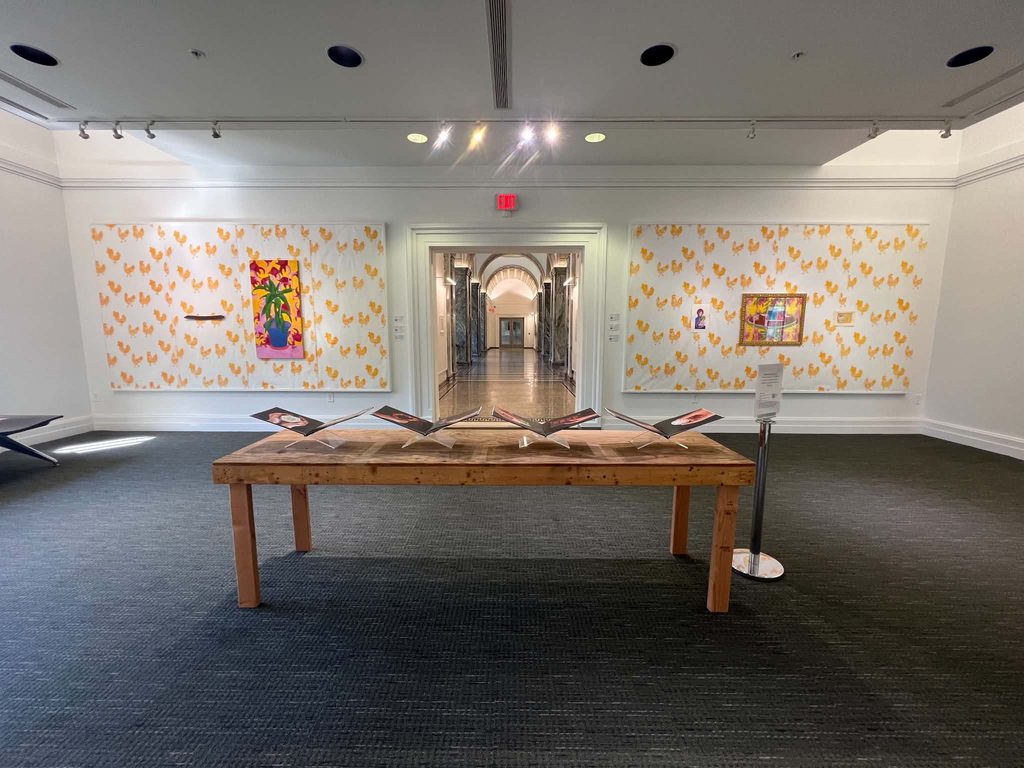
As a child in Puerto Rico, Raixa Velázquez loved to watch the roosters run free, recalling how the birds graced the landscape from the beaches to neighborhood streets with such frequency that their appearance became commonplace.
In brainstorming how she wanted to approach her contribution to the group exhibition “Immigration: A Journey of Belonging,” open through Nov. 12 at the Losinski Gallery at the Main Library, the artist immediately homed in on that memory, creating her own wallpaper adorned with roosters as a means to conjure a “domestic” feel within the second-floor gallery, as she explained it.
“I’m always trying to think of a way to create a space that pulls the island closer,” said Velázquez, whose work is displayed in the exhibition alongside contributions from Mona Gazala, Kirsta Niemie Benedetti, Elham Bayati, Teresa Greve Wolf, and Dana Lynn Harper. “And roosters feel like home to me.”
A donation powers the future of local, independent news in Columbus.
Support Matter News
The concept of home is explored in myriad ways throughout the gallery, curator Julia Barrett marshalling a group of artists whose work innately speaks to this idea, whether they are exploring the ongoing erasure of their Palestinian homeland (“The idea of home is a really complicated question for me,” Gazala told me in 2021) or the complex feelings elicited from having grown up in Columbus as the child of immigrants, as Harper’s evolving body of work has done in recent years.
“One of the rooms definitely has a more homey vibe … but there are also a mix of artists in the space, so it’s like, what do we consider home? What is home?” said exhibition curator Julia Barrett, who will join the artists for an opening reception at the gallery from 2-4 p.m. on Saturday, Oct. 3.
During her late-September installation at the gallery – only Harper’s work had not yet been installed at that point – Velázquez said she was struck by how much of the work spoke to “the wild trajectory the world is on right now,” with ICE abductions continuing to ramp up against immigrant communities and a genocide still being waged in Gaza. The artist made note of the gorgeous portraits done by Benedetti, the flipside of each graced with the person’s passport photo, as well as Wolf’s emotionally jarring paintings, which she said spoke more directly to the cruelties being waged by ICE agents. Other sections of the exhibit elicited a comparative sense of comfort, she said, with Bayati’s work, for one, calling attention for her to memory and place.
“I think one of those throughlines [in the exhibit] is the history of immigration and why people immigrate, because so often in the general discourse … immigration is just talked about as this thing that happens, but there’s never an addressing of why? Why are people immigrating? What are the systems that are pushing people to immigrate?” Velázquez said. “And moving through the exhibition, you feel all of these layers and all of these histories of these people. It feels like we’re trying to place visitors in these other mindsets.”
This pull toward empathy is one of the things Barrett had in mind in brainstorming the group show earlier this year, tracing the initial seed of an idea to the sense of overwhelm she felt in watching news footage of ICE officers in Minneapolis. “And I was thinking, how can I get involved?” Barrett said. “But even before that, there have just been so many disheartening things happening with immigration for such a long time. … Even the commentary about Haitian people, and how that impacted real people living in Ohio in Springfield. … And so, I was just thinking of all the important things I wanted to talk about through curation, and everything funneled down from there.”
After being approached by Barrett, Velázquez said she began to consider more heavily the colonial relationship between Puerto Rico and the United States, and how even though Puerto Ricans are U.S. citizens, they are not often treated equally as such. “You’re always held as second class, or in a server kind of mentality,” she said, “where you can move freely but at the expense of your freedom.”
Velázquez also started to reflect on how Puerto Rico has become remilitarized under the Trump administration, with action at long-dormant bases ramping up in places such as Vieques, a small island off the coast that once served as an explosives testing ground for the U.S. military, leading to severe environmental contamination and high rates of chronic illness in locals.
“It killed residents, it caused cancer, it destroyed the ecosystem,” said Velázquez, who created the work “Battleship” in response to these reflections, her work built on references to old advertisements for the board game of the same name. “The box literally says that it’s America’s favorite pastime, with two smiling kids and ‘it’s a hit’ when you bomb something. … It’s telling you this is a game.”
While “A Journey of Belonging” would be timely in any era, the weight of the exhibition is particularly palpable in this political moment, with multiple social media reports surfacing just last week about ICE agents spotted moving en masse into a Groveport motel.
“Sometimes it can be disheartening hearing all this news. And that’s what made me want to do this, to kind of be like, hey, these are human beings, too,” Barrett said. “We’re all touched by immigration in some way, and I just want people to think critically about that instead of just seeing it as a black and white issue, because it’s not.”
Author

Related Articles
Deep conversations pave the way to ‘Chasing the Light’
A couple of years ago, Loren Bucek invited a group of artist friends to her Clintonville home. The gathering soon evolved into regular meetups that shaped the creation of a new exhibition opening this week at McConnell Arts Center.
Henry Hess says goodbye to his longtime Chromedge studio
Faced with a rent increase of more than 30 percent, the Hess family opted to move on from the artist’s creative home of the last eight years. And while the next steps remain uncertain, they stressed that Henry would maintain a presence in Franklinton. ‘We’re not going anywhere,’ Sophia Hess said.

Nick Stull adopts a quieter approach
With his latest collection, on view at Sarah Gormley Gallery beginning today (Friday, Sept. 11), the Columbus artist hopes to entice viewers to linger a little longer in his world.