
Ratboys’ Julia Steiner learns to speak it aloud with ‘Singin’ to an Empty Chair’
The Chicago musician will join her bandmates in concert at A&R Bar on Tuesday, June 16.
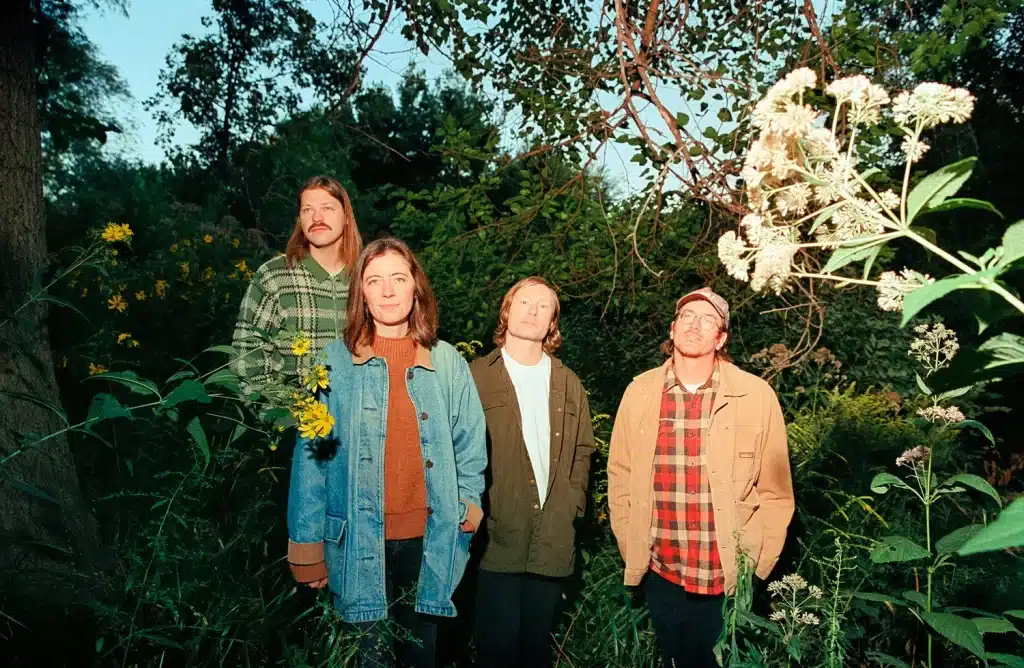
Around the time Julia Steiner was working on the songs that would become Ratboys’ breakout record, The Window, from 2023, she also wrote and shelved a longer, shoegaze-indebted track that dealt more explicitly with the knotted angst and anxiety she felt in the early Covid days, when the act of leaving the house could feel like an almost-Herculean task.
“And it was a heavy song, and I remember thinking, ‘This feels nice to work out, but at the same time, I don’t know if this is something I want to be thinking about all the time,’” said the Chicago musician, who will join her Ratboys bandmates in concert at A&R Bar on Tuesday, June 16, supported by Shallowater. “But the idea of using songwriting as a private form of therapy, that’s very useful. And I think the people who work on songs and write music for themselves, that’s a big part of it. It’s the private excavation experience and trying to understand yourself more for just you rather than anyone else.”
In the years that followed, Steiner also took up actual therapy, finding comfort in having a space in which she could speak things out loud in clear, direct language without the pressure to be creative. And yet, over time, the act began to influence how she approached songwriting, revealing itself most cleanly on “Just Want You to Know the Truth,” the nearly nine-minute exposed nerve that serves as the emotional centerpiece of the band’s staggering new album, Singin’ to an Empty Chair.
A donation powers the future of local, independent news in Columbus.
Support Matter News
“That was a song that I labored over for months and months, and the idea of doing the empty chair exercise, and even shouting it out in the song, came from my therapist,” Steiner said of the practice, which involves setting up a chair, envisioning the person you wish to address seated in it, and then speaking plainly and allowing your unguarded words to fill the empty space. “And that [practice] gave me a road map for how to approach the song emotionally. And I’m grateful, because it was a big task in my heart. … And working through those things on the side in those sessions, it helped prepare me, for sure.”
As the song unfolds, Steiner details her estrangement from a close loved one, tracing the arc of their relationship from childhood – “Lasanga’s in the oven/It’s another Christmas Eve,” she sings, “You and I would go and hide/Until it came time to eat” – through its abrupt end. As the song closes, the musician acknowledges within the track that she never said a proper goodbye but rather blocked the person’s number, while still leaving the door open to future communications. “Well, I’m not ready, but I hope I will be soon,” Steiner offers. “I just want you to know the truth.”
Though emotionally heavy, Steiner is buoyed throughout by her bandmates’ warm, delicate instrumentation, which serves to both steady and uplift the singer, who delivers her words in a loosely conversational, disarmingly comforting tone that sits miles at remove from how she actually felt standing at the microphone in the recording studio.
“The lyrics are all memories from my life, so I’m reliving those at the same time [as we’re recording]. But also, that song was one we never really demoed in the same way as the rest, and I wasn’t as used to singing those lyrics, because I had just written them a couple weeks earlier,” said Steiner, who shared how she benefited in the moment from the instruction relayed to her by producer Chris Walla. “One thing he really made me aware of, and made me hone in on, is how a great vocal take isn’t really about pitch, but more so the emotion and the timing and how it lands with the rest of the band. And I recorded those vocals pretty near the end of the whole album process, and I wanted to get it done so it wouldn’t be hanging over my head. … But it all worked out really well, and I remember I felt really great about it. And then we went to get Portillo’s for lunch that day, so it was a good reward.”
While the bulk of the songs on Singin’ to an Empty Chair skew inward, the album also features infectious pop-rock burners that may or may not have been written from the point of view of a dog (“Anywhere”), epically shaggy guitar jams (“Late Night Mountains All That”), and visceral rockers given seed by the frustration Steiner felt living through the reinvigorated Black Lives Matter movement that surfaced in the wake of Minneapolis police murdering George Floyd in May 2020 (“Burn It Down”).
“And it’s not that this was the first time this happened, but we were all stuck at home, and it was such a violent and clearly documented murder that I think we collectively were reckoning with racist policing and the history of racism and institutional injustice in the United States,” said Steiner, who noted that the song’s resonance has continued to expand and deeper for her in the six years since she first drafted lines about the want to burn everything down to build anew from the ashes. “The direction our country is going in is pretty troubling, especially here in Chicago, where last fall we watched ICE act with impunity and kidnap people off the streets. It’s really scary, and it’s the complete opposite of what America purports to be about, as far as liberty and freedom. … I don’t know. But I appreciate you letting me kind of rant and ramble about this stuff, because these are capital-p problems. And I’m definitely not qualified to parse all of it, but it’s still worth it to speak out loud.”
Author

Related Articles

Evan Weiss learns to loosen up
The Into It. Over It. frontman will perform solo at Secret Studio on Saturday, Oct. 3, supported by openers JG Shadid and Lydia Loveless.

‘You’re just trying to serve the song’: Get to know the backing band helping give life to the Ohio R&B Music Festival
LynMonty has spent the month listening to songs on repeat and charting out her bass parts in preparation for this weekend’s concert at Up Front Performance Space.
Kill Gosling rediscovers its joy on the way to ‘Super Plume’
The Columbus rock band will celebrate the release of its excellent new album in concert at Cafe Bourbon Street on Saturday, Sept. 26.