
Michael Fornadley leaves his mark with retrospective exhibition at the Cultural Arts Center
‘Allegories, Narratives, and Storytelling’ opens at the downtown art space tonight (Friday, June 27), and continues through Aug. 2.
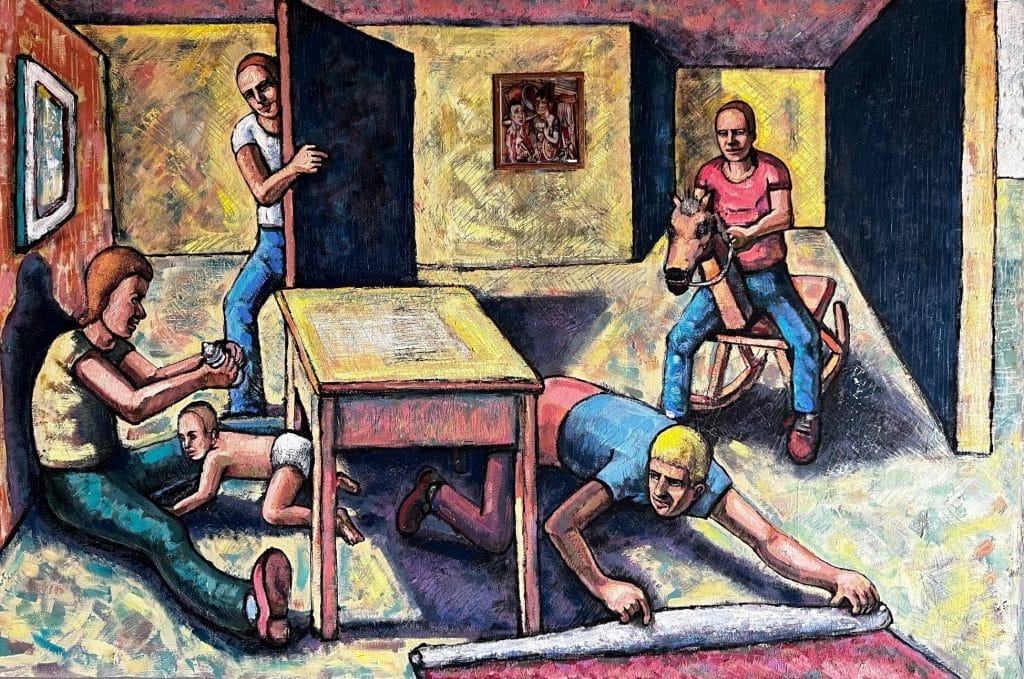
To hear Michael Fornadley tell it, he’s never given any weight to the business of art, his distaste for the commerce of it all attributable at least in part to the 46 years he spent as part of the Teamsters labor union while working for UPS.
“And in those years, I dealt with the corporation, and we had good supervisors and bad managers,” Fornadley said in late June at the Cultural Arts Center, where his new retrospective show, “Allegories, Narratives, and Storytelling,” opens tonight (Friday, June 27) and continues through Aug. 2. “But when you see stuff like that going on, you’ll stand up. The whole concept of a union – of sisterhood, brotherhood, coming together – it works. … And that certainly influenced me.”
Fornadley’s paintings encompass a range of ideas – the works wrestle with anti-capitalism, religion, and childhood, among other concepts – but are painted in a style uniquely his own, and one that has remained remarkably consistent in the three-plus decades he’s been making art. Influenced by the likes of German expressionist Max Beckmann, the characters in Fornadley’s paintings have an illustrative, two-dimensional quality that heightens the surrealism in his scenes, which often play like still frames from one of the Coen brothers’ black comedies.
A donation powers the future of local, independent news in Columbus.
Support Matter News
The paintings on display at CAC all have their roots in the artist’s sketchbook, which he treated for years as an illustrative diary, capturing doodles and stray thought fragments alongside intricate thumbnails that he could later transport to his wooden canvases, nearly all of which are formatted horizontally, affording more space for his detailed scenes to develop.
Generally, Fornadley said he paints on wood with some combination of egg tempera, oils and caseins (a type of paint that uses casein, a milk protein, as a binder), and then uses a fork and/or specialized carving tools to scrape away at certain sections, adding greater depth and texture to the paintings. (A series of wood-carved pieces also on display in the exhibition highlight his deft skills in this particular medium.)
“You can see here on this one, I scratched with a fork,” he said, directing me to one painting completed in 1992, sections of which bear the unmistakable imprint of prongs dragged across the surface.
Fornadley’s treatment of his wooden backdrops not as precious things but as tough, hearty canvases that can absorb a bit of abuse echoes in the unfussy nature with which he approaches art at large. At one point, Fordadley said, he stopped painting for about a decade, returning to it in 1990 at the urging of his wife. Asked if he missed making art in those years he spent away, Fornadley said, no, his half-smirking tone suggesting the question bordered on ridiculous.
“I’m not one of those artists who obsesses with it,” continued Fornadley, who these days works from a spacious studio located on the second story of his garage in Baltimore, Ohio, roughly 30 miles east of Columbus. “I can take it or leave it. And I think it’s a personality thing. I never thought of making a living with it, for some reason. … I never made art my God. And I had artist friends who did that, and they ended up in sorry shape, because that world will let you down if you rely totally on it for that reinforcement.”
And yet, Fornadley acknowledged that there are aspects of art-making that extend far beyond the simple act of creation, discussing his body of work in terms of how it can help to preserve his stories and perspectives in ways that can long outlast him.
“I mean, people sell, and good for them, but that’s never been a main drive for me,” he said. “They’re cave drawings. And you’re putting them out there and hoping it’s good enough that people will actually take it and hang it on a wall somewhere. It’s like you’re leaving your statement: I was here for a time, and I’m gone now.”
Author
Related Articles
WIT Gallery celebrates turning five while keeping an eye on the future
Poet, artist, and gallery founder Larry Robertson will celebrate the Franklinton art space’s anniversary with a sprawling group exhibition opening on Friday, June 12.
Adam Hernandez aims to uplift immigrant workers with his latest mural
The Columbus artist will be on site at 1014 Parsons Ave. for the public unveiling of ‘We the People/Nosotros la Gente” on Thursday, June 11.
Johnny Williamson finds himself on the other side of ‘Nightmares’
In the midst of rebuilding his life for the second time, the Columbus artist and musician will host a dual album listening party and exhibition at Rehab Tavern in Franklinton on Friday, June 5.