
Damon Mosley and Darryl Dunning II join forces to help people feel seen
The new collaborative film project brewing between the director and actor has its roots in the East Side Columbus neighborhood in which the two were born and raised.
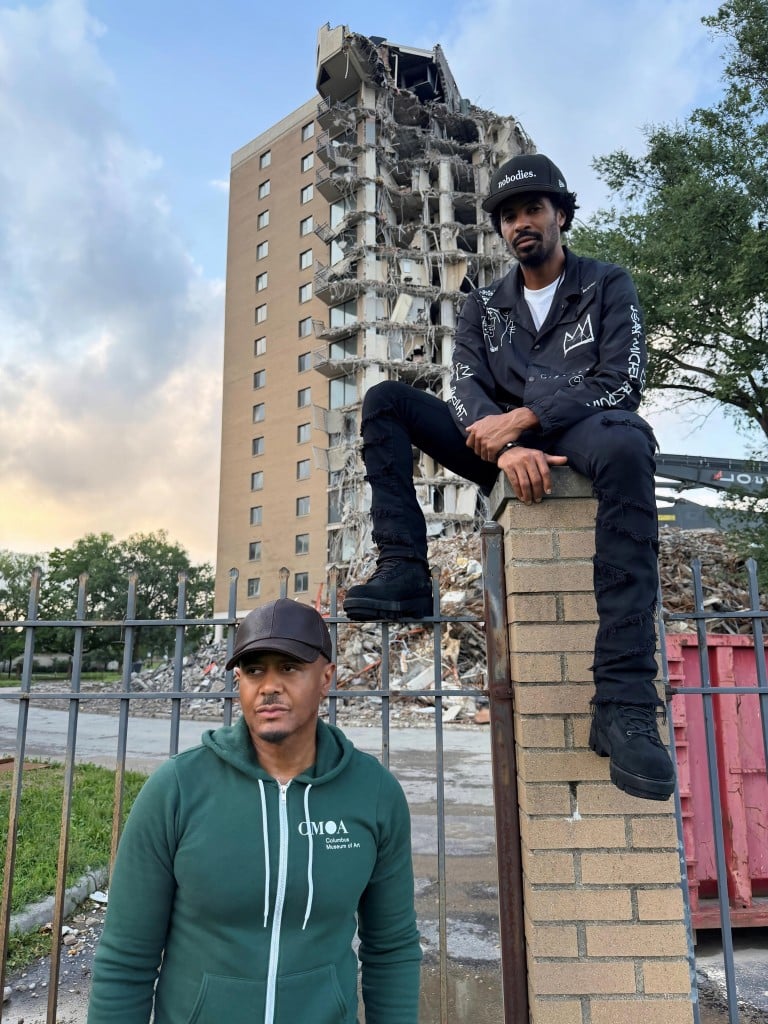
Filmmaker Damon Mosley spent the bulk of his adolescence living on 20th Street in Columbus’ Bronzeville neighborhood. Nearly 40 years later, following stints in New York City, Los Angeles, and Peru, he moved back, returning to the exact same street on which he once dwelled as a child.
While Mosley’s address might have been familiar, he said the area had declined in the years prior to his 2011 return, with the economic development that had then benefited other parts of the city having seemingly left the historically Black neighborhood behind.
“When I grew up here, it was a tight-knit community. … There were restaurants, there were shops,” Mosley said. “And coming back, it was sad to see … a lot of empty buildings, things being torn down. I always tell people, for me, it was like going on a reverse archeological dig, where every time I turned a corner, something was gone, and instead of finding something, I’d find something was missing.”
A donation powers the future of local, independent news in Columbus.
Support Matter News
As one example, the writer, director, and producer pointed to the recently collapsed building that used to stand two doors down from where he now lives, and which housed a corner store when he was a child. “And that particular store, it was the first time I ever crossed the street by myself when I was 6, because my mother was sick and needed me to go to the store to get her … 7-Up and Saltine crackers,” Mosley said. “Now of course, she was watching me the whole way, but I didn’t know that. And crossing that street for me was like Odysseus crossing the sea.”
Mosley was similarly struck by the recent demolition of what he knew in childhood as Sawyer Towers, his first job having consisted of delivering newspapers to the twin high-rises with his grandfather and uncles, who paid him in chocolate bars. “And I understand that things change, but when your community isn’t brought along with the change, and can’t participate fully or equally in that change, then you feel unseen,” he said. “You feel like somebody’s playing a game of dice with your life and the lives of the people around you.”
Dwelling on these early memories, Mosley began to formulate a new film project loosely rooted in the idea of “telling the stories of the people that are still here,” as he explained it, the seeds of which first emerged nearly a decade back. “They can knock the brick and mortar down, but there’s still a lot of life left here, and I think those stories are worth telling.”
Around the same time, Mosley also connected with actor and Columbus native Darryl Dunning II (“All American,” “The Chi”), who moved to Los Angeles in 2010 and described his visits home in similar fashion. “Coming back to the community where I literally learned to live life, it was not like I remembered it to be, and almost like a ghost town in spots,” said Dunning, who like Mosley was born and raised on the Near East Side. “And it was like, man, I’d love to tell a story that makes anyone who lives on one of these 20th Streets anywhere in America feel like their home is cemented in this project, where no one can take it.”
Over time, these ideas have gradually started to take shape in “20th Street,” a collaboration still in its nascent stages that Mosley positioned as an action-packed tribute to the 2015 B movie “Kung Fury,” with Dunning starring as Jaden, an average joe who daydreams about saving his neighborhood from invaders, and which the two said could take shape as either a film or TV series (or some combination of the two) as early as next year.
Within this fantastical realm, Mosley intends to explore more grounded themes, describing a central mission of the project – and much of his work in general – as focused on making sure people from overlooked communities feel seen. Within that, other ideas have started to develop, Mosley beginning to unpack what it means to be from a place where success is sometimes defined by how far you can cast yourself from it.
“When you come from the hood, people measure your success by how far away you can get from here, and that can do a number on your psyche,” said Mosley, who wrestled with this idea more intensely once he returned from a pair of mission trips to Peru. “And on the way home, I’m thinking, like, I don’t have to leave the country to make a difference. There are neighbors to the left of me, to the right of me. I can do that right here.”
While the pair hatched the idea a number of years back, the filming has been delayed by everything from financial issues to a series of personal challenges, including a back injury Mosley sustained on the set of a Christmas film and the death of Dunning’s partner, who was diagnosed with stage four colorectal cancer five weeks after giving birth to the couple’s son.
Dunning said he has been drawn to the screen from childhood, recalling how the shows he watched on TV in adolescence allowed him to imagine “a life outside of the one we had.” It wasn’t until high school, however, that he began to take acting classes. And even then, he never landed roles in any of the school plays, his first characters emerging in the running game of “I Love You Most” he played with his mom.
“And it was essentially, whoever says, ‘I love you the most’ first in an interaction wins,” said Dunning, who took to portraying a range of characters when phoning the salon where his mom worked, tricking her into taking the call so he could then, in his own voice, deliver the line: I love you the most. “And it was the first time I was like, okay, I can make people believe things that aren’t true. And today, I’m from Nigeria, and I have to find out if I can walk into this place for an appointment.”
In time, Dunning eventually made his way to LA, where he auditioned for reality television programs but found himself turned off by the process, recalling how one producer who, left unsatisfied by his responses in an interview, asked if he would be okay with being given a storyline to act out. “And I was like, ‘I just don’t feel comfortable with you guys writing the narrative of my real life,’” said Dunning, who experienced a breakthrough when he met a different producer on a trip to Las Vegas, which led to an on-set job where he made more industry connections. “And from there, the sky’s been the limit, man.”
In telling the story of his career, Dunning gradually homed in on the pull he feels toward acting, and one that has made him uniquely suited to partner on this project with Mosley, who used similar language in describing his hopes for “20th Street.”
“For me, with acting, it’s always been about making one person feel seen,” Dunning said. “If I can do that, it’s worth it.”
Author
Related Articles
‘American Doctor’ asks viewers to not look away
The gut-wrenching documentary from director Poh Si Teng, who will be on hand when the film screens at the Wexner Center this weekend as part of ‘Unorthodocs,’ takes viewers inside Nasser Hospital in Gaza.
A newly restored ‘Riverbend’ finds fresh resonance in the modern era
A series of unlikely events collided to give new life to the 1989 film, which will screen at the Wexner Center for the Arts on Friday, Oct. 2.

‘Ice Cream Land’ balances fantasy, reality in making its way to the big screen
More than two decades in the works, the new documentary from artist David Denniston lovingly traces the life and experiences of Ricky ‘Ice Cream’ Jackson, who will be on hand when the film premieres at the Lincoln Theatre on Thursday, Sept. 17.