
Notes on a cross-country Amtrak
With Ohio considering expanding train access, our columnist reports on a summer spent riding the rails.
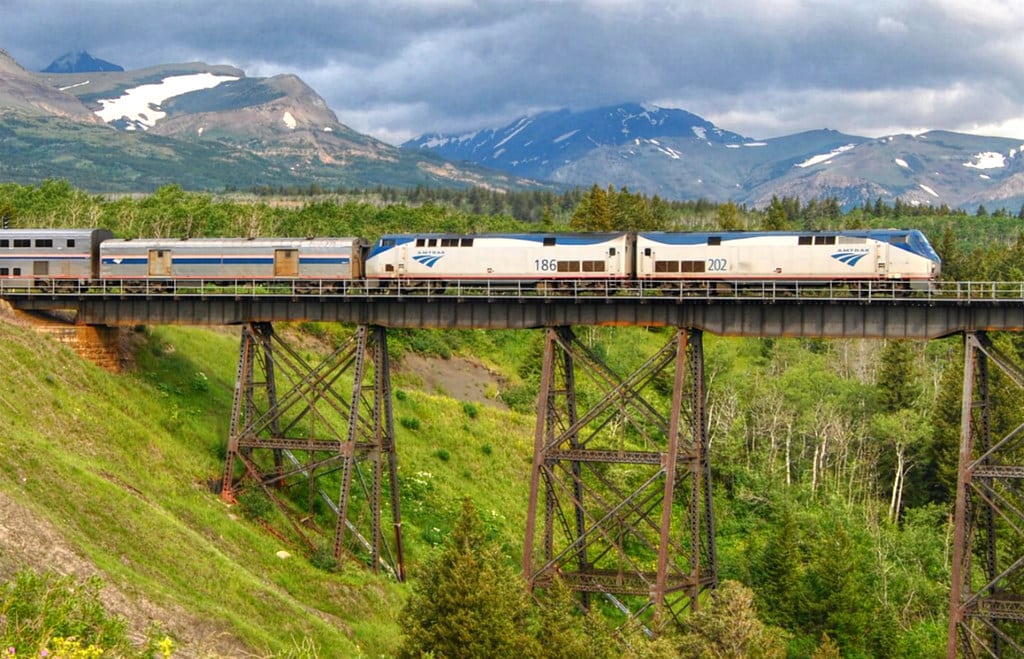
There’s a special rail pass you can buy from Amtrak to travel the country for $500.
With so many people in Columbus currently itching for an Amtrak route through the city – a potential rail expansion that Gov. Mike DeWine opted to punt to the next person to hold the office – I decided to purchase one of these passes to learn for myself if there was any merit to these desires. After logging more than 60 hours on these metal beasts, I would like to report my findings to those hopeful travelers and give a few suggestions to the engineers and legislators who engineer and legislate such things.
The first thing to know about Amtrak is that the train will never leave early, but it will often leave unexpectedly on time. It’s common when looking at a departure screen for a train that is said to be “delayed” for an unspecified amount of time to actually be on time – something you might not realize until it’s already gone. In Chicago’s Union Station, I tried to take a leisurely walk to the bathroom after a “delayed” sign flashed on the Zephyr line. Before I even began my journey back, I discovered that it was actually on time and would be departing in five minutes. I found myself at the back of a lengthy line with dozens of confused passengers. Such is the fate of the overly prepared and easily fooled.
A donation powers the future of local, independent news in Columbus.
Support Matter News
It was on the other side of the country where I learned that this delay is due to a technical shortfall. In the lonely Salinas, California station, the single employee opened his door to make an announcement: “Hello folks,” he said, and was immediately interrupted by the automated voice over the speaker.
“Okay,” he said after the voice finished explaining the location of the train. “I will take you out to the platform at 1:55 p.m. If the screen says the train is late, don’t listen to it. It can take 15 minutes for it to update and tell you that it’s actually on time, in which case you would’ve already missed the train.”
If it’s your business to be on the train before it leaves, it’s best to assume it’s always on time, even when unexpectedly so.
It’s helpful then that there are only a handful of stations across the country where a rider can reliably get lost. New York, Chicago, and Los Angeles, as I have learned, are the transit hubs where a platform assignment is not only relevant but essential to catching a train. Unlike the single platform stations across the country in places such as in Lincoln, Nebraska, which hosts one midnight train on its one platform, these larger stations include a series of platforms, many of which can be invisible to the human eye.
I had once been scheduled to arrive well before my train’s boarding time at New York’s newly renovated Moynihan Train Hall in Penn Station. Where the station was purported to be, however, I found only a long hallway. The station itself was hidden from subway commuters, tucked behind a deceptive wall as if it were designed to be overlooked. By the time I learned where I was going, the going had already gone. I’d missed the last train to Chicago and had no choice but to purchase a plane ticket instead. My advice? Pair any early arrival with a directional consultation with an Amtrak employee.
After you find yourself in the correct place, you will find a conductor scanning tickets and sometimes an attendant handing out seat assignments. On the Zephyr and Coast Starlight routes, the trains are double-deckers and most seats are on the top level. Each row consists of two seats on each side of the train: one window seat and one aisle seat. On the top level, all seats are forward facing. On the bottom level, which is largely reserved for those with accessibility needs, the seats face to the rear of the train. If seats are being assigned, you should always have a general seat in mind and bolster the request with an excuse. I’ve devised my own concise script to secure window access: “Can I have a forward-facing window seat? I get motion sickness.”
Unfortunately, I actually do get motion sickness. Fortunately, I packed a bag full of motion sickness remedies, so theoretically I was more than prepared to weather the movement. I put on my motion sickness wristbands, inserted my nausea patches on my wrists and neck, ate chewy ginger snacks, and opened my foldable pill container to select a Dramamine for motion sickness along with a Zofran for nausea. Taken together, they had a lethal effect on my senses. While others flocked to the observation or snack cars, I stayed put, attempting to track the horizon at all times as I started to doze off.
Due to the Dramamine, I found myself only partially conscious for the most scenic 20 hours of the Zephyr route, just conscious enough to wake up every hour or so in the middle of the Rockies and think to myself, “Wow, that’s a nice mountain.”
I believe the 33-hour leg of the Zephyr route from Denver to Emeryville was designed to break the motion-challenged. Looking out nauseously on the Western canyons, I could see a number of flatter and less winding potential routes. Instead, we weaved in and out of dozens of tunnels and mountains that sent my mind spinning. I rode through the most desirable scenery that our sprawling country has to offer and all I found was nausea.
I did, however, learn interesting historical tidbits along the way. “This is Granby, Colorado. The town is famous for the ‘killdozer rampage’ when Marvin John Heemeyer modified a bulldozer and demolished multiple buildings throughout the town, including the town hall,” the conductor said over the speakers at one point in my journey. “The Ace Hardware on your right is where the rampage came to an end. Heemeyer forgot the floor was wooden and [the bulldozer] collapsed into the basement. Of course, it wasn’t Ace Hardware back then. Again, this is Granby, Colorado, known for the killdozer.”
I joined everyone else on the train in wearing a confused grin throughout the entirety of this announcement, which left us all hoping he might have other recreational facts to brandish along the way. Surely, he couldn’t have another tragic anecdote lined up for the next stop? And yet!
”This is Glenwood Springs,” he said. “This is the third and final jail that serial killer Ted Bundy escaped from. Bundy had found a way out of his cell and evaded a thorough search before getting captured again.”
If Amtrak eventually does make it to central Ohio, the company would do good to employ this conductor to provide somber anecdotes about the state’s various cities and towns. “This is Columbus, Ohio, known as the temporary home of Jeffrey Epstein,” he might announce, “and the location of the largest AI weapons facility in the United States, Anduril.”
Related Articles
Opinion: To meet climate goals, Columbus leaders must address data centers
With the City Council presenting its draft proposal for municipal data center policy this week, residents must seize the moment to demand meaningful safeguards that will actually minimize the climate impacts of data centers.
On Development: More local voices needed
The city needs to find ways to support economic development and build more housing without so readily awarding tax breaks, and that means bringing in new perspectives.
Local Politics: The small-time data center resistance
A petition to ban data centers statewide won’t be going to the ballot this year. So organizers are working locally instead.