
Chris Mercerhill finds common threads in new Chaos Contemporary Craft exhibition
In ‘Thread Code,’ the Columbus artist and quilter explores concepts ranging from conservation and the nature of choice to the importance of community building.
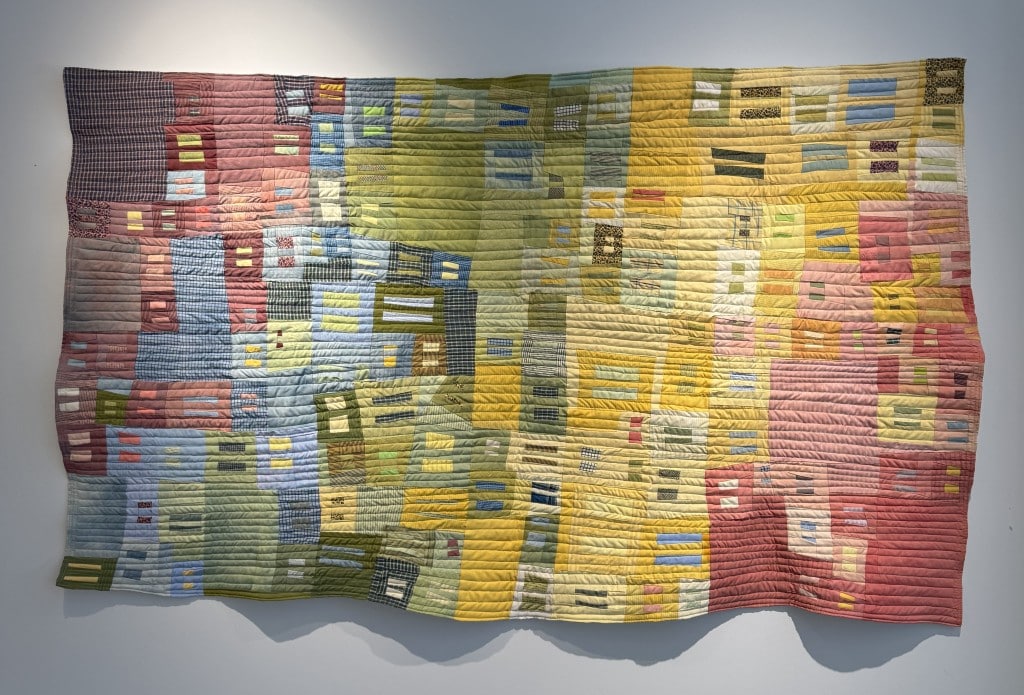
Part of the pull artist Chris Mercerhill initially felt toward quilting extended from the recycled nature of the practice, in which old shirts, sheets, and swaths of fabric could find new life in a decorative blanket or wall hanging.
“I was always attracted to the geometric patterns of quilting but I also wanted to get away from always going out and buying new, new, new,” said Mercerhill, who gradually introduced this idea into each element of his practice, creating fabric dyes from those things that existed within arm’s reach at his Columbus home, whether grown (black walnuts, indigo) or otherwise salvaged (discarded screws, metal shavings). “I kind of coined this term suburban terroir. And it all comes from the suburb I’m in, with the thrift stores, and the black walnut trees in my backyard, and the indigo plants I grow. This is what I can make here. It’s very much of the place, and based on the conditions and the time and the resources that I have.”
Mercerhill completed his first quilt in college, initially taking a more traditional approach adapted from the book 1,001 Patchwork Designs, which he stumbled onto at the school library. Within short order, he began to experiment with sewing together other, less easily controlled materials, including photographs and cut and unrolled aluminum cans and two-liter bottles. In exploring these more outward realms, his interests began to shift toward improvisational quilting, which emphasizes spontaneity over pre-fabricated patterns.
A donation powers the future of local, independent news in Columbus.
Support Matter News
“With improvisational quilting, what you tend to do is pick a motif, which could be an equal sign inside a square or a rectangle,” said Mercerhill, directing me toward the rainbow-hued “Equality,” one of the improvisational quilts on display in his new exhibition, “Thread Code,” which opens at Chaos Contemporary Craft on Friday, Aug. 22. “And then once you have the motif, you have to start thinking, well, what’s going to go where? If this piece [of fabric] is bigger, am I going to trim it? If I’m going to add a piece here, do I need another block to fill in this space? … Do I want to keep going? Make it bigger? Refine it? Do I want more colors? … And so, you’re constantly making decisions.”
Making decisions is something Mercerhill said he is historically loath to do. To illustrate his point, he recalled an experience from art school when, following almost three years of lessons in which the professor told the class explicitly what to paint, this same instructor began a new session by refusing prompts and asking the students to simply create.
“And I was like, what the hell are you talking about? No, you tell me the thing, and I do it. That’s how this works,” Mercerhill said, and laughed. “And I think that was a really critical point. I was like, how do you make these choices? What are my choices? What am I trying to say?”
The artist now describes this decision making process as something instinctual, his choices guided by an internal voice and steadied by years of training. “You should go buy some sheets at the thrift store. You see those nuts in the backyard? Those are kind of interesting, aren’t they? Scratch that itch and boil some. What am I going to do with all this black and brown fabric? Get some scissors. Get a sewing machine. Figure it out,” Mercerhill said. “It’s almost like I don’t see the path ahead of me, so I can’t make choices to advance along it. But I trust that when I take a step, the path will appear under my foot. And then when I look back, all of these things I care about – working and acting locally, being environmentally responsible, advocating for social justice – they’ll come through [in the work] somehow.”
The quilts on display in “Thread Code” are paired with a series of generative paintings, which Mercerhill created with the assistance of his “robot” (a 3D printer modified to hold a paintbrush or drawing implement). Again exploring the idea of choice, the artist would give the machine a series of parameters to work within, and the robot would then make the decisions to give life to the finished painting. “Generative art and improv quilting are more similar than they appear,” Mercerhill said in a press release accompanying news of the exhibition, which will remain on display through Oct. 3. “Both rely on systems. Both introduce variation. Both require the artist to decide which parameters to define, and which to let shift. In that way, they constantly mirror each other.”
With at least one quilt, Mercerhill blurred the lines between these processes, assigning different shades to a digital eight-sided dice and then “rolling” it as a means of selecting the colors to incorporate into his design. “So, this dice is making the choice, and it’s out of my hands. And there are choices in here I wouldn’t make,” he said. “But starting to question things, asking, if a machine makes a decision, should I follow it or should I not, I think more and more that’s an important idea to wrestle with as AI starts getting baked into everything.”
While Mercerhill has an interest in machines and computer technology and the various ways these developments can impact why and how people make decisions, his quilting work is universally shot through with deeply humanistic characteristics, including a relentless pull toward community and the strength and beauty evident when people of all kinds come together and find common ground.
“I think quilts are really beautiful metaphors, where you take all of these disparate parts and stitch them together to where they make a strong, beautiful whole,” he said. “I think these are all really beautiful metaphors for how I’m trying to live my life.”
Author

Related Articles
WIT Gallery celebrates turning five while keeping an eye on the future
Poet, artist, and gallery founder Larry Robertson will celebrate the Franklinton art space’s anniversary with a sprawling group exhibition opening on Friday, June 12.
Adam Hernandez aims to uplift immigrant workers with his latest mural
The Columbus artist will be on site at 1014 Parsons Ave. for the public unveiling of ‘We the People/Nosotros la Gente” on Thursday, June 11.

Johnny Williamson finds himself on the other side of ‘Nightmares’
In the midst of rebuilding his life for the second time, the Columbus artist and musician will host a dual album listening party and exhibition at Rehab Tavern in Franklinton on Friday, June 5.